European Parliament delays key AI Act requirements and backs ban on nudify apps
The European Parliament voted by an overwhelming majority to postpone key requirements of the EU AI Act. Developers of high-risk AI systems, meaning those that threaten health, safety or citizens' rights, get an extension until December 2027. Companies whose products fall under sector-specific standards, such as toys or medical devices, get until August 2028. At the same time, lawmakers backed a ban on nudify apps, which create fake nude images of real people.
AI-processed from The Verge; edited by Hamidun News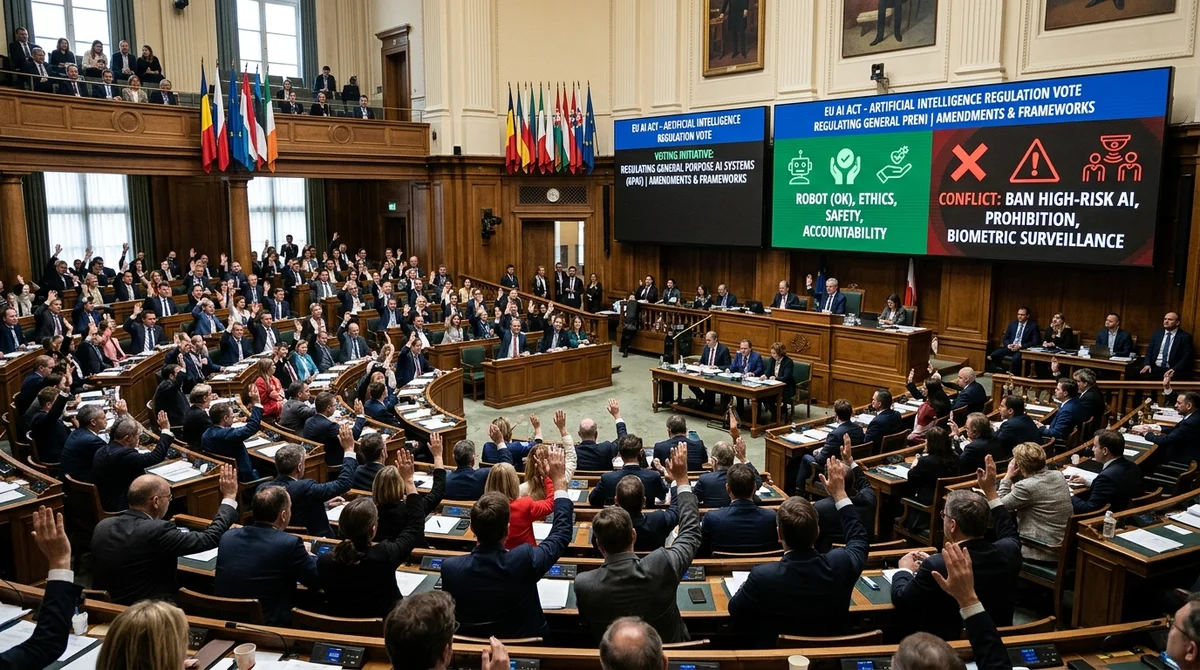
The European Parliament has voted by a majority to postpone key deadlines of the EU AI Act, the European Union's flagship law regulating artificial intelligence. At the same time, lawmakers backed a ban on nudify apps, which use AI to create fake nude images of real people.
The amendments, approved by a substantial majority in Parliament, push compliance deadlines for developers of high-risk AI systems, those deemed a serious threat to health, safety or citizens' fundamental rights, to December 2027. Companies whose AI products are also covered by sector-specific safety standards, for example in children's toys or medical devices, get even more time: until August 2028.
The EU AI Act was adopted in 2024 and became the world's first comprehensive law regulating AI. It divides systems into four risk categories, from fully prohibited (social scoring systems, real-time biometric surveillance) to minimal-risk systems. High-risk systems, such as algorithms for hiring, medical diagnostics and managing critical infrastructure, must undergo independent audits, disclose training data and meet strict transparency requirements.
The delay came in response to pressure from the tech industry and several member states, which warned that the original deadlines would stifle innovation and put European companies at a disadvantage against competitors from the US and China. Business representatives have repeatedly argued that meeting all the technical and organizational requirements in the originally allotted time is unrealistic, especially for startups without dedicated legal teams.
Alongside this, Parliament voted to ban nudify apps, tools that use AI to create realistic nude images of real people without their consent. Over the past two years such services have spread widely online: thousands of people, mostly women, have fallen victim to the technology, with their social media photos turned into compromising content and circulated through messengers.
The ban on nudify services is part of a broader package of measures against the malicious use of generative AI. Several EU countries have already passed national laws criminalizing certain forms of synthetic content, but until now there was no single EU-wide standard. Parliament's decision closes that gap.
The same package includes a mandatory labeling requirement for AI-generated content. Providers of generative models will have to technically mark the images, video and text they produce, so that users and platforms can tell synthetic content from real content. The measure is aimed primarily at disinformation and manipulation during elections.
The adopted amendments still need formal approval by the EU Council. Despite the delays, the core architecture of the EU AI Act remains unchanged: bans on unacceptable-risk systems have applied since February 2025, and rules for general-purpose systems, including large language models, since August 2025.
Parliament's decision exposes a contradiction facing regulators worldwide: how do you write workable rules for a fast-moving technology without choking competitiveness? The delay gives industry time to prepare, but human rights advocates warn that the longer oversight of high-risk systems is postponed, the greater the likelihood of real harm to people who already encounter AI today in healthcare, employment and banking.
- Oct 31, 2026Author puts his script before an AI jury: the verdict cost 850 thousand tokens
- Oct 30, 2026Agent traffic on Zocdoc is up 30x since July, and ChatGPT faces two health lawsuits
- Oct 29, 2026OvisOCR3: an 0.8B-parameter model that reads documents better than specialized systems
- Oct 29, 2026Tencent releases Youtu-Parsing-Omni: one model parses documents, audio and video
Test Frontier LLMs & Autonomous Agents in One Workspace
Run Claude Opus 5.5, GPT-6, Gemini 3.1, and DeepSeek side-by-side in Nomad AI (nomadnet.ai) — unified model routing, deep research, and multimodal workflows under one subscription.
The AI world, distilled — once a week
Seven stories that actually mattered, hand-picked. No noise, no reposts, no press releases.
Done! Check your inbox for a confirmation.