Cohere releases open-source transcription model with 2 billion parameters and 14 languages
Cohere has released an open voice model built specifically for transcription. At just 2 billion parameters, it is designed to run on an ordinary consumer GPU, with no need for expensive server hardware. The model supports 14 languages and targets teams that want to deploy transcription in-house without sending audio to third-party cloud services. Its compact size makes it accessible to startups and small teams.
AI-processed from TechCrunch; edited by Hamidun News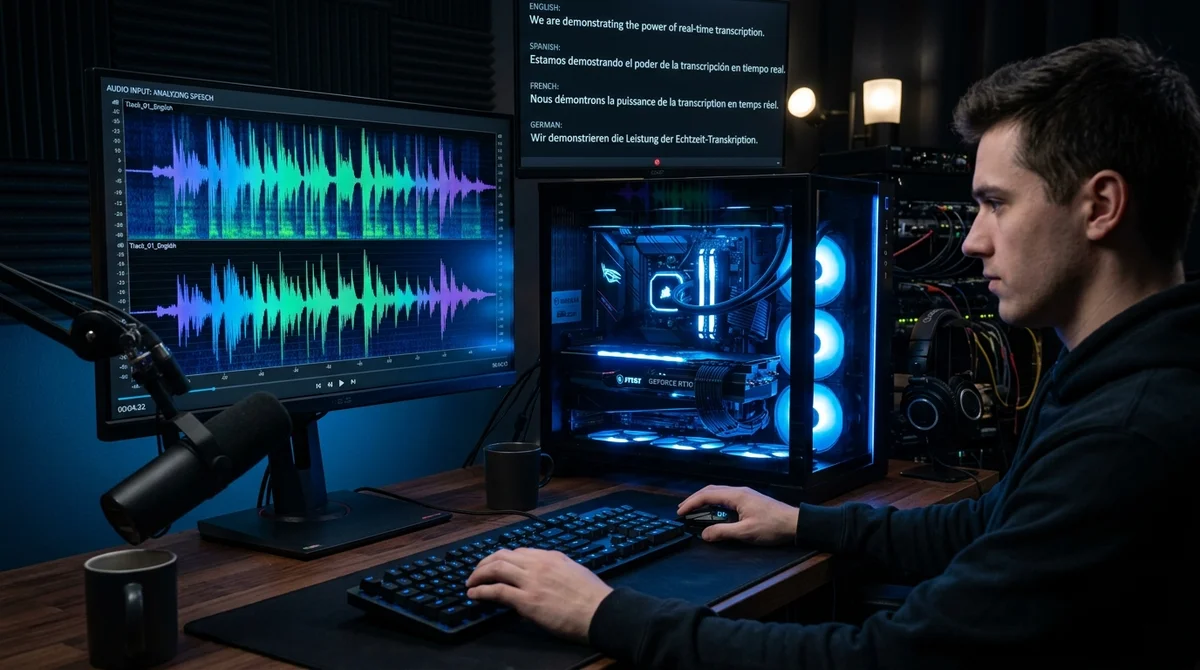
Cohere has released an open voice model designed specifically for speech transcription. Unlike most comparable models, it has only 2 billion parameters. That is deliberate: it lets developers run it on an ordinary consumer GPU, without costly server clusters or cloud APIs. The company positions the release as a tool for developers who want to host transcription themselves.
Cohere is a Canadian AI company founded in 2019 by alumni of Google Brain. Until now it was known mainly as a provider of enterprise language models: its flagship Command model competes with GPT-4 and Claude in the enterprise segment, and its Embed embeddings system is used in thousands of production applications for semantic search. Voice tools are a new direction for the company, and it starts with a specialized product: instead of a universal multimodal solution, it has released a tool tuned for a single task.
The automatic speech recognition market is undergoing a transformation. It was historically controlled by tech giants: Google Speech-to-Text, Amazon Transcribe, Microsoft Azure Speech. All of them work on a cloud model: audio goes to the provider's servers, gets processed there, and text comes back. This creates two problems: rising costs at high volumes, and privacy concerns that are critical for a number of industries. Large providers make money at scale, but for startups and mid-sized companies the cost of cloud transcription quickly becomes a significant expense.
The turning point came in 2022, when OpenAI released Whisper, an open transcription model that can be run locally. Whisper changed the market: developers moved en masse to self-hosted transcription, and fast variants such as faster-whisper, built on CTranslate2, appeared alongside lightweight distilled versions. However, Whisper has known limitations. The large versions require a GPU with 8–10 GB of VRAM, and the model has not received significant updates since Large v3 came out in 2023. The market was waiting for a worthy alternative. This is where Cohere's model finds room.
2 billion parameters is not a compromise but a deliberate bet on accessibility. For comparison, Whisper Large v3, considered the quality benchmark, has 1.5 billion parameters and requires at least 8 GB of VRAM in half precision. Cohere's model is slightly larger in parameter count, but judging by its stated compatibility with consumer GPUs, it is better optimized to run without a data center. Support for 14 languages covers most production scenarios of global companies.
Open-source status is also a privacy issue. Companies in the financial, medical, legal and government sectors cannot simply send sensitive conversations and recordings to the servers of third-party providers. Regulatory requirements such as HIPAA, GDPR, Russia's Federal Law 152-FZ and similar laws demand control over data processing. Self-hosted transcription removes this barrier completely: audio is processed locally, and nothing leaves the premises. Until now, the only mature option for such scenarios was Whisper, with its limitations in production.
Releasing an open tool is also a strategic move for Cohere. A free model draws developers into the company's ecosystem, builds future reliance on corporate cloud products as their business scales, and establishes a reputation as a partner that can be trusted. It is the same logic Meta uses with Llama and Mistral uses with its open models: build trust through openness first, then monetize through enterprise.
Independent benchmarks should appear in the coming weeks. It is not yet clear how the model behaves with heavy noise, difficult accents and specialized terminology. If its accuracy turns out to be comparable to Whisper Large v3, it will significantly shift the balance of power in open-source transcription. Developers building meeting transcription systems, call centers, medical documentation tools or voice notes should add Cohere's model to their list of candidates for testing.
*Meta is recognized as an extremist organization and banned in Russia.
- Nov 2, 2026Meta's Muse assistant keeps dossiers on loved ones and gets root on Ubuntu by default
- Nov 1, 2026Local models lose to Opus and Codex: 0.21 on a MacBook versus 1.00 for Codex
- Nov 1, 2026Kimi scores 96.2% on a 1C database analytics test and emerges as a fallback if Claude access is blocked
- Nov 1, 2026OpenAI Rewrites GPT Behavior Rules: Five Values and a Chain of Command
Test Frontier LLMs & Autonomous Agents in One Workspace
Run Claude Opus 5.5, GPT-6, Gemini 3.1, and DeepSeek side-by-side in Nomad AI (nomadnet.ai) — unified model routing, deep research, and multimodal workflows under one subscription.
The AI world, distilled — once a week
Seven stories that actually mattered, hand-picked. No noise, no reposts, no press releases.
Done! Check your inbox for a confirmation.