Wikipedia tightens its rules: AI-written text under scrutiny in article writing
Wikipedia is tightening its rules on text written with the help of AI. The site has long faced a wave of automatically generated content that violates its verifiability principles and contains factual errors. The site's policy keeps evolving, and the community has not yet reached a single consensus.
AI-processed from TechCrunch; edited by Hamidun News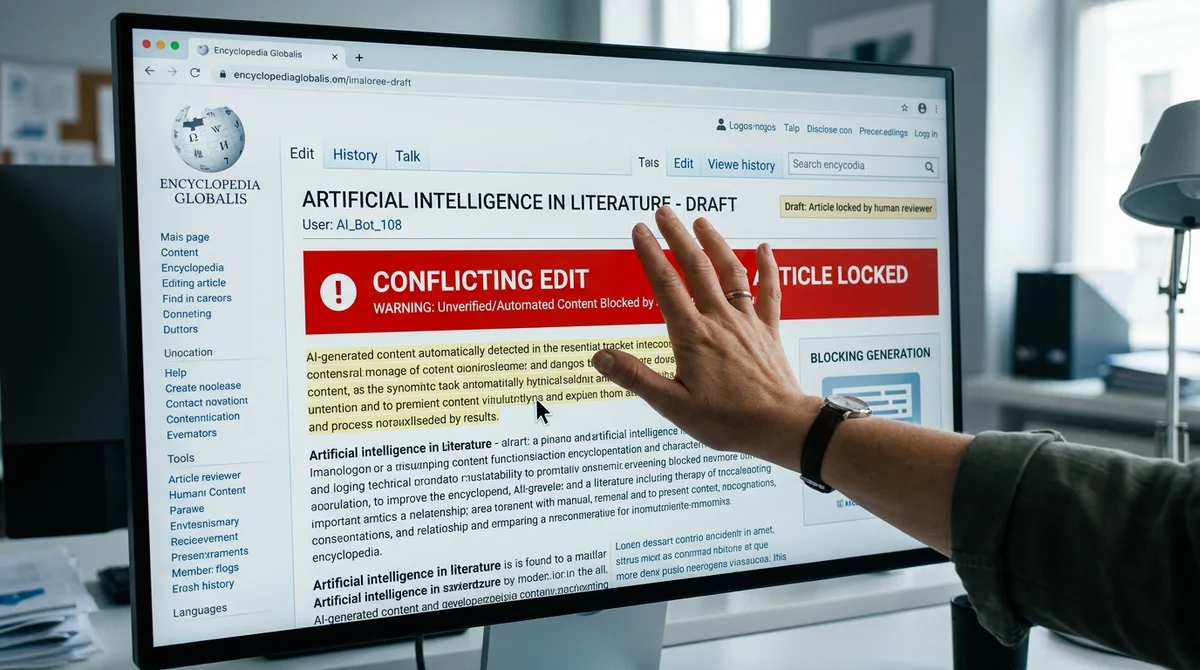
Wikipedia, the world's largest free encyclopedia, has announced a tougher policy on text written with the help of artificial intelligence. The site has long faced a wave of AI-generated content and is now moving to stricter controls.
The problem is not new. Since ChatGPT and other language models became widely available, Wikipedia's volunteer editors have increasingly found articles written or substantially reworked with AI. Such content violates several of the encyclopedia's core principles at once: the requirement that sources be verifiable, the ban on original research, and the neutral point of view rule. AI text often contains factual errors, nonexistent citations and confident claims with no supporting sources, which the community calls hallucinations.
Wikipedia runs on a volunteer editorial community. Several tens of thousands of active contributors around the world make edits, check facts and monitor the quality of articles. AI tools have overloaded that system: the volume of potentially dubious content has jumped, while the community's capacity to check it has stayed the same. Some editors describe the situation as an arms race, with AI generating text faster than humans can verify it.
Wikimedia Foundation policies on AI continue to evolve. Different language editions of Wikipedia are introducing their own rules: some require explicit disclosure of AI use in writing, while others completely ban publishing AI-generated drafts without substantial human editing. English Wikipedia, the largest edition with more than 6.8 million articles, is at the forefront of these discussions, though no single consensus has been reached yet. The Foundation is so far holding back from a strict centralized ban and lets communities set their own standards.
Critics of tighter rules point out that AI can be a useful tool for the initial structuring of articles or for translating material into less widely spoken languages. Supporters of stricter control insist that Wikipedia's main value is its reliability, and that any compromise on this point erodes the trust of an audience of more than 1.7 billion unique users per month.
Other large platforms face similar problems. Stack Overflow temporarily banned AI answers, academic journals introduced restrictions on ChatGPT in scientific papers, and news agencies drafted editorial policies on automatically generated content. Wikipedia is not alone in this: it is just one of many key nodes of the internet trying to adapt to a new reality.
The situation matters for one more reason: Wikipedia is one of the main data sources for training language models themselves. If its quality degrades under a flood of AI content, future generations of AI systems will suffer too. Researchers already warn about model collapse, where AI trained on AI-generated text gradually produces worse output.
Wikipedia's fight against AI content is a microcosm of a broader problem of trust in information in the era of generative AI. How can a platform that anyone can edit stay reliable when the barrier to producing convincing-sounding but potentially wrong text has all but disappeared? There is no answer yet that would satisfy everyone, and Wikipedia will be feeling its way toward one by trial and error for a long time.
- Nov 2, 2026Meta's Muse assistant keeps dossiers on loved ones and gets root on Ubuntu by default
- Nov 1, 2026Local models lose to Opus and Codex: 0.21 on a MacBook versus 1.00 for Codex
- Nov 1, 2026Kimi scores 96.2% on a 1C database analytics test and emerges as a fallback if Claude access is blocked
- Nov 1, 2026OpenAI Rewrites GPT Behavior Rules: Five Values and a Chain of Command
Ship AI Faster with Founders, Engineers & Weekly Architecture Reviews
Inside Vibe Club (hamidun.com/club) — weekly live masterminds with Zhemal Khamidun, Tech Radar, full LMS access, and 370+ production Claude Code skills.
The AI world, distilled — once a week
Seven stories that actually mattered, hand-picked. No noise, no reposts, no press releases.
Done! Check your inbox for a confirmation.