Artificial Intelligence Has Taken Over Weather Apps: What It Means for Users
Weather apps are undergoing a quiet revolution: most major services already use machine learning for forecasting. Accuracy has increased—especially on…
AI-processed from Wired; edited by Hamidun News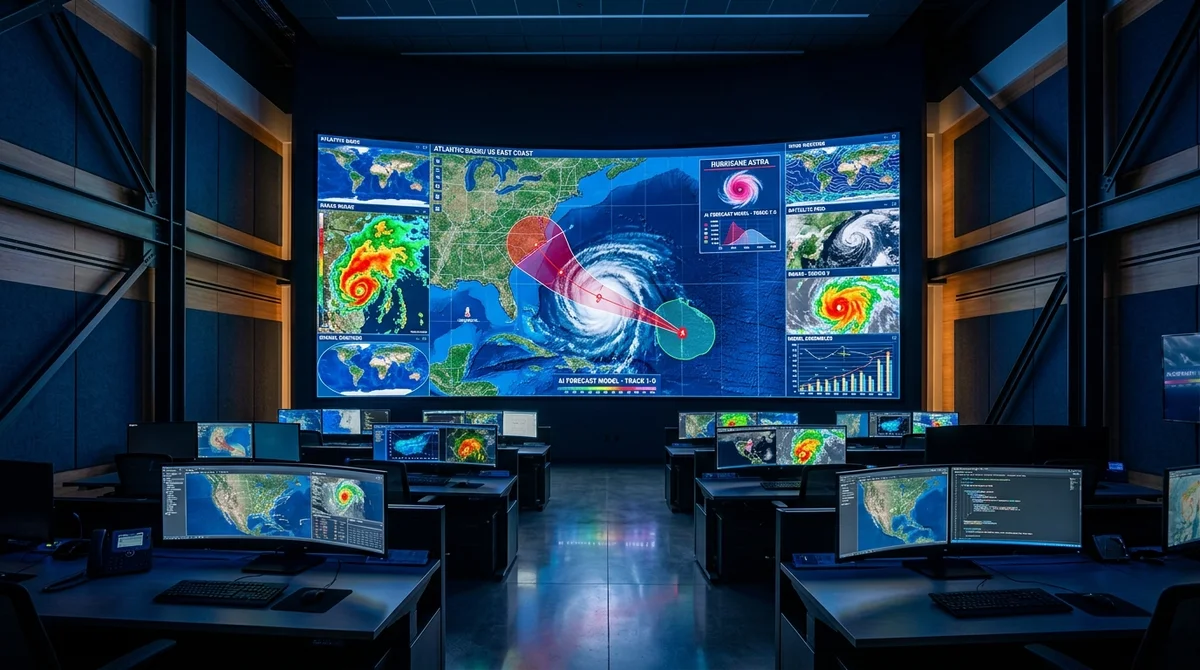
Artificial intelligence has become one of the first industries where machine learning has delivered measurable and easily verifiable results. Over the past two years, the largest technology companies — Google DeepMind, Huawei, NVIDIA — have released their own AI models for meteorology that, in many tasks, surpass traditional numerical methods. But there is a vast gap between a breakthrough in the laboratory and what a user sees on their smartphone.
Traditional numerical weather forecasting requires enormous computational resources: ECMWF (European Centre for Medium-Range Weather Forecasts) supercomputers process a single model for hours. AI systems accomplish the same task in minutes. GraphCast from Google DeepMind, introduced in late 2023, demonstrated superiority over classical methods in predicting hurricanes and extreme temperatures over a horizon of up to ten days.
Pangu-Weather from Huawei and FourCastNet from NVIDIA showed similar results in independent tests. Commercial applications — AccuWeather, Weather.com, Gismeteo — operate on their own models and update with a delay relative to academic developments.
Some services have already integrated ML elements for hyper-localization of forecasts: so-called downscaling allows refining a global model to the level of a specific neighborhood or street. But users, as a rule, do not know about this.
Here arises a marketing problem. The word "AI" in weather applications means different things depending on context. Some services truly use neural networks to analyze data from home weather stations and IoT sensors, aggregating thousands of hyper-local points. Others have simply renamed long-existing statistical algorithms. Wired analyzed the largest American weather services and found a significant gap between "AI-powered" in marketing and actual machine learning application in the product.
The professional meteorological community approaches AI models with caution. Classical methods allow meteorologists to understand why the forecast is the way it is: atmospheric fronts, pressure fields, and humidity are visible. Neural networks are a black box. The US National Weather Service and ECMWF integrate AI as an auxiliary tool, preserving traditional models as the foundation. This is a sensible strategy: AI systems trained on historical data may perform worse with rare anomalous phenomena not represented in the training dataset.
For the average user, a different question is important: have forecasts become more accurate? The answer is a cautious "yes," especially over short horizons of up to 48 hours and in warnings about extreme events. But quality depends heavily on the region. In the USA and Western Europe, a dense network of weather stations, radars, and satellite data allows AI to work well. In Central Asia or Africa, sparse infrastructure limits the capabilities of any model: a neural network cannot compensate for the absence of input data.
Weather applications are becoming a competitive field where differentiation occurs through the accuracy of hyper-local forecasts and the speed of warnings. IBM Weather Company, Tomorrow.io, and Climavision are actively investing in this direction. The stakes are high: an accurate forecast of a downpour ten minutes before it starts is not just a convenience, but a solution in insurance, agriculture, and aviation.
AI has indeed come to weather applications — but unevenly and often invisibly to the user. While scientists publish models that outperform traditional methods, commercial services digest these developments with a delay of several years. The accuracy of forecasts will improve — just not as quickly as marketing promises.
Want to stop reading about AI and start using it?
AI News is a curated feed of AI/tech news. Hamidun Academy teaches you to use AI systematically in your work.