Google Maps now automatically captions photos and videos with Gemini AI
Google has added Gemini-based AI captions to Maps: when a user wants to share a photo or video, the AI automatically suggests ready text. It is especially…
AI-processed from TechCrunch; edited by Hamidun News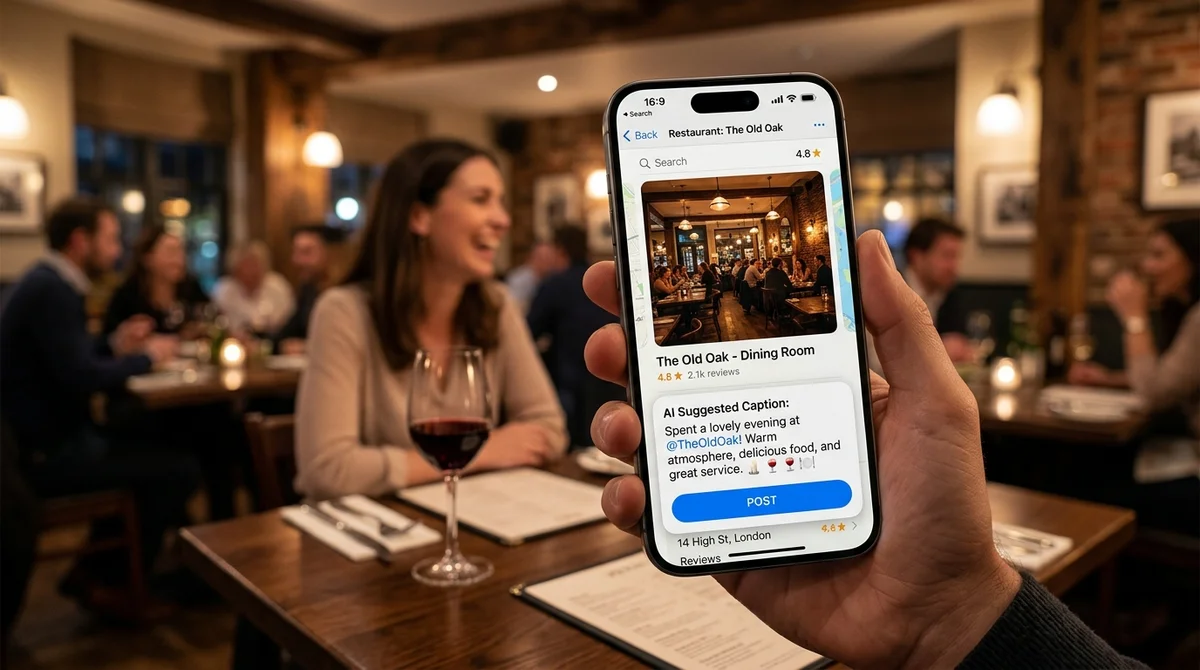
Google is expanding Google Maps functionality with Gemini AI: the service now has the ability to automatically generate captions for photos and videos that users want to share through the application.
How the New Feature Works
The mechanics are straightforward. When a user selects a photo or video for publication — for example, a photo of a dish at a restaurant, a hotel view, or a landmark — Gemini analyzes the image and suggests a ready-made text caption. The user can accept the suggested option, edit it to their liking, or write the text from scratch. There is no mandatory use — the feature acts as an assistant, not a replacement for the user's own perspective.
For Google Maps, this is a logical step. User-generated content — photos, ratings, reviews — is one of the main drivers of the service. Millions of photos are uploaded daily through the application: restaurants, hotels, stores, parks. But most of them either have no captions at all or are accompanied by minimal text. AI captions lower this barrier: adding a description to a photo now requires neither time nor effort.
Gemini in Google's Ecosystem
The appearance of Gemini in Google Maps is part of the company's large-scale strategy to integrate AI into all products. Over the past year, Gemini has appeared in Gmail (help with writing emails), in Google Docs (text refactoring and formatting), in Chrome (page summarization), in search (AI Overviews — summary answers instead of links). Maps logically fits into this lineup.
Google consistently positions Gemini not as a separate product, but as an intelligent layer that permeates the entire ecosystem. This fundamentally distinguishes Google's strategy from OpenAI's approach, which builds primarily autonomous products. Google is betting on embedded AI — features that users don't specifically seek out, but simply discover at the right moment.
Context: The AI Features Market in Mapping
Google Maps is not the first mapping service experimenting with AI for content handling. Apple Maps uses machine learning for automatic place category detection based on uploaded photos. Yelp has implemented AI tags that help classify the atmosphere of an establishment based on user photos. Tripadvisor is testing AI summarization of reviews. But Google operates at a different scale. Google Maps alone has more than two billion monthly active users. Even if AI captions are used in a small fraction of uploads, in absolute numbers this means millions of additional text descriptions per month.
This directly improves the quality of Maps data — which benefits both users (more complete information about places) and advertisers (more precise context for targeting). For businesses listed in Google Maps, the new feature is potentially important: more captioned photos mean more context for ranking algorithms. Restaurants and hotels whose photos are accompanied by meaningful descriptions traditionally receive higher visibility in search results.
What This Means
Google is methodically transforming Maps from a navigation tool into a full-fledged place discovery platform. AI captions are a small but telling detail: the company is reducing friction for user-generated content, making its creation so simple that opting out of captioning becomes harder than agreeing to it.
In a broader context, this is a continuation of the trend toward invisible AI — features that are embedded in familiar scenarios and don't require special knowledge or intent from the user. This approach, it seems, will define the competitive landscape in the coming years: not autonomous AI agents, but smart assistants embedded in products that people use every day.
Want to stop reading about AI and start using it?
AI News is a curated feed of AI/tech news. Hamidun Academy teaches you to use AI systematically in your work.