US Army builds its own chatbot, VICTOR, to support soldiers on missions
The US Army is developing VICTOR, its own chatbot for military personnel. The system is trained on real military data and is designed to give soldiers mission-critical information. The project is part of the Pentagon's broader push to bring AI into combat operations — this time built on the military's own data, without commercial providers.
AI-processed from Wired; edited by Hamidun News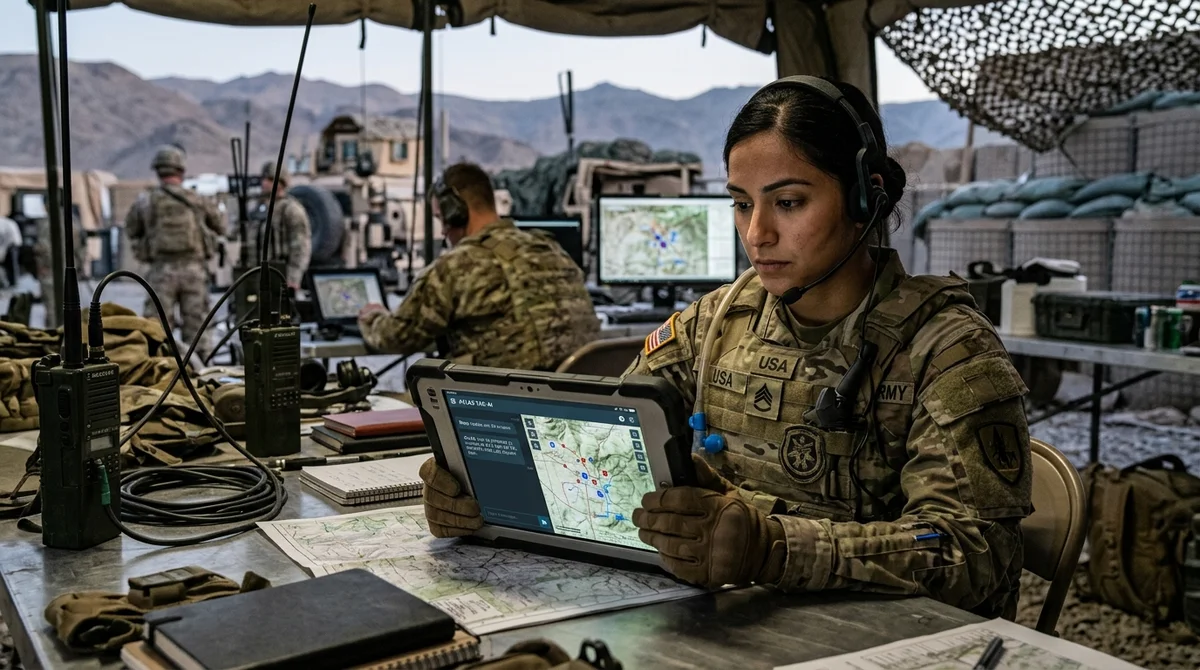
The US Army is building its own military AI chatbot, called VICTOR. The system is trained on real Army data and can give soldiers mission-critical information while they are carrying out tasks, Wired reports.
VICTOR is being developed as an alternative to commercial language models such as ChatGPT and Copilot. Service members had already started turning to those tools on their own, but they are not trained on specialized military data and are not designed for use under operational secrecy. The Army needs a system that knows military doctrine, tactical manuals, order formats, and logistics protocols — not in general terms, but with precision good enough for real-world use.
The idea is to give every soldier access to a tool that can quickly answer questions like: which protocol applies in a specific scenario, how to properly file a report, or where to find the relevant section of a field manual. In essence, it is a digital assistant that holds the Army's institutional knowledge and is available at any moment.
The project is running inside the Pentagon amid a broader wave of military AI integration: the Army, the Air Force, and other US agencies are actively experimenting with generative AI for logistics, operations planning, and intelligence analysis. In 2024, the Department of Defense issued a directive permitting cautious use of commercial AI tools, but tasks involving real operational data have always required closed, vetted systems.
VICTOR is exactly that kind of system. Rather than simply wrapping an off-the-shelf model in a military prompt, it is trained on a corpus that reflects actual Army practice: field manuals, operations orders, reports, and internal instructions. That fundamentally changes the quality of its answers: the model doesn't interpret military terminology "by inference" — it knows it the way a soldier does.
Building such a tool also carries obvious risks. Language model hallucinations are an inconvenience in civilian tasks. In a combat context, an inaccurate answer can cost lives. That is why the focus is on verified sources and narrow specialization: VICTOR isn't supposed to "know everything" — it is supposed to know precisely what a soldier needs, right here and right now.
The project is still in development and testing, and there is no public information on deployment timelines or scale. But the fact that the Army is investing in its own language model rather than renting capacity from Microsoft or OpenAI signals a shift in approach: the military no longer wants to depend on civilian AI providers where the stakes are highest.
- Nov 1, 2026Local models lose to Opus and Codex: 0.21 on a MacBook versus 1.00 for Codex
- Nov 1, 2026Kimi scores 96.2% on a 1C database analytics test and emerges as a fallback if Claude access is blocked
- Nov 1, 2026OpenAI Rewrites GPT Behavior Rules: Five Values and a Chain of Command
- Nov 1, 2026Google admits AI Mode cuts search revenue, shares fall 15%
Test Frontier LLMs & Autonomous Agents in One Workspace
Run Claude Opus 5.5, GPT-6, Gemini 3.1, and DeepSeek side-by-side in Nomad AI (nomadnet.ai) — unified model routing, deep research, and multimodal workflows under one subscription.
The AI world, distilled — once a week
Seven stories that actually mattered, hand-picked. No noise, no reposts, no press releases.
Done! Check your inbox for a confirmation.