Physical Intelligence unveils π0.7, a robot brain that can pick up unfamiliar tasks
Startup Physical Intelligence has unveiled π0.7, a new version of its robot "brain." Its main feature: the model can handle tasks it was never taught. The company calls this an "early but significant" step toward a general-purpose robot, a long-standing goal of the entire robotics industry.
AI-processed from TechCrunch; edited by Hamidun News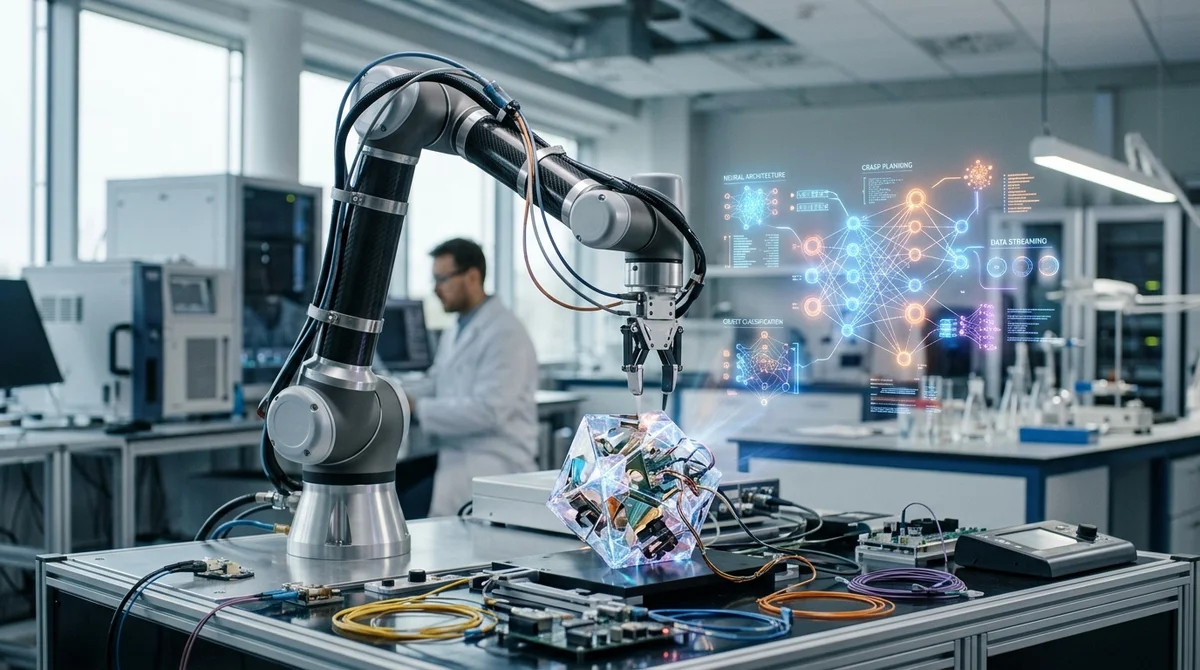
Physical Intelligence, one of the most talked-about players in robotics, has unveiled π0.7, an updated version of its robot "brain" model. The key achievement: the system can now handle tasks it was not specifically trained for.
Physical Intelligence was founded in 2023 by a team of former researchers from Google DeepMind, Berkeley and other leading labs. From the start, the company set an ambitious goal: to build a universal AI brain for physical robots, much as GPT did for text processing. In its first year the startup raised about 400 million dollars; its investors include Khosla Ventures, Thrive Capital and Amazon.
The first public model, π0, came out in late 2024. It could control manipulators and perform household tasks such as folding laundry and washing dishes. But it was trained on specific skills: every action was demonstrated in advance and baked into the model's weights.
π0.7 goes further. According to the company, the new model can transfer knowledge to tasks it has never been trained on. In other words, it generalizes rather than merely reproducing what it memorized. That is what makes the step significant: not refinement within familiar scenarios, but the emergence of the first traces of "common sense" about the physical world.
The company itself is cautious in its wording, calling this an "early but significant step" toward a long-sought goal: a universal robot that can handle any physical task without separate training for each new scenario. That is a fundamental difference from the current state of affairs, in which an industrial manipulator does exactly what it was programmed to do and nothing more.
Generalization has been one of the central problems in robotics for decades. Training a robot to tighten a bolt on a conveyor is not hard. Training it to "figure out" a new task using a general understanding of physics and space is something else entirely. The success of large language models is what pushed the whole field in this direction: it turned out that large-scale training on diverse data gives models the ability to generalize. Physical Intelligence applies the same principle to physical actions in the real world.
The architecture of π0.7 has not been disclosed in detail. Historically, the company has built its models on a diffusion approach, applying it not to pixels but to the robot's action space: instead of picking the next step from a fixed set, the model generates a movement trajectory and refines it gradually, much as a neural network refines an image.
How unfamiliar the "unfamiliar" tasks really are remains an open question. The company has not yet published detailed benchmarks, and video demos, the traditional marketing weapon of robotics startups, do not always reflect how reliable systems are in uncontrolled conditions.
Still, the fact itself matters: a well-funded startup with a world-class team records a measurable step toward generalization. The race for a "brain for the robot" is running in parallel with the race for large language models, and the stakes are comparable. If a truly universal model for controlling a physical body is built in the coming years, it will change the entire automation industry, from logistics to surgery.
π0.7 is not the finish line yet. But it is one of the few real signals that a road to it exists.
- Nov 2, 2026TJ Digital: 23% of AI-cited pages open with a direct answer, versus 14% of uncited ones
- Nov 2, 2026Karpathy builds a YouTube clone with 6454 videos from Hacker News recommendations in two hours
- Nov 2, 2026Karpathy used Claude to build HackerTube from 6,454 videos recommended on Hacker News
- Nov 2, 2026Anthropic needs to grow revenue 32% a year to cover $850 billion in contracts
Test Frontier LLMs & Autonomous Agents in One Workspace
Run Claude Opus 5.5, GPT-6, Gemini 3.1, and DeepSeek side-by-side in Nomad AI (nomadnet.ai) — unified model routing, deep research, and multimodal workflows under one subscription.
The AI world, distilled — once a week
Seven stories that actually mattered, hand-picked. No noise, no reposts, no press releases.
Done! Check your inbox for a confirmation.