Russian company builds AI factory on Nvidia chips barred from export to China
Speech Technology Center, one of the pioneers of the Russian speech recognition market, plans to spend 210 million rubles on five high-performance servers built on the Nvidia HGX H200 platform. Experts say the scale of the purchase and the class of hardware clearly point to an intention to build a full-fledged AI factory for training large language models. Notably, these are the very chips subject to US export restrictions with respect to China, which makes their appearance in Russian infrastructure especially resonant amid the global race for computing power.
AI-processed from CNews AI; edited by Hamidun News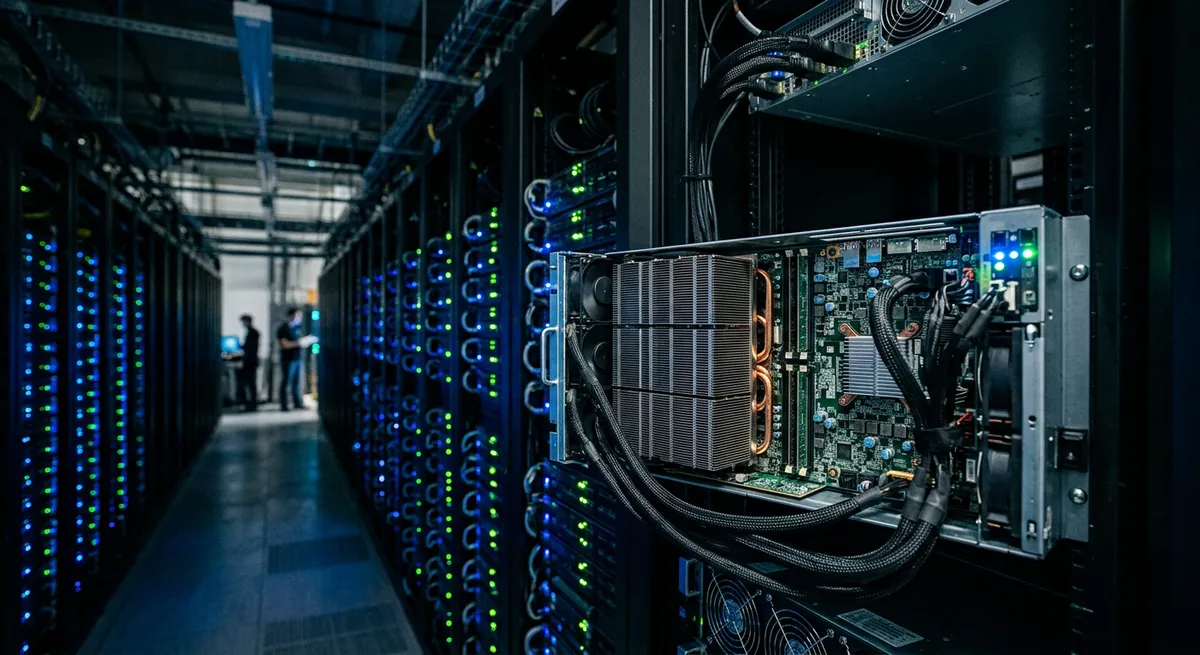
Russian company builds AI factory on Nvidia chips barred from export to China
Speech Technology Center, one of the oldest and most respected players on the Russian speech recognition market, has announced plans to invest 210 million rubles in five high-performance server platforms based on Nvidia HGX H200. According to the expert community, the move marks a qualitative shift for the company, from a specialized developer of speech solutions to a full participant in the race for generative artificial intelligence. It does so on hardware whose export to China is officially prohibited under US law.
To grasp the scale of what is happening, some context is needed. The Nvidia HGX H200 is not just another update to a line of graphics accelerators. It is the pinnacle of modern computing architecture for machine learning, a platform capable of processing enormous volumes of data at a performance unattainable for previous generations of hardware. That is why the US Department of Commerce imposed export restrictions on H200 shipments to China: Washington openly treats access to such chips as a strategic advantage in the technological confrontation. Against this backdrop, the appearance of five H200-based server clusters in Russian corporate infrastructure takes on a distinct geopolitical dimension.
Speech Technology Center itself is a company with deep roots. Founded in the Soviet era on the basis of academic research, it spent decades working on voice processing and speech analytics, supplying its solutions to banks, telecom companies and security agencies. This background matters: the company has not only the money to buy hardware, but also the engineering culture, accumulated data and an understanding of how to build high-performance language processing systems. For it, moving to training large language models is not a gamble but a logical evolution.
Five servers on the HGX H200 platform are exactly the threshold at which experts start talking about an AI factory rather than just a compute cluster. Each such platform combines several H200 accelerators with a high-speed NVLink bus, providing dense interconnection between nodes and allowing model training to be distributed across machines with minimal performance loss. In total, such infrastructure can compete with serious research centers in the amount of computing power available for training frontier models. This is no longer a tool for one company's tasks; it is a potential center of expertise for a wide range of customers.
The consequences of this step reach far beyond the corporate strategy of a single company. First, the very fact of successfully acquiring hardware barred from export to China will raise uncomfortable questions for Western regulators: through which channels and jurisdictions this hardware passed, and how effective the existing export control mechanisms are. Second, the Russian market gains a precedent for building independent computing infrastructure at a level sufficient to develop competitive language models, at a time when most analysts predicted the country's inevitable technological lag under sanctions pressure. Third, if Speech Technology Center opens its capacity to outside users under a cloud computing model, it will significantly change the balance of power in the Russian AI infrastructure market.
The question of which models are planned for training on this hardware deserves separate attention. The company's speech specialization suggests the development of multimodal systems able to work with audio and text at the same time, an area where global competition is intensifying rapidly. However, the power of the infrastructure being acquired is clearly excessive for narrowly specialized speech tasks, which indirectly confirms broader ambitions.
The story of Speech Technology Center's AI factory is not just corporate news. It is a symptom of a deeper process: an attempt to build a sovereign computing stack at a time when international supply chains have turned out to be an instrument of geopolitical pressure. Whether the attempt fully succeeds will be shown not by the size of the investment, but by the quality of the models built on this hardware.
- Nov 2, 2026TensorFold 1.2.0 boosts Qwen3.8-27B throughput on M3 Ultra by 44.2% at 16 streams
- Nov 1, 2026Local models lose to Opus and Codex: 0.21 on a MacBook versus 1.00 for Codex
- Nov 1, 2026Habr author fine-tunes YOLOv8l on dental X-rays and pushes mAP50 to 0.642
- Nov 1, 2026Voice bots built on LLMs turn to Jev, a fast classifier, for decisions in 200–500 ms
Test Frontier LLMs & Autonomous Agents in One Workspace
Run Claude Opus 5.5, GPT-6, Gemini 3.1, and DeepSeek side-by-side in Nomad AI (nomadnet.ai) — unified model routing, deep research, and multimodal workflows under one subscription.
The AI world, distilled — once a week
Seven stories that actually mattered, hand-picked. No noise, no reposts, no press releases.
Done! Check your inbox for a confirmation.