Self-Aware MCP Server: Teaching AI Agents About the Real World
Developers have released Self-Aware MCP Server, a tool that gives AI agents such as Claude Code real-world context: operating system, time zone, file paths and system parameters. Without this data, models regularly get things wrong. They suggest Windows commands on Linux or ignore local settings. The MCP server acts as a "bridge" between the model's abstract intelligence and the user's concrete environment. It turns an AI that is smart but detached from reality into a genuinely context-aware assistant.
AI-processed from Habr AI; edited by Hamidun News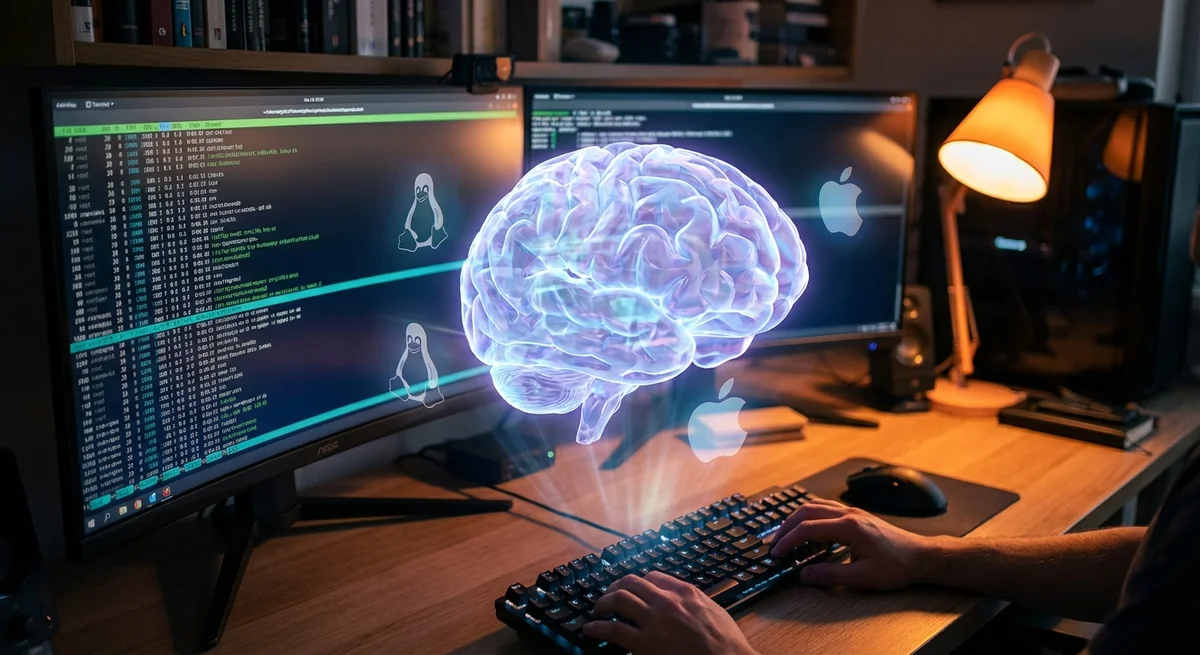
Anyone who has spent even a week working with AI coding assistants has run into the same paradox. The model can generate a complex algorithm, make sense of a microservices architecture and propose an elegant refactoring, yet it has no idea which operating system you are on. It suggests Windows-style file paths when you work on Linux. It calls PowerShell commands on macOS. It ignores your time zone when handling dates. This gap between a language model's intellectual power and its total blindness to the real-world context is one of the most underrated problems in modern AI development. Self-Aware MCP Server is a project that tries to solve exactly that.
The problem runs deeper than it first appears. Large language models are trained on huge volumes of text, but that data is a static snapshot of the past. The model knows that different operating systems, file systems and time zones exist. It does not know which specific configuration it is facing right now. It is like hiring a brilliant programmer who has never seen your computer and works blindfolded. They can write excellent code in a vacuum, but every decision that depends on the runtime environment becomes a lottery.
MCP, the Model Context Protocol, is a standard for connecting external tools and data sources to language models. Put simply, MCP servers work as "sense organs" for an AI agent: they give the model information it cannot get from its training data. Self-Aware MCP Server uses the protocol for one specific job: it tells the AI agent the basic parameters of the environment it runs in. That includes the operating system, CPU architecture, current time and time zone, available system resources and paths to key directories. Any human developer knows these things intuitively, but they stay invisible to the model.
Technically, the solution is elegant in its simplicity. The MCP server runs locally and exposes a set of tools through a standardized interface that the AI agent can use to query system information. When Claude Code or another compatible assistant starts a session, it can contact the server and get a full picture of the environment. After that, every recommendation and every generated code snippet takes real conditions into account. No more backslashes in paths on Unix systems. No more `apt-get` calls on a macOS machine.
It helps to understand the context in which this project appears. The market for AI developer assistants is maturing fast. GitHub Copilot, Claude Code, Cursor, Kilo Code and dozens of other tools compete for programmers' attention. Competition is shifting from raw code-generation quality to how well a tool integrates with the workflow. The models are already smart enough; now they need to be informed enough. Self-Aware MCP Server fits that trend: it does not make the model smarter, it makes it more grounded and more practical.
This approach raises an interesting philosophical question about the nature of "self-awareness" in AI systems. Of course, this is not consciousness in the human sense. But a system's ability to obtain and use information about its own runtime environment is a functional analogue of what cognitive science calls situational awareness. An AI agent equipped with such a server does not just generate code. It generates code for a specific machine, a specific user and a specific moment in time. In practice, the difference between these two modes of working is huge.
The implications for the industry go beyond a single project. MCP is gaining momentum as a protocol, and Self-Aware Server demonstrates an important pattern: the future of AI assistants lies not in isolated super-smart models but in ecosystems where the model is surrounded by specialized services, each responsible for its own aspect of reality. One server knows about the file system, another about the project's databases, a third about the CI/CD pipeline, a fourth about the runtime environment. Together they form a complete picture of the world in which an AI agent can make truly well-founded decisions.
We are on the verge of a transition from AI assistants that impress in demos to AI assistants that work reliably in production. That transition will be determined not by model size or parameter count, but by the quality of the models' connection to the real world. Self-Aware MCP Server is a small but telling step in that direction. It is a reminder that even the smartest advice is useless if it is given without understanding the context.
- Nov 2, 2026Bun creator uses Claude Code to port 750K lines from Zig to Rust in 11 days
- Nov 2, 2026mcp-linter finds 18 undescribed parameters in Anthropic's filesystem server
- Nov 2, 2026The Verge reviewer builds a $50 Meta Muse Charm alternative with Claude Code
- Nov 2, 20268 Skills for video in Claude Code: from 244 pixel effects to rough-cut editing
Build & Ship Production AI Agents Without Boilerplate Code
Start your free 72-hour trial at Hamidun Academy (academy.hamidun.com) — interactive lessons on Claude Code & Cursor, live Tech Radar, and production agent templates.
The AI world, distilled — once a week
Seven stories that actually mattered, hand-picked. No noise, no reposts, no press releases.
Done! Check your inbox for a confirmation.