Developer builds spine MRI analyzer with Python and Gemini
A Russian developer built Spine Advisor in a week: a Python desktop app that uses the multimodal Gemini 3 Flash model to analyze spinal MRI scans. The app helps patients track the progress of their back treatment through a digital diary. The project grew out of personal experience. After years of sedentary work, the programmer was tired of lower back pain and decided to automate what a doctor usually does during an appointment. The case is typical of a growing trend: medical AI tools built by patients themselves.
AI-processed from Habr AI; edited by Hamidun News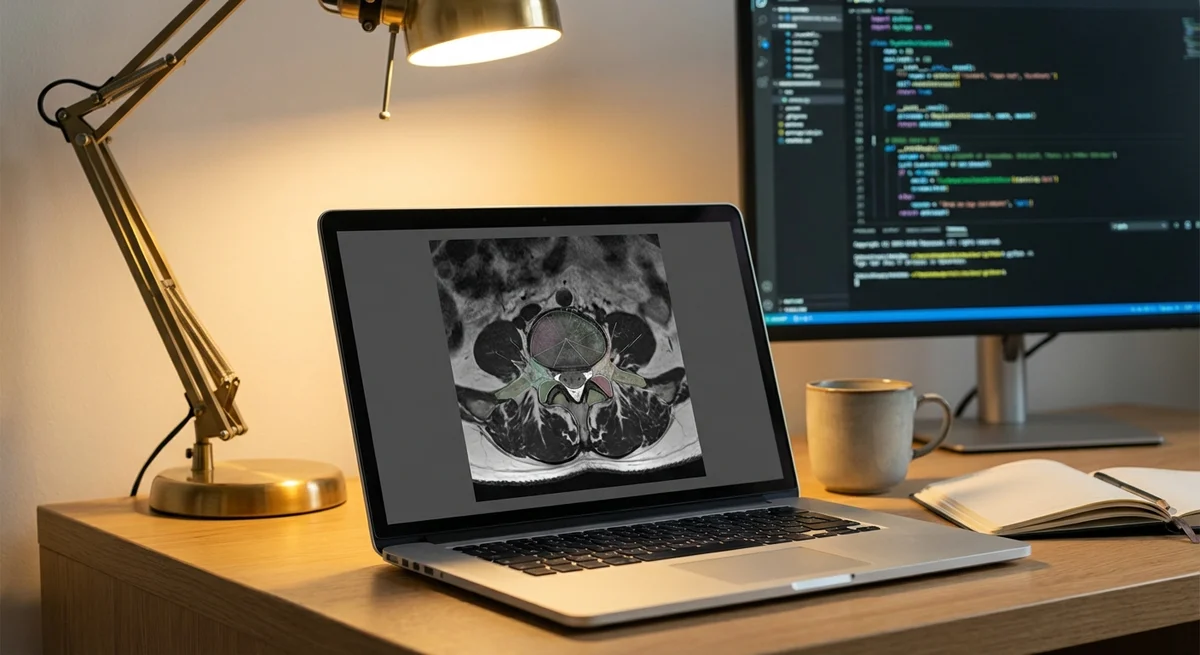
Ten hours a day at a monitor, chronic lower back pain and yet another visit to the neurologist: a familiar story for hundreds of thousands of developers worldwide. But one of them decided not just to put up with it and wrote his own tool for analyzing spinal MRI scans. The result is Spine Advisor, a Python desktop app that processes medical images in seconds using the multimodal Gemini 3 Flash model.
The project's story, published on Habr, begins in a mundane and recognizable way. The author is a working programmer who spent years ignoring signals from his own body. When occasional "shooting" pains turned into constant discomfort, doctor visits became regular, and a stack of MRI scans piled up with them. Each time, the specialist spent time comparing results, explaining the changes over time and interpreting the reports. The developer asked a logical question: could at least part of this routine be handed off to a language model?
It turned out it could. Spine Advisor works as a digital back diary with a built-in AI assistant. The user uploads MRI scans, and Gemini 3 Flash analyzes the images, picking out key patterns such as protrusions, hernias and changes in the intervertebral discs. The app lets users compare results over time and follow treatment progress from visit to visit. In essence, it is a personal medical tracker that speaks plain language to the patient instead of leaving them alone with the impenetrable terminology of radiology reports.
The author's technical choices deserve a closer look. Gemini 3 Flash is a relatively new multimodal model from Google that handles image analysis well, with fast response times and moderate API costs. For a desktop app aimed at ordinary users, that is a reasonable compromise between interpretation quality and cost. Python as the main language is no accident either: a rich ecosystem of libraries for medical imaging, from pydicom to nibabel, makes it the de facto standard in medical ML.
Still, the project raises questions that reach far beyond a single app. We are watching a new class of medical tools take shape: built not by corporations with multimillion-dollar certification budgets, but by patients solving their own problems. That is both inspiring and worrying. On one hand, multimodal models have indeed reached the point where they can extract meaningful information from medical images. Research from the past two years shows that large language models come close to the accuracy of medical interns on a range of radiology tasks. On the other hand, none of these models is a certified medical device, and their interpretations should not replace professional diagnosis.
To his credit, the author positions Spine Advisor as an assistive tool, not a replacement for a doctor. The app helps patients prepare for a visit, formulate questions and track changes, but the final word stays with the specialist. It is an important caveat that medical AI enthusiasts often forget. Regulators around the world, from the FDA to Roszdravnadzor, have yet to settle on a common approach to such "patient-built" tools, and the legal status of these apps remains a gray area.
Nevertheless, the trend is clear. As multimodal models get cheaper and more accessible, and as APIs from major providers simplify integration, the barrier to building medical AI assistants is falling fast. Today, one developer cobbles together an MRI analyzer in a week. Tomorrow, such tools could become a standard add-on to the electronic health record. The only question is whether regulation can keep pace with the technology, or whether patients armed with Python and API keys will once again end up one step ahead of the healthcare system.
- Nov 2, 2026Bun creator uses Claude Code to port 750K lines from Zig to Rust in 11 days
- Nov 2, 2026The Verge reviewer builds a $50 Meta Muse Charm alternative with Claude Code
- Nov 1, 202616 models tested on 7 search tools: Exa averaged 10.5 out of 14, SearXNG about 3
- Nov 1, 2026Google's StreamVibe video agent beats other models by 10.7% on response timing and quality
Test Frontier LLMs & Autonomous Agents in One Workspace
Run Claude Opus 5.5, GPT-6, Gemini 3.1, and DeepSeek side-by-side in Nomad AI (nomadnet.ai) — unified model routing, deep research, and multimodal workflows under one subscription.
The AI world, distilled — once a week
Seven stories that actually mattered, hand-picked. No noise, no reposts, no press releases.
Done! Check your inbox for a confirmation.