The AGI Economy: Humans Become Verifiers While Machines Take Over the Work
Researchers at MIT, Washington University and UCLA have published an analysis of the economy in the age of AGI. Their central thesis: as we approach the singularity, most productive labor will shift to machines, and humans will move into the role of verifiers, the people who check and confirm the quality of AI's work. The same issue of Import AI also covers testing AI with procedurally generated games and the concept of "agent ecologies," systems in which autonomous AI agents interact with one another. Together, these pieces paint a picture of a world where human expertise does not disappear but is radically transformed.
AI-processed from Import AI; edited by Hamidun News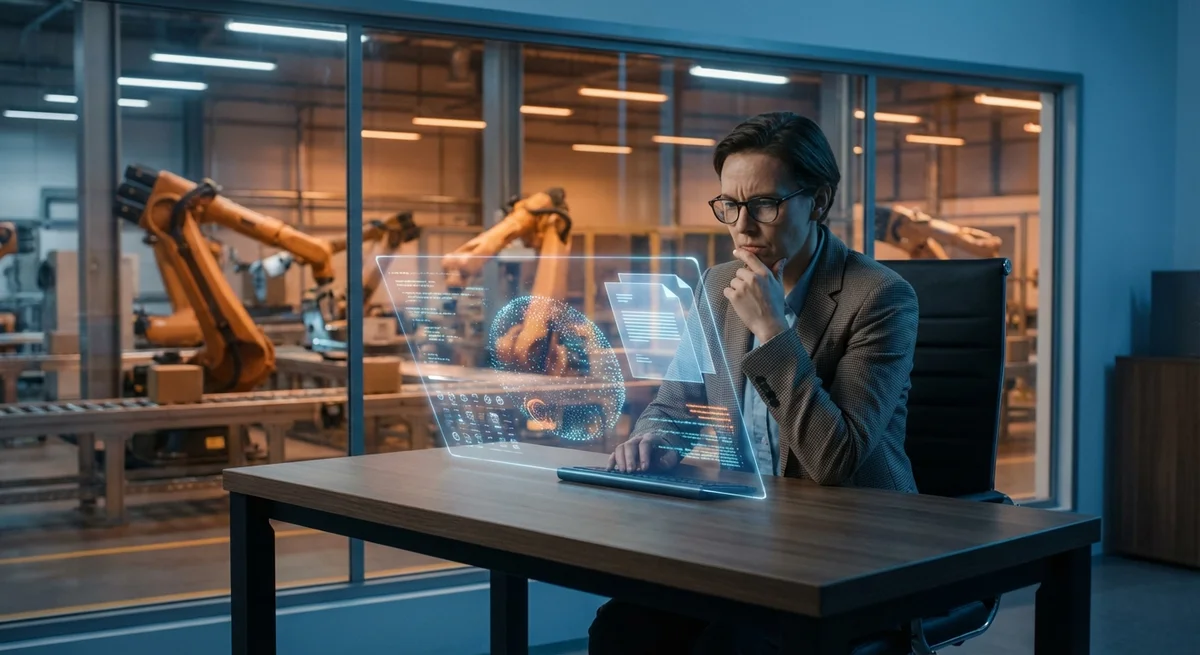
Talk of the technological singularity has long since stopped being the preserve of science fiction writers and futurists with YouTube channels. Now economists at leading universities are taking it up, and their conclusions deserve close attention. In the latest issue of the Import AI newsletter, one of the most authoritative sources on artificial intelligence research, the central topic is a model of the "AGI economy" proposed by a group of researchers from the Massachusetts Institute of Technology, Washington University in St. Louis and the University of California, Los Angeles.
Their work boils down to a simple but unsettling formula: in a world where artificial general intelligence becomes reality, the overwhelming share of productive labor passes to machines. Humans do not vanish from the economic equation, but their role changes fundamentally. Instead of creating, people start checking. Instead of producing, they verify. This is not just the automation of routine tasks. It is a restructuring of the very logic of the division of labor, which has existed for millennia.
Why verification specifically? The answer lies in the fundamental asymmetry between creating and checking. AI systems already generate code, draft legal documents and design parts at impressive speed. But making sure the result is correct, safe and matches real needs still requires human judgment. The researchers record what practitioners in the industry already see: engineers write less and less code from scratch and review more and more of what Copilot or Claude proposes. Lawyers check AI-drafted contracts rather than writing them themselves. The MIT and WashU model simply extrapolates this trend to its logical limit.
Here, however, a paradox emerges, one the authors appear to recognize, judging by the description of their work. Verification is a skill built through the practice of creating. A surgeon can judge the quality of an operation because they have performed thousands. A programmer spots a bug in generated code because they spent years writing code by hand. If new generations of specialists step straight into the verifier role, skipping deep hands-on experience, the quality of verification itself will inevitably degrade. This creates a kind of competence trap that economists and policymakers should start thinking about now.
The same issue of Import AI raises two more topics that fit the picture well. The first is the use of procedurally generated game environments to test AI systems. The idea is that static benchmarks quickly go stale and get "memorized" by models, while dynamically created game scenarios can assess genuine ability to generalize and adapt. This is an important methodological shift: the industry is beginning to understand that a machine's intelligence should be measured not by tests but by its ability to handle the unexpected.
The second topic is the concept of "agent ecologies," meaning systems in which many autonomous AI agents interact with one another, compete and cooperate. If the AGI economy describes the relationship between humans and machines, agent ecologies describe the relationships among machines themselves. This is the next level of complexity, where predictable behavior from an individual agent does not yet guarantee a predictable system. Emergent effects in such ecologies can be productive or dangerous, and this is a direct bridge to questions of AI safety.
Taken together, these three topics form a coherent and rather sobering picture. We are heading toward a world where machines produce, humans verify, and the machines build their own ecosystems of interaction among themselves. This is neither utopia nor dystopia but a new economic reality whose outlines are already visible today.
The question is not whether it will arrive, but whether we will manage to prepare the institutions, education and regulatory frameworks that let people keep not just employment but real agency in this new world. The researchers at MIT, WashU and UCLA, at least, are asking the right questions. The answers will have to be found by all of us, preferably before the AGI economy becomes a fait accompli.
- Nov 2, 2026Bun creator uses Claude Code to port 750K lines from Zig to Rust in 11 days
- Nov 2, 2026mcp-linter finds 18 undescribed parameters in Anthropic's filesystem server
- Nov 2, 2026The Verge reviewer builds a $50 Meta Muse Charm alternative with Claude Code
- Nov 2, 20268 Skills for video in Claude Code: from 244 pixel effects to rough-cut editing
Test Frontier LLMs & Autonomous Agents in One Workspace
Run Claude Opus 5.5, GPT-6, Gemini 3.1, and DeepSeek side-by-side in Nomad AI (nomadnet.ai) — unified model routing, deep research, and multimodal workflows under one subscription.
The AI world, distilled — once a week
Seven stories that actually mattered, hand-picked. No noise, no reposts, no press releases.
Done! Check your inbox for a confirmation.