Vibe coding: how thoughtless AI use is eroding engineering expertise
Concern is growing in the developer community that the mass adoption of AI assistants in everyday programming is degrading engineering skills. The phenomenon, known as vibe coding, means writing code "by feel": the developer accepts generated solutions without really understanding how they work. Experts warn that unless the industry draws a clear line between AI as a tool that amplifies skills and AI as a substitute for thinking, it risks losing an entire generation of qualified engineers.
AI-processed from Habr AI; edited by Hamidun News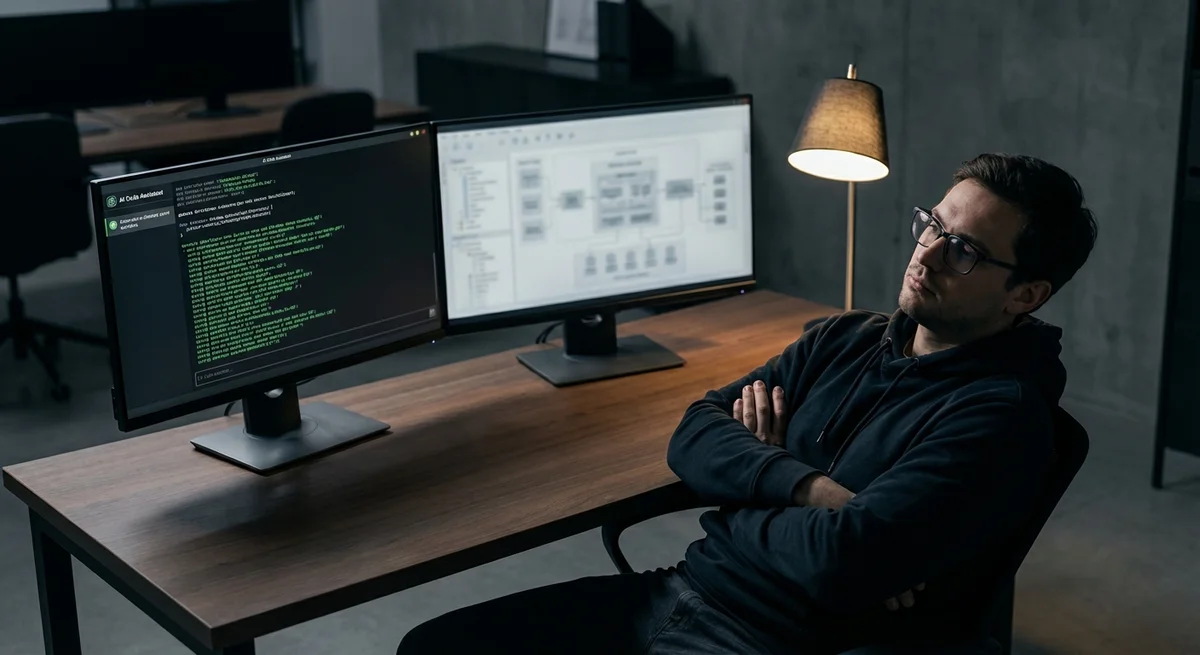
Just a couple of years ago, the term vibe coding sounded like a joke — a wry description of a developer asking a language model to write code, skimming the output, and shipping it to production without digging into the details. By March 2026, it had stopped being a joke. The phenomenon has grown to a scale that raises real questions about the future of the engineering profession as a whole.
Habr has published yet another piece on the subject — and arguably one of the most widely discussed — about how thoughtless integration of AI tools into development workflows is gradually wearing away the very core of the profession: deep technical expertise. The author draws on observations from their own work, but behind the personal notes lies a systemic problem the industry still prefers to ignore.
The mechanics of this decline look deceptively harmless. A developer gets a task, writes a prompt for Copilot, Cursor, or Claude, receives a working snippet, and drops it into the project. The ticket is closed, the sprint moves forward, the manager is happy. The problem is that this approach cuts a key step out of the loop: understanding. The programmer never goes from the problem statement through an analysis of architectural options to a deliberate choice of solution. They get a ready-made answer and take it on faith. Time after time, month after month, the neural connections responsible for engineering thinking simply never form — or, worse, they atrophy in people who used to have that kind of thinking.
Junior developers are especially vulnerable. For them, an AI assistant doesn't amplify existing skills — it replaces them. A junior who has relied on a language model for ready-made solutions since day one risks never developing the ability to think through architecture independently, debug complex systems, or understand why code works the way it does and not some other way.
After three or four years of this, the market will get a mid-level developer who has experience on paper but in practice can't solve a non-trivial problem without an AI prompt. This isn't a hypothetical scenario: the first signs are already showing up in technical interviews, where candidates display a striking gap between how fast they handle routine tasks and how completely helpless they are when faced with unfamiliar ones.
To be clear, the problem isn't the tools themselves. AI coding assistants may be the biggest leap in developer productivity since IDEs gained autocomplete. They are excellent at routine work: generating boilerplate, writing tests from templates, refactoring repetitive code, and rapid prototyping. An experienced engineer who uses AI to speed up tasks they already know how to solve gains an enormous advantage. But in the hands of someone who doesn't understand the fundamentals, the same tool becomes a technical debt generator, producing code that is neatly formatted and syntactically correct but architecturally fragile.
The parallel is obvious. Calculators didn't make mathematicians dumber, but only because mathematicians first learn mental arithmetic and the nature of numbers. GPS navigation didn't destroy the orientation skills of people who could read maps — yet an entire generation of drivers who grew up with GPS really does get lost without it. The question is which of these scenarios is closer to what's happening in software development now. And the answer, by all appearances, isn't reassuring.
There's another rarely discussed dimension to the problem: the effect on team dynamics. When a large share of a team practices vibe coding, code review loses its point — the reviewer waves generated code through just the same, without digging into the logic. Collective expertise, which used to build up through debates over architectural decisions and post-mortems of bugs, gradually evaporates. The team turns into a group of operators running an AI pipeline who can't fix that pipeline when it breaks.
The solution clearly isn't to abandon AI tools — that would be Luddism. The solution is to use them deliberately. Companies should invest in a culture where AI amplifies thinking rather than replacing it. Education programs need to adapt: fundamentals first, tools second. And developers themselves would benefit from occasionally solving problems without AI on purpose — the way athletes train with extra weight so they can move faster without it. Artificial intelligence should make strong engineers even stronger, not create an illusion of competence where none exists.
- Nov 1, 2026OpenAI Rewrites GPT Behavior Rules: Five Values and a Chain of Command
- Oct 31, 2026Author puts his script before an AI jury: the verdict cost 850 thousand tokens
- Oct 31, 2026Anthropic: Fold Subagents Back Into a Single Loop — One Customer's Tasks Ran Twice as Fast
- Oct 30, 2026Mistral opens Large 4 weights: strong at code, but Chinese models score 32 to its 26
Build & Ship Production AI Agents Without Boilerplate Code
Start your free 72-hour trial at Hamidun Academy (academy.hamidun.com) — interactive lessons on Claude Code & Cursor, live Tech Radar, and production agent templates.
The AI world, distilled — once a week
Seven stories that actually mattered, hand-picked. No noise, no reposts, no press releases.
Done! Check your inbox for a confirmation.