AI Moves Into Advanced Mathematics: Breakthrough or Threat?
Since the release of GPT 5.2, AI has been moving rapidly into advanced mathematics. Experts disagree on its impact on science: does it speed up research, or does it devalue fundamental knowledge? Some see a breakthrough that could accelerate the solution of extremely hard problems. Others fear a loss of the human role in the field.
AI-processed from TechCrunch; edited by Hamidun News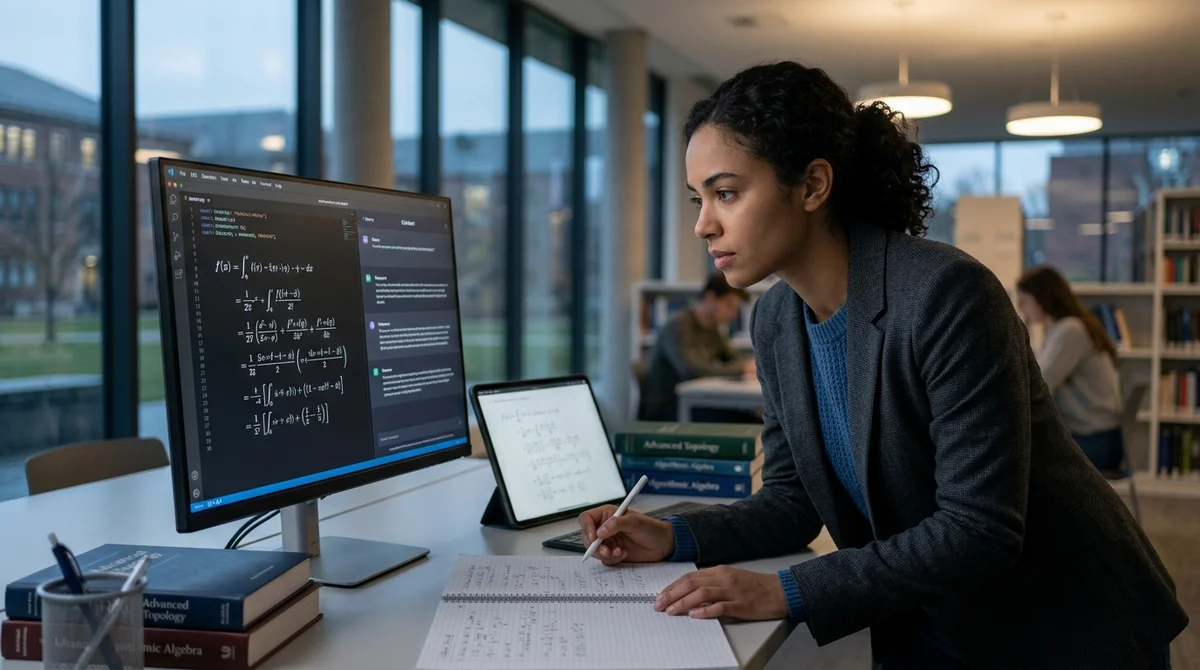
Since the release of GPT 5.2, artificial intelligence tools have become nearly indispensable in advanced mathematics. That has set off a wave of debate in the scientific community: some see a breakthrough that could speed up the solution of extremely hard problems, while others fear the devaluation of fundamental knowledge and a diminished role for human intelligence.
Historically, mathematics was considered one of the hardest and most "human" fields of knowledge. For a long time, people assumed that solving complex mathematical problems required intuition, creativity and a deep understanding of fundamental principles – qualities that machines were thought to lack. But recent advances in artificial intelligence, in particular the development of large language models (LLMs) such as GPT, have shown that this assumption may be wrong.
Thanks to its ability to analyze huge volumes of data, spot patterns and generate new solutions, GPT 5.2 has proved an effective tool for a range of difficult mathematical problems. It can not only check existing proofs but also propose new approaches to problems that previously seemed unsolvable. Some researchers already use GPT 5.2 to automate routine calculations, which lets them focus on the more creative parts of their work.
However, the spread of AI in mathematics also raises concerns. One of the main ones is the reliability of results obtained with AI. Models like GPT are trained on large datasets that may contain errors or biases. As a result, AI may generate incorrect solutions or reinforce existing biases in science. There is also the question of authorship for discoveries made with AI: who owns results produced by a machine – the model's developers, the scientists who used it, or the machine itself?
Using AI in mathematics may also change the role of mathematicians. If machines can handle most routine work, mathematicians will have to focus on harder, more creative tasks that require critical thinking and a deep understanding of fundamental principles. Mathematics education will need to revise its curricula and put the emphasis on skills that cannot be automated.
AI's influence on mathematics is a complex, multifaceted process that will continue in the coming years. It is important for the scientific community to take an active part in discussing the ethical and methodological questions around the use of AI in science, so that its application is responsible and effective. Only then will it be possible to capture all the benefits AI can offer mathematics and avoid the potential risks.
- Nov 2, 2026Steering vectors in LLM fine-tuning improved SFT and distillation across three seeds
- Nov 2, 2026EDU-Jev 4B grades student work with 67.6% accuracy, beating commercial APIs by 9.4 points
- Oct 28, 2026Anthropic reveals how it builds Claude with Claude: the brain separate from the hands
- Oct 28, 2026Bayer Launches Multi-Agent Engine on AgentCore: 80% of Questions Handled Without Engineers
Test Frontier LLMs & Autonomous Agents in One Workspace
Run Claude Opus 5.5, GPT-6, Gemini 3.1, and DeepSeek side-by-side in Nomad AI (nomadnet.ai) — unified model routing, deep research, and multimodal workflows under one subscription.
The AI world, distilled — once a week
Seven stories that actually mattered, hand-picked. No noise, no reposts, no press releases.
Done! Check your inbox for a confirmation.