When Machines Decide What Matters: AI Hunts for New Physics in the Collider Data Stream
Particle physics is going through a quiet crisis: the Standard Model works but does not explain all of reality, and new discoveries are not arriving. Researchers are wiring AI into the detectors of the Large Hadron Collider, not to confirm existing theories but to find anomalies that humans cannot even imagine. Neural networks compressed to fit on FPGA chips decide within fractions of a second which of the 40 million collisions per second are worth keeping. This is not just automation: AI becomes part of the scientific instrument itself, stretching the limits of human imagination.
AI-processed from IEEE Spectrum AI; edited by Hamidun News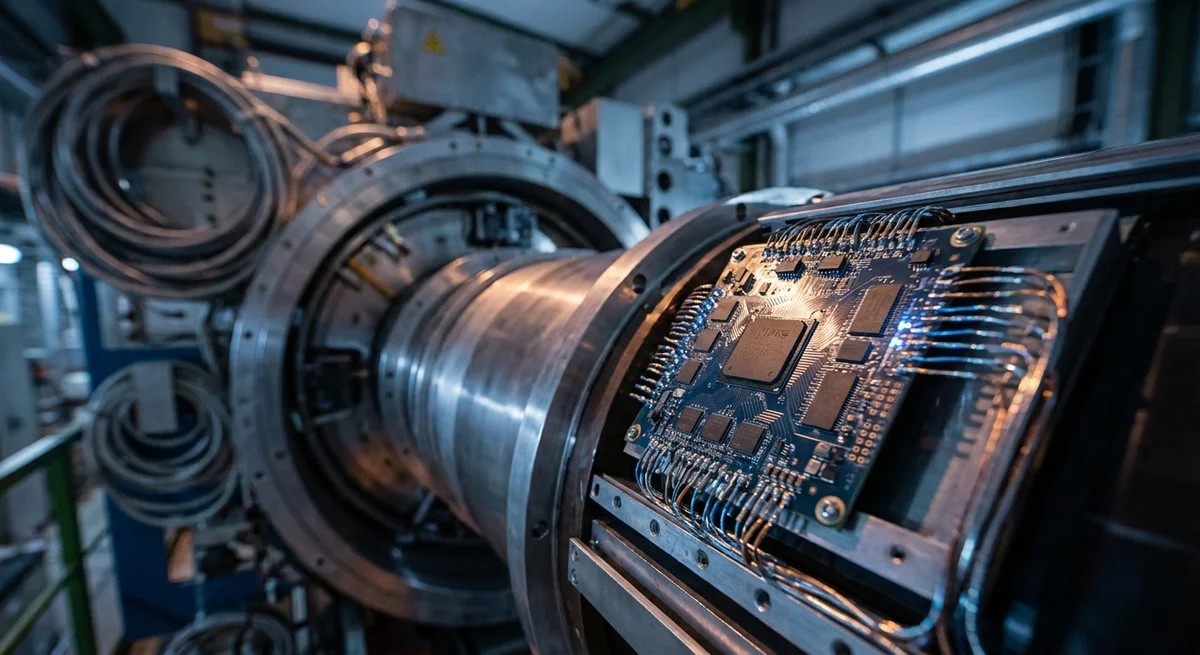
Every second, 40 million particle collisions take place inside the 27-kilometer ring of the Large Hadron Collider. The vast majority of these events will never be saved. For decades, engineers have built filters that decide what to record and what to discard forever. Now those decisions, made within fractions of a microsecond, are increasingly handed to neural networks. And this is not about speeding up routine work. It is an attempt to find something physicists do not even know how to look for.
Particle physics is going through what specialists delicately call a "quiet crisis." The Standard Model, the fundamental theory describing the known particles and forces, works flawlessly. Every new collider experiment confirms its predictions with unnerving precision. The problem is that the model is known to be incomplete: it does not explain dark matter or dark energy, and it does not reconcile with gravity. Theorists have spent decades proposing extensions: supersymmetry, extra dimensions, new particles. Experimentalists built gigantic machines to test them. Yet despite petabytes of collected data, no breakthrough has come. As journalist Matthew Hutson noted in IEEE Spectrum, "there are key components of reality that we are completely missing."
This is where artificial intelligence enters the equation, though not in the way you might expect. This is not another "AI for everything" story in which the technology simply speeds up data processing or automates routine tasks. The researchers are not asking neural networks to test existing hypotheses. They are asking AI to find anomalies: any deviation from the expected that could point to "new physics" beyond the Standard Model. It is essentially unsupervised learning in its purest form: the algorithm does not know what it is looking for, and that is the whole point. Instead of confirming theories born of human imagination, the machine can highlight patterns nobody suspected existed.
The technical implementation is an engineering feat in its own right. The neural networks that analyze collider data do not run on powerful servers in a data center. They run directly on field-programmable gate arrays (FPGA chips) attached to the detectors. These chips have limited memory and computing power, so complex models literally have to be "squeezed" down to a size that fits into the hardware logic. Hutson cites a telling quote from a theorist addressing an engineer: "Which of my algorithms will fit on your damn FPGA?" Behind that line lies a real tension between the ambitions of science and the limits of hardware.
What is happening now at CERN fits a centuries-old tradition. Every fundamentally new observational tool in the history of science did not merely answer existing questions; it made it possible to ask new ones. Galileo's telescope revealed the moons of Jupiter, whose existence nobody had suspected. The first microscopes opened up entire worlds of microorganisms invisible to the naked eye. By analogy, AI at the collider's detectors is not just a faster filter. It is a fundamentally new way of looking at data, free of the experimenter's biases and expectations. The machine does not know what it "should" find, and so it may notice what a human would dismiss as noise.
The significance of this approach reaches well beyond particle physics. If a neural network can detect unknown anomalies in a stream of millions of events per second, the same principle applies to astronomy, genomics, climatology, and any field where data volumes long ago outgrew human analysis. We are used to thinking of AI as a tool that answers our questions. It is far more interesting when AI helps formulate questions we would not have thought to ask.
Of course, the approach has limits. An anomaly in the data is not yet a discovery. A neural network can flag a statistical deviation, but only a human can explain its physical meaning. Moreover, compressing models to fit FPGAs inevitably costs accuracy, so some subtle signals will be missed anyway. Still, the very framing of the problem is impressive. If the crisis of modern physics is less a shortage of data than a limit of human imagination, then handing part of the "observational" work to a machine looks not like surrender but like a sensible strategy. AI will not discover new physics, but it may well show people where to look.
- Nov 2, 2026Steering vectors in LLM fine-tuning improved SFT and distillation across three seeds
- Nov 2, 2026EDU-Jev 4B grades student work with 67.6% accuracy, beating commercial APIs by 9.4 points
- Oct 28, 2026Anthropic reveals how it builds Claude with Claude: the brain separate from the hands
- Oct 28, 2026Bayer Launches Multi-Agent Engine on AgentCore: 80% of Questions Handled Without Engineers
Test Frontier LLMs & Autonomous Agents in One Workspace
Run Claude Opus 5.5, GPT-6, Gemini 3.1, and DeepSeek side-by-side in Nomad AI (nomadnet.ai) — unified model routing, deep research, and multimodal workflows under one subscription.
The AI world, distilled — once a week
Seven stories that actually mattered, hand-picked. No noise, no reposts, no press releases.
Done! Check your inbox for a confirmation.