Billion-Dollar Deals: The Infrastructure Holding Up the AI Boom
The world's largest tech companies have launched an AI infrastructure spending race. Meta, Microsoft, Google, Oracle and OpenAI are together putting hundreds of billions of dollars into building data centers, buying GPUs and assembling compute clusters. The scale is unprecedented even by Silicon Valley standards. Analysts disagree on whether demand for AI services will justify these enormous costs, or whether the industry will end up with excess capacity. One thing is clear: physical infrastructure has become the main battlefield for dominance in the age of artificial intelligence. *Meta is designated an extremist organization and banned in Russia.
AI-processed from TechCrunch; edited by Hamidun News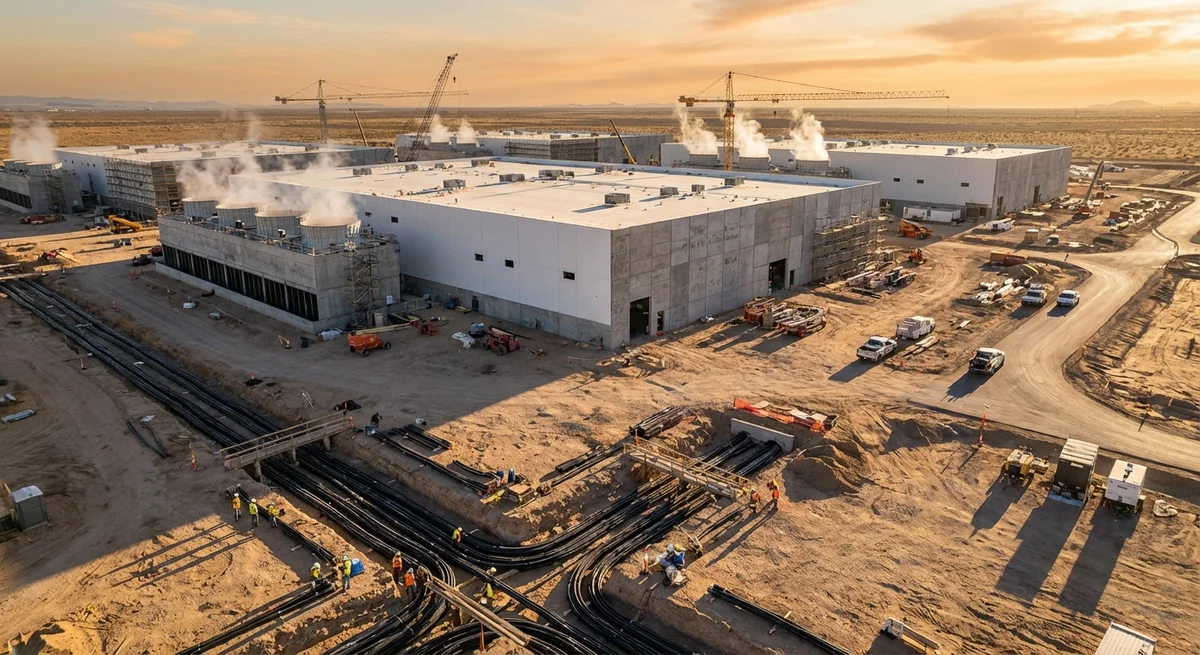
When people talk about artificial intelligence, attention usually fixes on new models, impressive demos and philosophical debates about humanity's future. But behind the scenes, an equally dramatic story is unfolding: one of concrete, cables, cooling systems and server racks. The planet's largest technology corporations have entered an infrastructure race whose scale has no precedent in the industry's history.
Meta, Microsoft, Google, Oracle and OpenAI have each announced multibillion-dollar projects to build data centers and expand computing capacity. Announced investments add up to hundreds of billions of dollars. Meta, for example, announced in early 2025 plans to spend tens of billions on infrastructure in a single year.
Microsoft, working through its partnership with OpenAI and its own Azure cloud services, is simultaneously building out a network of giant computing campuses worldwide. Oracle, which few people associated with the cutting edge of AI just a few years ago, has unexpectedly become one of the key players thanks to aggressive data center construction and strategic contracts. Google, for its part, is betting not only on standard GPU clusters but also on its own TPU chips, building a vertically integrated infrastructure.
To grasp the scale of what is happening, it helps to look back. Earlier waves of technology investment, the dot-com boom and the cloud build-out of the 2010s, look modest next to today's figures. The difference is not only quantitative but qualitative. Training and running modern AI models takes orders of magnitude more computing resources than any previous task in the history of computing. Each new generation of models consumes several times more energy and capacity than the last. That creates an insatiable demand for physical infrastructure, which companies are trying to meet ahead of their rivals.
Energy is a chapter of its own. Next-generation data centers consume electricity in volumes comparable to small cities. This has already strained power grids in several US states and European countries. Companies are being forced to sign long-term power supply contracts, invest in renewables and even look at nuclear power. Microsoft signed an agreement with the operator of the Three Mile Island nuclear plant, and Google is exploring small modular reactors. Energy has gone from a technical detail to a strategic factor that may determine who wins the race.
For Russian observers, the situation carries a double meaning. On one hand, the concentration of computing power in the hands of a few Western corporations widens the technological gap. Countries and companies without access to advanced GPUs and infrastructure risk becoming consumers of other people's AI services rather than creators of their own. On the other hand, the sheer scale of the investment raises the obvious question of whether it will pay off. Some analysts are already drawing parallels with the dot-com bubble, warning that current demand for AI services may not justify the hundreds of billions buried in concrete and silicon.
Still, there is a fundamental difference from the late 1990s. Back then, infrastructure was built for demand that did not yet exist. Today, the largest cloud providers report that demand for AI computing capacity already exceeds supply. Waiting lists for GPU cluster rentals have stretched to months. Companies that manage to build infrastructure first will gain more than a competitive edge: they will define the architecture of the entire AI economy for the next decade.
Ultimately, the current infrastructure race is not simply a contest of wallets. It is a fundamental bet that artificial intelligence will become the foundation of the next economic order, just as electricity became the foundation of the industrial era. If the bet pays off, those pouring concrete and laying fiber today will own the critical infrastructure of the future. If not, the world will be left with the most expensive monuments to technological optimism in history. Judging by the determination with which the planet's largest corporations are acting, they have picked their side of this wager.
*Meta is designated an extremist organization and banned in Russia.
- Nov 2, 2026Meta's Muse assistant keeps dossiers on loved ones and gets root on Ubuntu by default
- Nov 1, 2026Local models lose to Opus and Codex: 0.21 on a MacBook versus 1.00 for Codex
- Nov 1, 2026Kimi scores 96.2% on a 1C database analytics test and emerges as a fallback if Claude access is blocked
- Nov 1, 2026OpenAI Rewrites GPT Behavior Rules: Five Values and a Chain of Command
Ship AI Faster with Founders, Engineers & Weekly Architecture Reviews
Inside Vibe Club (hamidun.com/club) — weekly live masterminds with Zhemal Khamidun, Tech Radar, full LMS access, and 370+ production Claude Code skills.
The AI world, distilled — once a week
Seven stories that actually mattered, hand-picked. No noise, no reposts, no press releases.
Done! Check your inbox for a confirmation.