ASML Is Ready to Ship Next-Generation Lithography Machines for AI Chips in Volume
ASML, the world's only maker of EUV lithography equipment, has confirmed that its High-NA EUV systems are ready for volume production. Each machine costs more than $350 million and can print chips with record transistor density, which the next generation of AI accelerators will depend on. The technology opens the way to 2 nm process nodes and below, which will directly shape how powerful AI models become in the coming years. The race for the new chips has officially begun.
AI-processed from AI News; edited by Hamidun News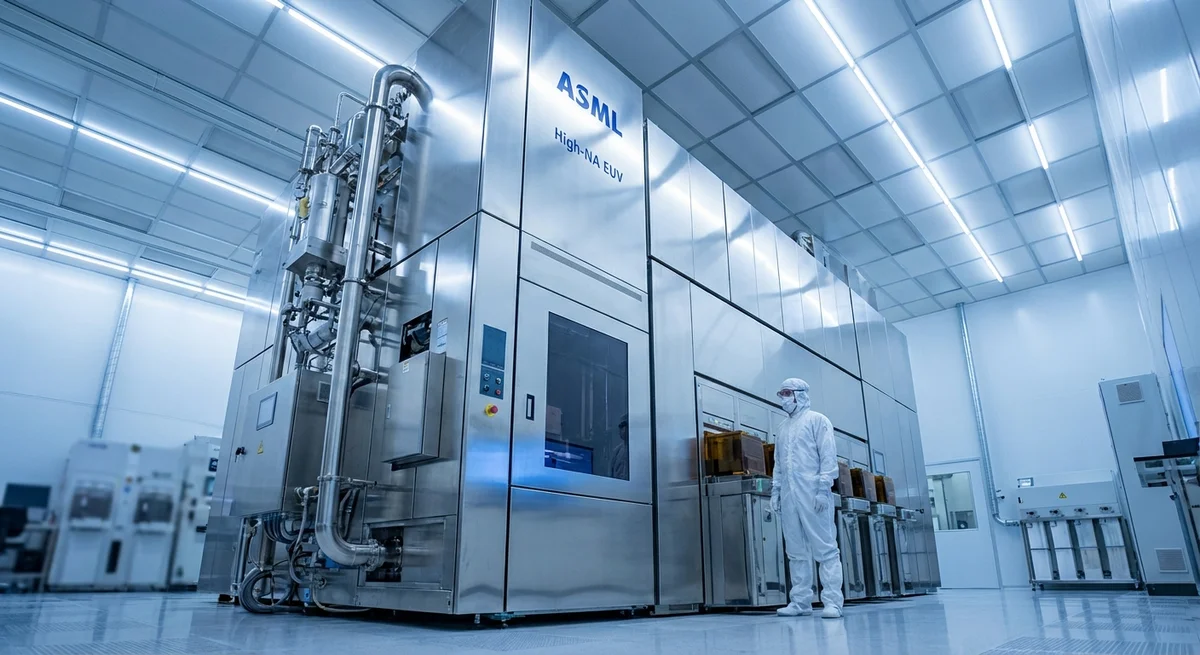
The machine that will shape artificial intelligence for the next decade has just been declared ready for volume production. The Dutch company ASML, which holds an absolute global monopoly on commercial extreme ultraviolet lithography equipment, has confirmed that its High-NA EUV systems have crossed the threshold from experimental prototypes to full-fledged industrial tools. For the whole semiconductor industry, and by extension for AI, the news is comparable to discovering a new oil field in the middle of an energy crisis.
To grasp the scale, it helps to go back to basics. Every modern chip, from smartphone processors to the giant AI accelerators from NVIDIA and AMD, is made through lithography: a process in which light "draws" microscopic circuits onto silicon wafers. The shorter the wavelength of that light, the finer the features and the more transistors fit on a single die.
ASML's standard EUV systems, which operate at a 13.5-nanometer wavelength, have already become indispensable for producing chips on 7, 5 and 3 nm process nodes. But physics is unforgiving: shrinking features further requires optics with a higher numerical aperture.
That is exactly what High-NA delivers. The numerical aperture rises from 0.33 to 0.
55, which makes it possible to form structures smaller than two nanometers.
Each of these machines is an engineering marvel weighing about 150 tonnes and costing, by various estimates, between $350 million and $400 million. Moving a single unit takes several dozen trucks. ASML shipped the first High-NA EUV units to leading chipmakers, Intel, TSMC and Samsung, back in 2024–2025, but until now they were used on research and pilot lines. An announcement of readiness for mass production means something fundamentally different: the technology has passed tests for stability, reproducibility and economic viability. Fabs can begin integrating these tools into their production chains not as an experiment, but as a foundation.
For the AI industry, the news has a direct and immediate impact. Today's large language models and multimodal systems are already running into the physical limits of existing chips. Training models on the scale of GPT-5 or Gemini Ultra requires tens of thousands of accelerators drawing megawatts of power. The move to 2 nm process nodes and below, made possible by High-NA EUV, promises a substantial gain in transistor density, and therefore more compute at lower power consumption per unit of die area. Put simply, the next generation of AI chips will be able to do more while using less, and ASML's lithography machines will be the tool that makes it happen.
The geopolitical context adds further weight. ASML remains the only company on the planet able to build this kind of equipment. The Netherlands, under pressure from the US, has already restricted exports of advanced lithography systems to China. The readiness of High-NA EUV for mass production widens the technological gap between countries with access to these machines and those without it. For Beijing, which is investing heavily in its own semiconductor industry, this means the distance to be covered is not shrinking but growing. Control over lithography effectively becomes control over the future of the AI industry.
The economics matter too. With a single tool priced comparably to the budget of a small unicorn startup, only the largest players will be able to afford High-NA EUV. That further entrenches the oligopoly in advanced chipmaking: TSMC, Samsung and Intel are, in essence, the full list of companies that will use this technology in their fabs for the foreseeable future. For AI developers, this means continued dependence on a narrow circle of silicon suppliers, which may affect the cost and availability of compute.
ASML's announcement is not just a technical milestone. It is the starting signal for a new stage of the semiconductor race, whose results will determine what AI models look like in three to five years. While some companies compete on neural network architectures and training data volumes, the foundation of all that progress is being laid in the clean rooms of Veldhoven in the Netherlands, the town where the most complex machines ever built by humankind are assembled. The clock on the next technological leap has started counting down.
- Nov 2, 2026Bun creator uses Claude Code to port 750K lines from Zig to Rust in 11 days
- Nov 2, 2026The Verge reviewer builds a $50 Meta Muse Charm alternative with Claude Code
- Nov 1, 202616 models tested on 7 search tools: Exa averaged 10.5 out of 14, SearXNG about 3
- Nov 1, 2026Google's StreamVibe video agent beats other models by 10.7% on response timing and quality
Ship AI Faster with Founders, Engineers & Weekly Architecture Reviews
Inside Vibe Club (hamidun.com/club) — weekly live masterminds with Zhemal Khamidun, Tech Radar, full LMS access, and 370+ production Claude Code skills.
The AI world, distilled — once a week
Seven stories that actually mattered, hand-picked. No noise, no reposts, no press releases.
Done! Check your inbox for a confirmation.