DeepSeek teams up with Tsinghua and Peking University to improve AI agent reasoning
DeepSeek has released a new paper written with Tsinghua University and Peking University. The study looks at how to optimize the reasoning process in large language models built for agentic tasks. The collaboration pairs one of China's most visible AI labs with two of the country's top technical universities. It continues a run of DeepSeek publications that have drawn close attention from the global AI community in recent months. Details of the architectural choices and benchmark results are expected in the full version of the paper.
AI-processed from Jiqizhixin (机器之心); edited by Hamidun News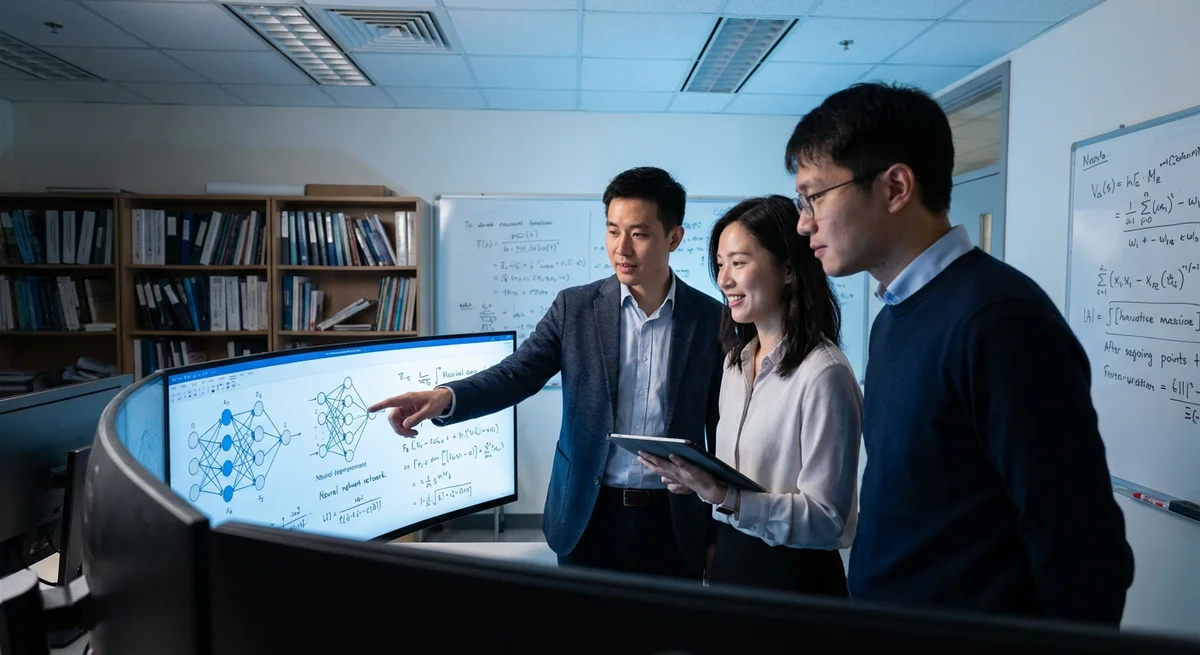
DeepSeek keeps surprising the global AI community. The Chinese lab has published a new paper together with Tsinghua University and Peking University, the country's two flagship technical universities. The study tackles one of the most pressing problems in modern machine learning: how to make large language models reason more effectively when they act not as passive conversation partners but as autonomous agents able to plan and carry out multi-step tasks.
Context helps explain why this matters. Over the past twelve months, DeepSeek has steadily built a reputation as a research organization that can challenge far more resource-rich Western labs. Its R1 series drew attention for its approach to chains of reasoning, and each new paper from the team promptly reached the top of academic aggregators and became a talking point in leading AI communities. Now, by joining forces with Tsinghua and Peking University, DeepSeek is betting on synergy between commercial development and academic expertise, a combination that has historically produced strong results in fundamental research.
The topic itself, optimizing reasoning in agentic models, is no accident. Standard language models trained to answer questions in a dialogue setting run into fundamental limits once they are built into agentic systems. An agent does not simply generate an answer: it has to decompose a task, pick a suitable tool, perform an action, interpret the result and decide what to do next. Each of these steps requires stable, consistent reasoning, and this is where current LLMs often fail, lose context or accumulate errors over long chains of actions. Dozens of labs around the world are trying to solve the problem, and every new approach has practical value well beyond academic benchmarks.
The details of the architectural choices and the concrete scores on standard tests are still awaiting publication in the full version of the paper, but the collaboration itself says a lot. Tsinghua University has some of the strongest research groups in deep learning and the theoretical foundations of neural networks, while Peking University is traditionally strong in optimization and mathematical methods. DeepSeek, for its part, brings infrastructure for large-scale training and experience with production systems. An alliance like this lets the team not only propose a new method but also test whether it works on real-scale tasks.
The research matters for the industry in several ways. First, the quality of reasoning in agentic tasks directly determines how reliably AI agents can be deployed in enterprise scenarios, from automating code development to managing complex business processes. Second, publications of this caliber from Chinese institutions increase competitive pressure on OpenAI, Google DeepMind and Anthropic, pushing them to speed up their own research in adjacent areas. Finally, the open academic format means independent teams around the world can adapt and reproduce the methods in this work, which accelerates progress across the whole field.
Still, don't expect the results to show up in commercial products right away. The road from an academic paper to a stable production system is long and rough. Benchmarks record improvements under controlled conditions, while real agentic scenarios are full of unpredictable edge cases. Even so, work like this sets the direction: it spells out which properties the next generation of agentic models should have and which tools can measure them.
DeepSeek keeps moving along its own trajectory, methodically, publicly and with a clear eye on long-term influence. A paper co-authored with Tsinghua and Peking University is not just an academic publication but a signal that China's AI ecosystem can merge university science and industrial resources into a single research stream. The full version of the paper will show how far this collaboration has come, and what it can offer developers who are already building the next generation of agentic systems.
- Nov 2, 2026DeepSeek open-sources Super-agent prototype: p95 task completion time of 15.7 minutes vs. 29.5
- Nov 1, 202616 models tested on 7 search tools: Exa averaged 10.5 out of 14, SearXNG about 3
- Nov 1, 2026MoneyGate safety layer blocked all 42 fraudulent requests to local AI models
- Oct 31, 2026DeepSeek-V4.1-Flash cuts HBM KV cache to 890 bytes per token, down from 3514
Test Frontier LLMs & Autonomous Agents in One Workspace
Run Claude Opus 5.5, GPT-6, Gemini 3.1, and DeepSeek side-by-side in Nomad AI (nomadnet.ai) — unified model routing, deep research, and multimodal workflows under one subscription.
The AI world, distilled — once a week
Seven stories that actually mattered, hand-picked. No noise, no reposts, no press releases.
Done! Check your inbox for a confirmation.