Nvidia reports Q4 earnings: key takeaways for the AI market
Nvidia has published its fiscal fourth-quarter results, and Wall Street is scrutinizing every figure. Matt Bryson, an analyst at Wedbush Securities, notes that the company remains the barometer for the entire AI industry. Nvidia's guidance for the coming quarters shows how durable demand is for accelerators used to train and run AI models. Investors are weighing whether exponential growth will hold or the market is nearing saturation.
AI-processed from Bloomberg Tech; edited by Hamidun News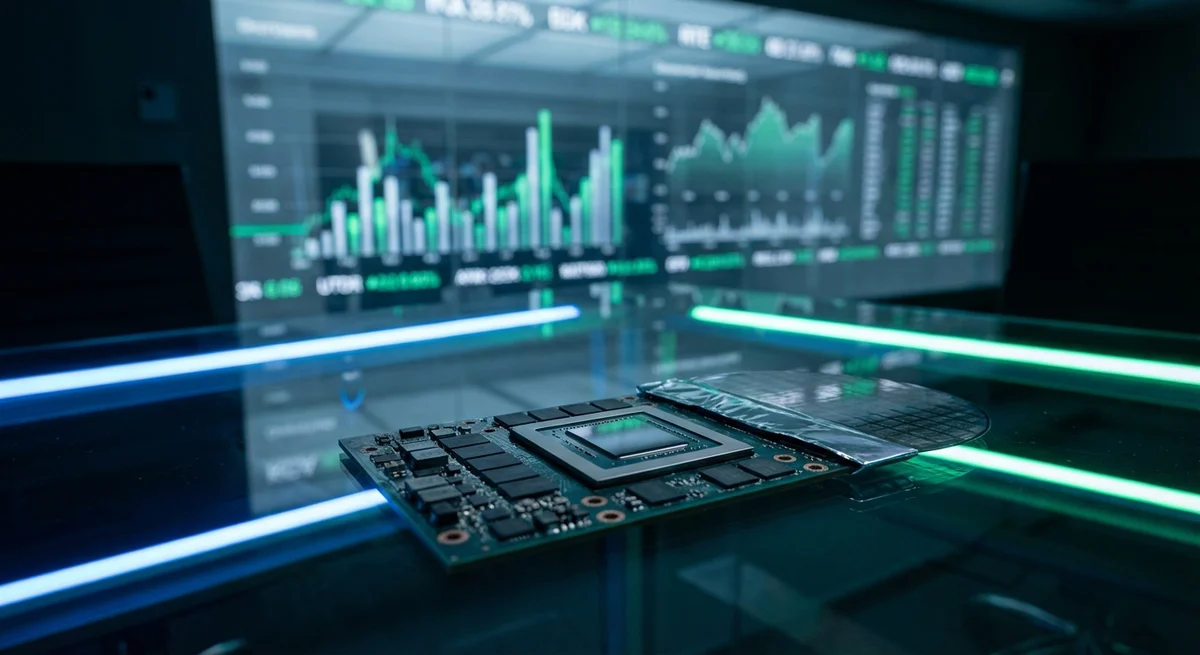
Every Nvidia quarterly report has long been an event watched not only by Wall Street but by the entire tech industry. When the company whose chips underpin the AI revolution publishes its financial results, the market holds its breath, and this time was no exception. The fiscal fourth-quarter results and the outlook once again drew the attention of analysts, investors and technology leaders worldwide.
Matt Bryson, managing director of hardware research at Wedbush Securities, was among the first to comment on Nvidia's results, speaking on Bloomberg. His assessment boils down to this: Jensen Huang's company remains the main indicator of the health of the entire AI infrastructure sector. The quarter's figures reflect more than one corporation's success. They show how intensively the world's largest tech companies keep investing in computing capacity to train and deploy AI models.
To grasp the scale of what is happening, it helps to recall the context. Over the past two years, Nvidia has posted unprecedented revenue growth, driven by explosive demand for A100 and H100 GPUs and then for the newest Blackwell-architecture accelerators. The hyperscalers (Microsoft, Google, Amazon, Meta*) are putting tens of billions of dollars into building data centers, and a significant share of those budgets goes to Nvidia products. The question that torments analysts every quarter has not changed: how long can this capital spending cycle last, and is the market approaching overheating?
The fourth quarter gave a mixed answer. On one hand, Nvidia's revenue keeps growing, confirming that demand for AI accelerators is far from saturated. Companies are not just buying chips for experiments; they are building large-scale infrastructure for products that already generate revenue. Inference, meaning running trained models in production, is becoming an increasingly important demand driver alongside training new models. This is an important structural shift: where skeptics could once argue that companies were simply stockpiling GPUs, it is now clear that the computing capacity is actively used in real services.
On the other hand, Nvidia's guidance for the coming quarters makes analysts think about the pace of growth. The market is used to the company beating expectations by a wide margin every time, and any slowdown in that momentum is taken badly. Wedbush's Bryson stresses that investors need to separate absolute figures from relative growth rates. Even if quarter-over-quarter percentage growth slows, it does so against an enormously high base, and in absolute terms Nvidia keeps adding revenue at a pace that seemed impossible for a semiconductor company just a few years ago.
The competitive landscape deserves separate attention. AMD continues to gain share in AI accelerators with its Instinct line, and Nvidia's largest customers are actively developing alternatives: Google with TPUs, Amazon with Trainium and Microsoft with its own Maia chips. Even so, the CUDA ecosystem, which Nvidia has built for more than fifteen years, remains a formidable competitive advantage. Moving developers to alternative platforms takes significant effort, and so far no competitor has offered a software ecosystem of comparable maturity.
For the Russian technology community, Nvidia's results carry particular weight. Sanctions restricting the supply of high-performance GPUs to Russia remain in force, making access to advanced computing capacity one of the key challenges for domestic AI developers. Each new leg of Nvidia's growth is a reminder of the scale of infrastructure investment needed to compete globally in artificial intelligence.
The bottom line is simple but important: Nvidia remains the company through which the market judges the future of the entire AI industry. The fourth quarter confirmed that the AI investment cycle is far from over, but it also showed that the era of unrestrained growth is gradually giving way to a more mature phase, in which the market demands not just impressive numbers but proof of sustainability and return on investment. The coming quarters will show whether Nvidia can keep its status as the indispensable supplier of "shovels" in the AI gold rush, or whether competitors will finally start taking significant chunks out of its dominant market share.
*Meta is designated an extremist organization and banned in Russia.
- Nov 2, 2026NVIDIA releases Nemotron 3.5 Bolt E4B: 4 GB and 133 tokens per second on an RTX 5070
- Nov 2, 2026Cosmos generated training video for drones: detector mAP@50–95 up 10.3%
- Nov 2, 2026Anthropic needs to grow revenue 32% a year to cover $850 billion in contracts
- Nov 2, 2026TensorFold 1.2.0 boosts Qwen3.8-27B throughput on M3 Ultra by 44.2% at 16 streams
Ship AI Faster with Founders, Engineers & Weekly Architecture Reviews
Inside Vibe Club (hamidun.com/club) — weekly live masterminds with Zhemal Khamidun, Tech Radar, full LMS access, and 370+ production Claude Code skills.
The AI world, distilled — once a week
Seven stories that actually mattered, hand-picked. No noise, no reposts, no press releases.
Done! Check your inbox for a confirmation.