Gemini can now call you a ride and order food on your phone
Google has taken a major step toward turning Gemini into a full-fledged mobile agent. Starting with the Samsung Galaxy S26, the assistant can complete tasks in third-party apps on its own: booking rides through Uber, ordering food on DoorDash, and automating other routine actions. The company demonstrated the feature live. In practice, this marks a shift from a voice assistant that answers questions to an agent that acts on your behalf. For now, the integration is limited to a handful of popular apps, but the direction is clear.
AI-processed from Wired; edited by Hamidun News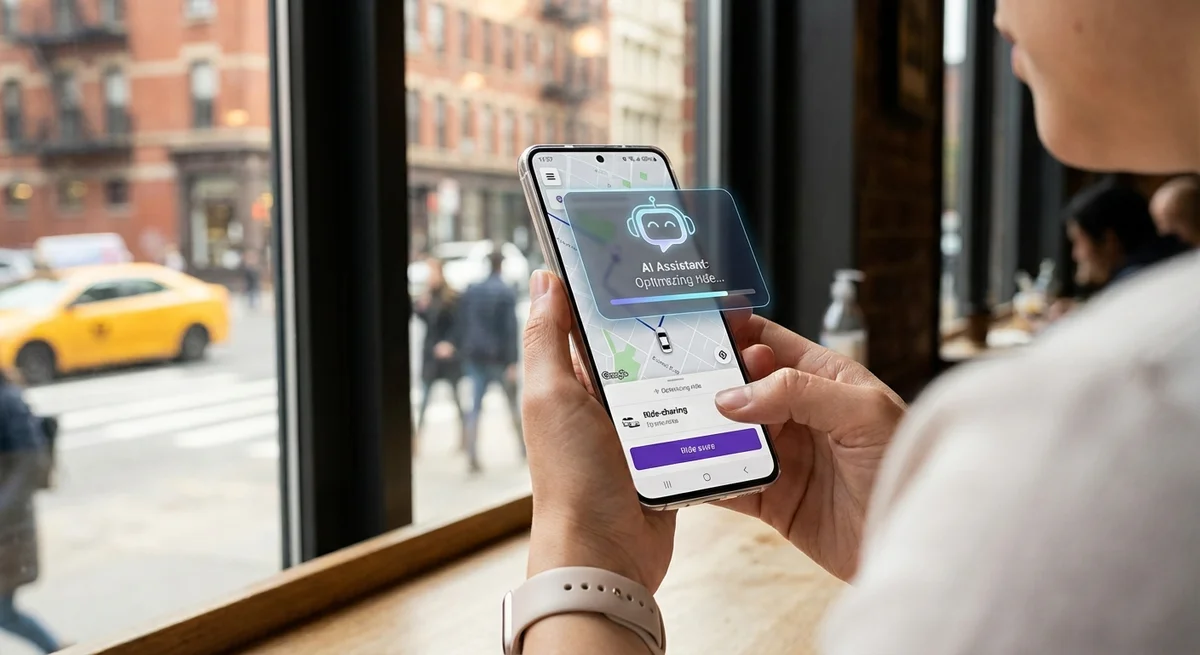
For years, voice assistants promised a future where you'd speak a command and your phone would handle the rest. In practice, that future amounted to setting timers and checking the weather. Google now appears ready to close the gap between promise and reality. The company announced that Gemini, its flagship AI assistant, can now carry out actions in third-party mobile apps on its own. It can book an Uber, order food through DoorDash, or complete a purchase, all without the user touching the screen once. The Samsung Galaxy S26 is the first device to support the feature.
To grasp the scale of this announcement, consider the context. For the past year and a half, the industry has been obsessed with "AI agents": systems that don't just generate text or answer questions but take actions in the real world on a user's behalf. OpenAI is experimenting with Operator, Anthropic is testing Computer Use for Claude, and Apple is expanding Siri's capabilities through Apple Intelligence. But Google holds a unique position. It controls Android, an operating system that runs on billions of devices, so it can build agentic capabilities into the platform itself rather than bolting them on top.
On the technical side, Gemini combines several approaches. The assistant "sees" app interfaces through dedicated API bridges and Android's accessibility system, understands how screens are structured, and navigates them the way a person would: tapping buttons, filling in fields, confirming orders. In a live demo shown to Wired reporters, the process looked impressively smooth. The user said something like "get me an Uber to the airport," and Gemini opened the app, picked the route and ride type, and took the order all the way to the confirmation step. The final confirmation, tapping the payment button, still falls to the human for now, which looks like a sensible safety measure for a first release.
Choosing the Samsung Galaxy S26 as the launch device was no accident. Google and Samsung have been deepening their partnership for several years: Galaxy AI, joint work on generative features, and privileged access to the newest Android capabilities. For Samsung, this is a competitive edge over other Android makers. For Google, it's a chance to test agentic features on a premium audience that is highly likely to use exactly the apps Gemini integrates with. The feature will likely reach other flagships within a few months, and then a wider range of devices.
But the key question isn't technical; it's about the ecosystem. To be genuinely useful, an agent needs access to dozens or hundreds of apps, and those apps' developers have to be ready for this kind of interaction. Uber and DoorDash are showcase partners, demo cases.
Real value will arrive when Gemini can work with banking apps, messengers, booking services, and marketplaces. That raises a delicate balance of interests: for years, app developers have designed their interfaces to maximize the time users spend in them, the ads they see, and the impulse purchases they make. An AI agent that skips all those layers in seconds threatens their business models.
Google will either have to strike deals with every major service or build a developer platform so attractive that developers want to integrate on their own.
There's also the question of trust. Letting AI spend your money is a fundamentally different level of interaction than asking it to write an email or look something up. A mistake in generated text costs a couple of seconds. A mistake when booking a ride or paying for dinner costs real money. Judging by the demo, Google understands this, hence the requirement to confirm transactions manually. But as users get used to agents, pressure toward full automation will grow.
This announcement marks an important shift in mobile technology. The smartphone is ceasing to be a device you operate and is starting to become a device that handles tasks for you. Google has taken the first public step in this direction in the mass market. Now all eyes are on Apple and its WWDC: can Siri answer with something comparable, or will the gap between the two ecosystems grow even wider? One thing is already clear: the era of AI assistants that only talk is coming to an end. The era of assistants that act is beginning.
- Nov 1, 2026Google taught its StreamVibe video agent to decide when to step in on its own: +10.7%
- Nov 1, 2026OpenAI Rewrites GPT Behavior Rules: Five Values and a Chain of Command
- Nov 1, 2026Voice bots built on LLMs turn to Jev, a fast classifier, for decisions in 200–500 ms
- Nov 1, 2026Google admits AI Mode cuts search revenue, shares fall 15%
Delegate Deep Research, Coding & Multi-Step Workflows to Nomad Agent
Deploy autonomous task execution with Nomad Agent (agent.nomadnet.ai) — automated web research, data synthesis, code generation, and MCP tool orchestration.
The AI world, distilled — once a week
Seven stories that actually mattered, hand-picked. No noise, no reposts, no press releases.
Done! Check your inbox for a confirmation.