Foreign Investors Pour Into Taiwan Stocks at Record Pace on AI Boom
Global investment funds carried out their largest single-day purchase of Taiwanese stocks in two decades. The main bet is on chipmakers, which remain the key beneficiaries of the AI boom. The signal stands out against growing fears of disruption in the tech sector. Taiwan, home to TSMC and other semiconductor giants, is once again confirming its status as the epicenter of the global AI economy. Investors are making a clear choice: AI infrastructure is a long-term bet, not a speculative bubble.
AI-processed from Bloomberg Tech; edited by Hamidun News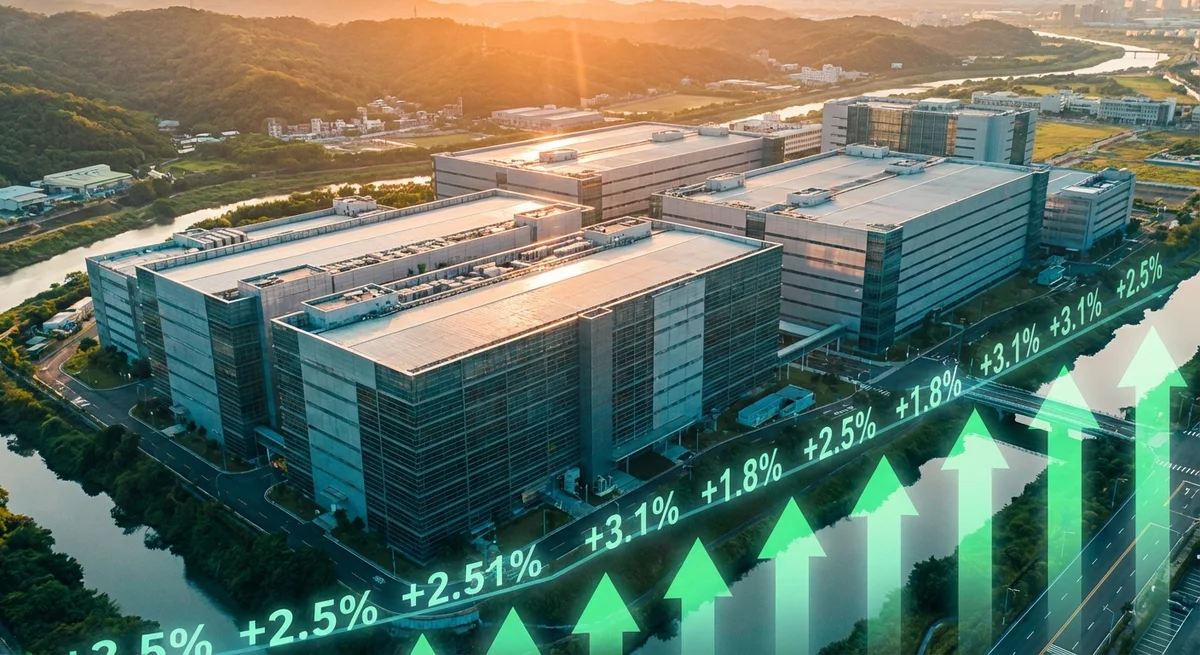
You have to go back twenty years to find a day when foreign investors bought Taiwanese stocks this greedily. According to Bloomberg, global funds staged their biggest single-day buying spree in two decades on the Taiwan Stock Exchange. The reason for the frenzy fits into two words: artificial intelligence.
Taiwan stopped being just an island in the Pacific with a complicated geopolitical position a long time ago. For the global tech industry, it is the holy land of semiconductors. It is home to TSMC, the company that manufactures the overwhelming majority of the world's most advanced chips. Its fabs produce processors for NVIDIA, Apple, AMD, Qualcomm, and dozens of other companies that shape modern technology. When investors buy Taiwanese stocks en masse, they are voting with their money for one simple idea: demand for AI chips will not just hold up, it will keep growing.
To grasp the scale of what is happening, consider the context. For the past several months, global markets have been on edge. Worries that the AI sector is overvalued, talk of a bubble, and slowdowns in a number of economies have all created a backdrop of uncertainty. Some analysts openly ask whether the AI boom is repeating the dot-com story. Against that backdrop, the decision by major funds not just to hold but to aggressively build up positions in Taiwanese semiconductor companies looks like a powerful vote of confidence.
The reasons for that confidence are tangible. Every new AI product — whether a language model, a video generation system, or an autonomous agent — needs compute. And not just any compute, but specialized chips made on the most advanced process nodes. TSMC remains the only company in the world capable of mass-producing chips at 3 nanometers and below. Its competitors, Samsung and Intel, still lag behind, and the gap is not narrowing. That means virtually any growth in the AI industry automatically turns into revenue growth for Taiwanese chipmakers.
But this is not only about TSMC. Taiwan's semiconductor ecosystem is much broader. Companies like MediaTek design mobile chips with built-in AI accelerators. ASE Technology and other players handle chip packaging, a critical step that keeps getting more complex as the industry moves to chiplet architectures and advanced 3D packaging. By investing in the Taiwanese market, funds are effectively buying a stake in the entire value chain of AI infrastructure.
The geopolitical dimension of this story deserves separate attention. Taiwan remains a potential flashpoint between the US and China. The fact that investors are willing to build up positions despite that risk says a lot. Either the market sees the likelihood of escalation as low, or — and this is the more interesting reading — the potential returns from the AI boom are so large that they outweigh even geopolitical fears. There is an old saying in investing: money goes where greed beats fear. Taiwan in February 2026 is a vivid illustration of that principle.
For the broader AI market, this record sends an important signal. Institutional investors are not retail traders buying stocks on a blogger's tip. These are funds with analyst teams that model scenarios years ahead. Their mass entry into Taiwanese stocks means the smart money still sees the AI boom as a fundamental trend, not a speculative one. Demand for compute infrastructure is growing faster than the industry can add capacity, and that imbalance will persist for a long time.
Still, it would be naive to ignore the risks. Concentrating critical infrastructure on a single island remains a vulnerability for the entire global tech economy. TSMC's new fabs in Arizona and Japan are meant to partly address the problem, but they will not reach full capacity until the end of the decade at the earliest. Until then, Taiwan will remain an irreplaceable link in the chain — and therefore a magnet for capital and the focus of close attention from everyone tracking the future of artificial intelligence.
- Oct 29, 2026Claude Code Edits Video From a Transcript: How the video-use Skill With 30 000 Stars Works
- Oct 29, 2026Stanford AI tool verifies part of Signal's code in half a day for under $500, versus five months of expert work
- Oct 29, 2026Liquid AI releases LFM3: six multimodal 2B models with a 256K context window
- Oct 29, 20268B iOS agent beats Gemini-3.5-Flash on UINavBench and matches Gemini-3.1-Pro
Ship AI Faster with Founders, Engineers & Weekly Architecture Reviews
Inside Vibe Club (hamidun.com/club) — weekly live masterminds with Zhemal Khamidun, Tech Radar, full LMS access, and 370+ production Claude Code skills.
The AI world, distilled — once a week
Seven stories that actually mattered, hand-picked. No noise, no reposts, no press releases.
Done! Check your inbox for a confirmation.