Unitree unveils new robot dog right after Spring Festival Gala appearance
Unitree Robotics, which had just appeared on China's biggest New Year TV show, the Spring Festival Gala, unveiled a new model of its signature robot dog almost immediately after the broadcast. The move looks like a deliberate marketing strategy: maximum media exposure ahead of an official product announcement. Unitree remains one of China's leading players in consumer and industrial robotics, and its quadruped platforms are in demand among both researchers and commercial customers.
AI-processed from Jiqizhixin (机器之心); edited by Hamidun News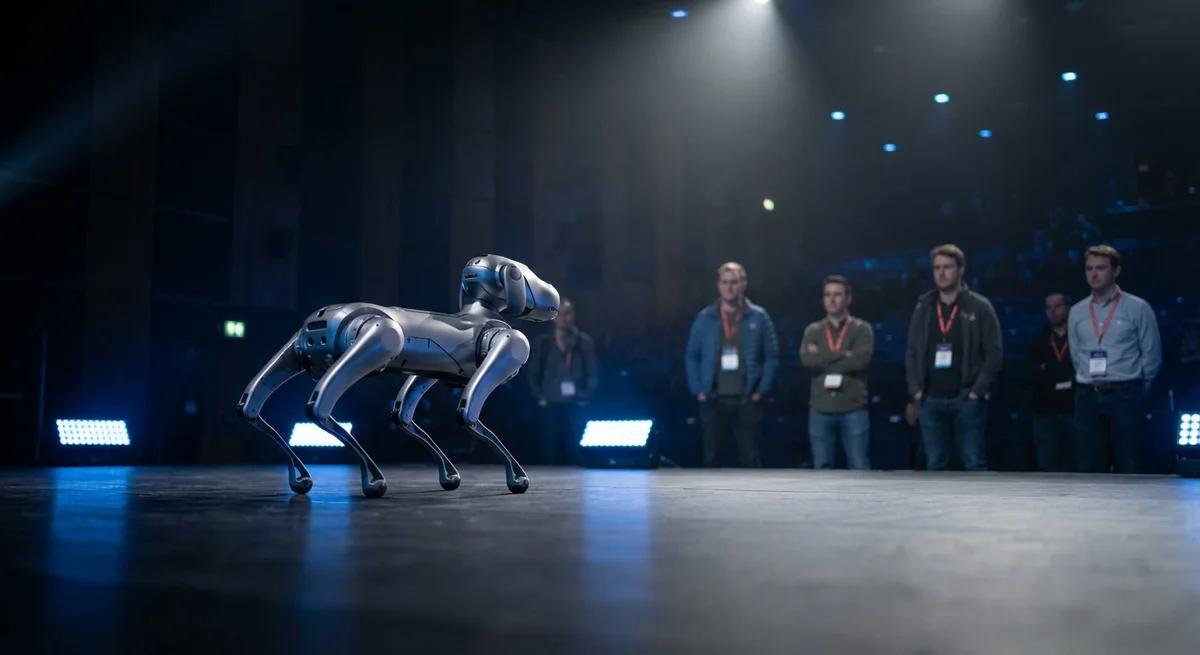
A billion viewers watched walking robots on the stage of China's biggest New Year show, and before the festive lights had dimmed, Unitree Robotics announced a new model of its robot dog. The timing is hardly a coincidence: the company played the media moment with a precision any marketer would envy.
The Spring Festival Gala, or CCTV Spring Festival Gala, is not just a TV program. It is a cultural phenomenon that draws hundreds of millions of families to their screens every year, across China and the Chinese diaspora. For a technology company, getting onto that stage is the equivalent of reaching the Super Bowl final and the Olympic opening ceremony at the same time. Unitree understood this and, by all appearances, prepared its announcement in advance: the robots' performance was not an end in itself but a prologue to a full product launch.
The Hangzhou-based company went from university startup to one of the most recognizable names in global robotics in a remarkably short time. Its quadruped platforms, the Go1, the Go2 and now the newest member of the family, combine a relatively affordable price with serious technical specifications. That has made them a de facto standard in academic labs doing research on autonomous systems. At the same time, Unitree is pushing aggressively into industrial and commercial use: perimeter security, facility inspection and factory logistics.
The new robot dog appeared publicly right after the broadcast, giving the audience no time to cool off from the spectacle of the New Year show. It is a classic example of what marketers call momentum: using a peak of public attention to lock in a product message. Viewers had just watched four-legged machines perform live on stage, the emotional response was primed, and a concrete offer followed immediately: here is the new version, here are the specs, here is the date. Psychologically, this works far more effectively than any traditional advertising campaign.
Technically, each new generation of Unitree platforms is above all an exercise in balancing three variables: dynamic stability, autonomy and cost. Quadruped robots are inherently harder to build than wheeled ones: they must continuously manage their center of mass, adapt to uneven terrain and recover from shoves. This is where a quiet but noticeable shift has taken place over the past two years, largely thanks to reinforcement learning methods that let robots acquire movement skills in simulation and then transfer them to the real world. Unitree uses this approach extensively, and each new platform generation shows clear progress in the smoothness and reliability of its gait.
For the industry as a whole, this announcement is one more sign that China is seriously intent on dominating the consumer and semi-professional robotics segment. A few years ago, Boston Dynamics was seen as the undisputed benchmark for quadruped systems. Today Chinese companies such as Unitree, Deep Robotics and Leju Robotics offer comparable capabilities at fundamentally different prices. That changes both the structure of demand and the geography of research: the robot dog is no longer an exotic toy for wealthy labs but an accessible tool.
Unitree's appearance on the Spring Festival Gala stage and its immediate new product announcement amount to more than a press release with a nice picture. It is a claim that robotics is entering mainstream culture: not as science fiction, but as everyday reality that deserves a place next to pop stars in prime time on national television. The next question competitors will ask themselves is when, and on what stage, their own machines will appear.
- Nov 2, 2026DeepSeek open-sources Super-agent prototype: p95 task completion time of 15.7 minutes vs. 29.5
- Nov 2, 2026Bun creator uses Claude Code to port 750K lines from Zig to Rust in 11 days
- Nov 2, 2026Microsoft releases 4B model Mage-VL-Cowork, which solves 66.0% of OSWorld-Verified tasks
- Nov 2, 2026Meta's Muse assistant keeps dossiers on loved ones and gets root on Ubuntu by default
Test Frontier LLMs & Autonomous Agents in One Workspace
Run Claude Opus 5.5, GPT-6, Gemini 3.1, and DeepSeek side-by-side in Nomad AI (nomadnet.ai) — unified model routing, deep research, and multimodal workflows under one subscription.
The AI world, distilled — once a week
Seven stories that actually mattered, hand-picked. No noise, no reposts, no press releases.
Done! Check your inbox for a confirmation.