BlackRock puts $250 million into Dutch AI chipmaker Axelera
Dutch company Axelera AI has closed a funding round of more than $250 million. Its investors include BlackRock, the world's largest asset manager. The startup designs energy-efficient semiconductors for running already-trained AI models, a workload known as inference. Investors find this segment increasingly attractive as the industry shifts its focus from training models to deploying them at scale. Axelera positions itself as a European alternative to the dominant NVIDIA.
AI-processed from Bloomberg Tech; edited by Hamidun News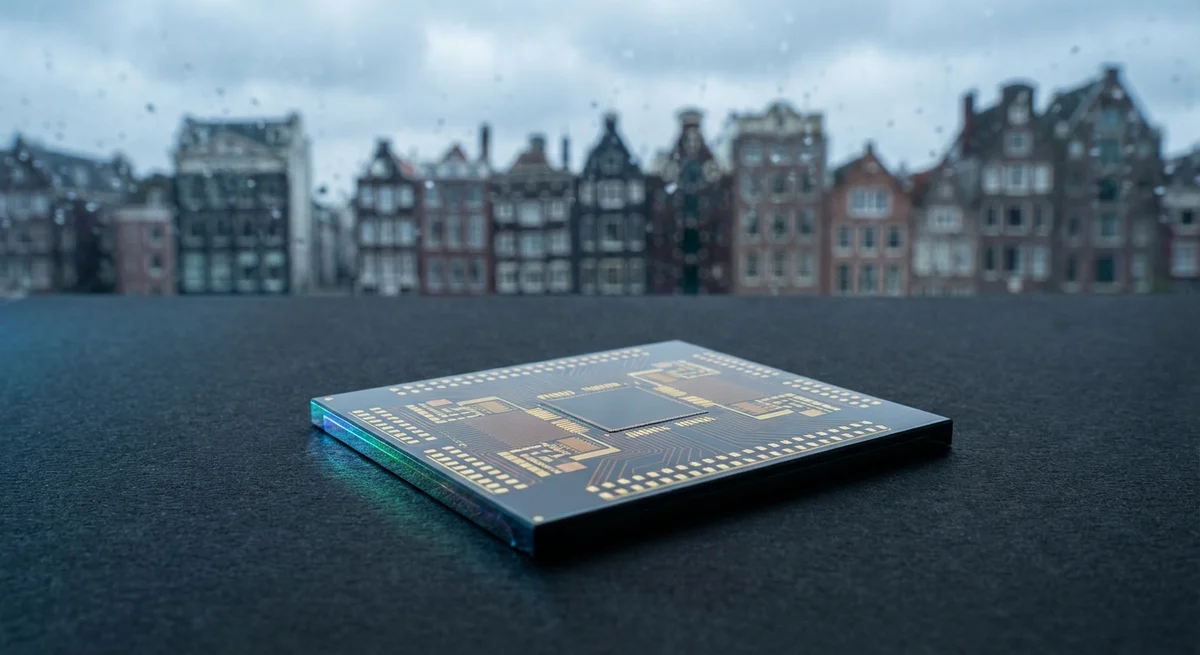
When the world's largest asset manager, with more than ten trillion dollars in assets, decides to back a semiconductor startup, it stops being just another venture round. It is a statement about the strategic direction of an entire industry. Dutch company Axelera AI has raised more than 250 million dollars in a new funding round with BlackRock participating, and that says far more about the AI chip market than it might seem at first glance.
Axelera AI is a relatively young company based in the Netherlands that specializes in energy-efficient processors for inference. Inference is the stage at which an already-trained AI model is put to work: answering user queries, analyzing images, controlling autonomous systems. If training a model is like a student preparing for an exam, inference is the exam itself, repeated billions of times a day. This is the stage that consumes a colossal amount of energy and computing resources. Axelera is betting that the process can be made radically cheaper and more efficient.
Until now, investors and the media have focused mainly on training chips: the NVIDIA GPUs that cost tens of thousands of dollars and are snapped up by data centers around the world. But as the industry moves from building foundation models to deploying them at scale, the economics of inference are moving to the forefront. By various estimates, inference already accounts for more of the total compute used for AI than training does, and the gap will only widen. Every ChatGPT query, every image generation, every call to an AI assistant is inference, and it has to be fast, cheap and energy-efficient.
This is the context in which BlackRock appears among Axelera's investors. An asset manager of this scale does not make venture bets for the sake of hype. In recent years, BlackRock has steadily built up its presence in AI-related infrastructure assets, from data centers to energy projects. An investment in an inference chipmaker fits that strategy: if you believe AI will become as basic an infrastructure as electricity, you need efficient "power plants" to run it.
The deal carries particular weight for Europe's technology sector. The Old World's semiconductor industry has traditionally been strong in chipmaking equipment. One need only think of the Dutch company ASML, without whose lithography machines no modern processor can be made. In designing AI chips themselves, however, Europe clearly lags American and Asian competitors. Axelera is one of the few European companies claiming a significant role in this race. Raising a quarter of a billion dollars from global investors strengthens its position and gives it resources to compete with players such as Groq, Cerebras and, of course, NVIDIA itself, which is also actively developing its own inference products.
Still, the road from raising capital to real market success is one of the longest and riskiest in the technology world. Developing a chip takes years, manufacturing requires partnerships with contract foundries such as TSMC, and persuading customers to switch from proven NVIDIA solutions to a new architecture has sunk more than one startup. Axelera must show that its energy-efficient approach delivers enough of an advantage in performance per cost to justify the risk of switching.
Nevertheless, the very fact that institutional investors of BlackRock's caliber are starting to fund alternative chip architectures points to a maturing market. The AI industry is outgrowing the era when an NVIDIA card was the only answer to any computing question. The future clearly belongs to a variety of specialized solutions, and companies like Axelera AI may end up at the center of this new ecosystem. The only question is whether 250 million dollars will be enough to turn ambition into silicon.
- Nov 2, 2026Meta's Muse assistant keeps dossiers on loved ones and gets root on Ubuntu by default
- Nov 1, 2026Local models lose to Opus and Codex: 0.21 on a MacBook versus 1.00 for Codex
- Nov 1, 2026Kimi scores 96.2% on a 1C database analytics test and emerges as a fallback if Claude access is blocked
- Nov 1, 2026OpenAI Rewrites GPT Behavior Rules: Five Values and a Chain of Command
Ship AI Faster with Founders, Engineers & Weekly Architecture Reviews
Inside Vibe Club (hamidun.com/club) — weekly live masterminds with Zhemal Khamidun, Tech Radar, full LMS access, and 370+ production Claude Code skills.
The AI world, distilled — once a week
Seven stories that actually mattered, hand-picked. No noise, no reposts, no press releases.
Done! Check your inbox for a confirmation.