Tariff Uncertainty and AI Anxiety Hammer the Tech Market
The tech sector is going through a rough patch. Uncertainty over trade tariffs and growing concern about the real return on AI investment have hit the shares of the biggest companies at the same time. The week promises to be especially tense: quarterly reports from Nvidia and Salesforce are due, and they could set the tone for the entire market. Bitcoin did not escape the anxious mood either, falling below $65,000 for the second time in February. Investors are reassessing their positions amid rising volatility.
AI-processed from Bloomberg Tech; edited by Hamidun News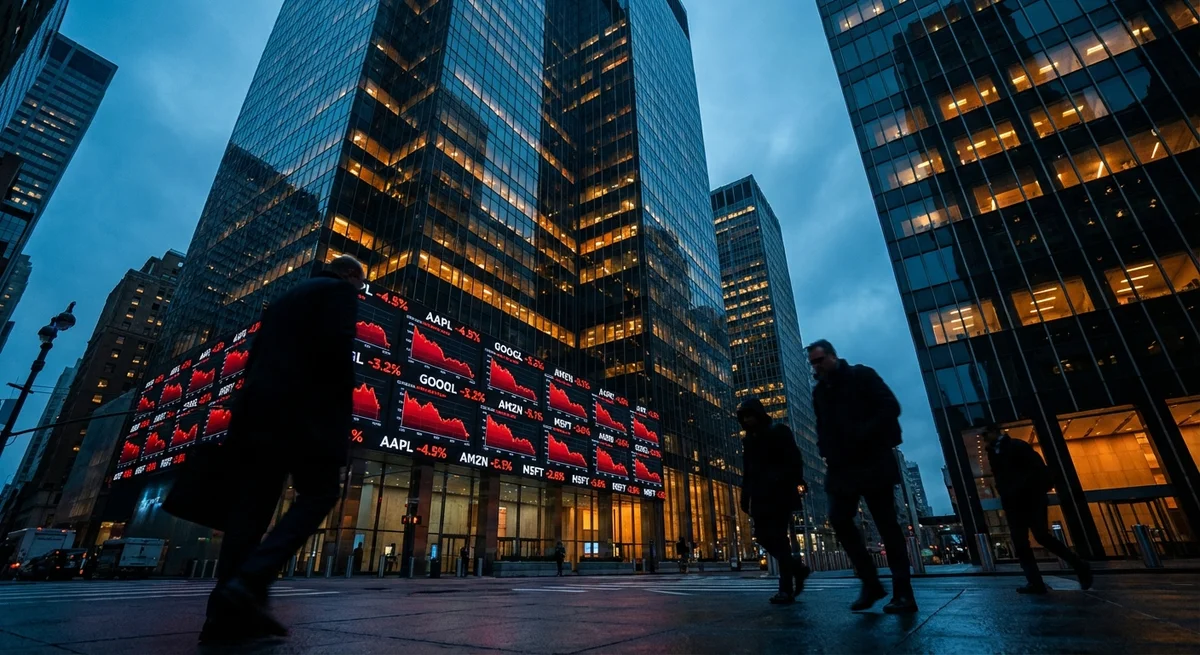
Monday, February 23, was another painful day for the tech sector. Two powerful forces, an unresolved trade tariff situation and mounting skepticism about the real return on gigantic investments in artificial intelligence, converged and sent the shares of the largest tech companies lower. After two years of a nonstop rally fueled by AI enthusiasm, the market is facing a situation in which both key narratives are working against it at once.
Tariff policy remains the main source of macroeconomic uncertainty for the tech sector. Companies whose supply chains are deeply integrated into global trade, from chipmakers to server hardware assemblers, cannot plan costs or forecast margins properly when the rules change with every new statement from Washington. Semiconductor companies proved especially vulnerable, since Asia remains their key manufacturing hub. Any tightening of the tariff regime hits their production costs directly and, as a result, their profitability.
But while tariffs are an external shock, the anxiety over AI is building inside the industry itself. After two years of an unprecedented investment boom, in which companies poured tens of billions of dollars into building data centers, buying GPUs and developing models, the market is starting to ask an uncomfortable question: where is the return on these investments? Enterprise adoption of AI is moving more slowly than expected. Many pilot projects never progressed to full-scale deployment. Monetization of generative AI beyond a handful of large platforms remains more a promise than a reality. This gap between capital spending and actual revenue is worrying investors more and more.
The week promises to be decisive. Quarterly reports are due from two companies that capture the current market mood almost perfectly. Nvidia, which has become the symbol of the AI boom and the main beneficiary of the race for computing power, needs to show that demand for its accelerators is still growing.
Any hint of slowing growth or a cautious outlook from management could trigger a large-scale selloff, not only in the company's own shares but across the whole sector. Salesforce, for its part, will show how successfully a major enterprise vendor is converting AI functionality into real revenue growth. Its results will indicate whether corporate customers are ready to pay a premium for AI tools, or whether the market overestimated how fast they would be adopted.
The cryptocurrency market, which in recent years has correlated ever more closely with sentiment in the tech sector, has also come under pressure. Bitcoin fell below $65,000, for the second time in February. That is especially notable given that only a few months ago the crypto community was uniformly optimistic. In this context, bitcoin's drop is less a story about crypto than an indicator of a general decline in risk appetite. When investors get nervous, the most speculative assets are the first to be hit.
It is important to understand the broader context. The tech sector has lived through a phenomenal rally, built largely on expectations of AI's transformative effect. The market capitalization of the "Magnificent Seven" has grown by trillions of dollars. But markets are cyclical, and a repricing phase was inevitable. The question was never whether a correction would come, but what would trigger it. Now we are seeing two triggers fire at once: geopolitical uncertainty has undermined confidence in macroeconomic stability, while growing skepticism about the pace of AI monetization has cast doubt on valuations that priced in years of flawless growth ahead.
For Russian observers, this situation carries several important signals. First, a slowdown in AI infrastructure investment in the West may affect the global availability of computing resources and, as a consequence, the cost of cloud services. Second, if the correction proves deep, it may lead to market consolidation: weaker AI startups, cut off from cheap capital, will be forced either to sell or to shut down. Third, tariff uncertainty may accelerate the regionalization of technology supply chains, which creates both risks and opportunities for local players.
The coming days will show whether the current decline is a healthy correction of an overheated market or the beginning of a deeper reassessment of expectations for the AI revolution. The Nvidia and Salesforce reports will give the market concrete figures in place of abstract fears. And those figures will determine whether optimism returns or gives way to a new, more sober reality.
- Nov 2, 2026TensorFold 1.2.0 boosts Qwen3.8-27B throughput on M3 Ultra by 44.2% at 16 streams
- Nov 1, 2026Local models lose to Opus and Codex: 0.21 on a MacBook versus 1.00 for Codex
- Nov 1, 2026Habr author fine-tunes YOLOv8l on dental X-rays and pushes mAP50 to 0.642
- Nov 1, 2026Voice bots built on LLMs turn to Jev, a fast classifier, for decisions in 200–500 ms
Ship AI Faster with Founders, Engineers & Weekly Architecture Reviews
Inside Vibe Club (hamidun.com/club) — weekly live masterminds with Zhemal Khamidun, Tech Radar, full LMS access, and 370+ production Claude Code skills.
The AI world, distilled — once a week
Seven stories that actually mattered, hand-picked. No noise, no reposts, no press releases.
Done! Check your inbox for a confirmation.