Particle now pulls the key moments out of podcasts for you
The AI news app Particle has launched a feature that automatically analyzes podcasts and pulls out their key segments. Short audio clips appear directly in the feed, next to topically related articles. Users no longer need to listen to hour-long episodes in full: the algorithm finds the most important parts on its own. It is another step toward multi-format news consumption, where text, audio and video merge into a single stream. Particle keeps pushing the boundaries of how AI can curate the information space.
AI-processed from TechCrunch; edited by Hamidun News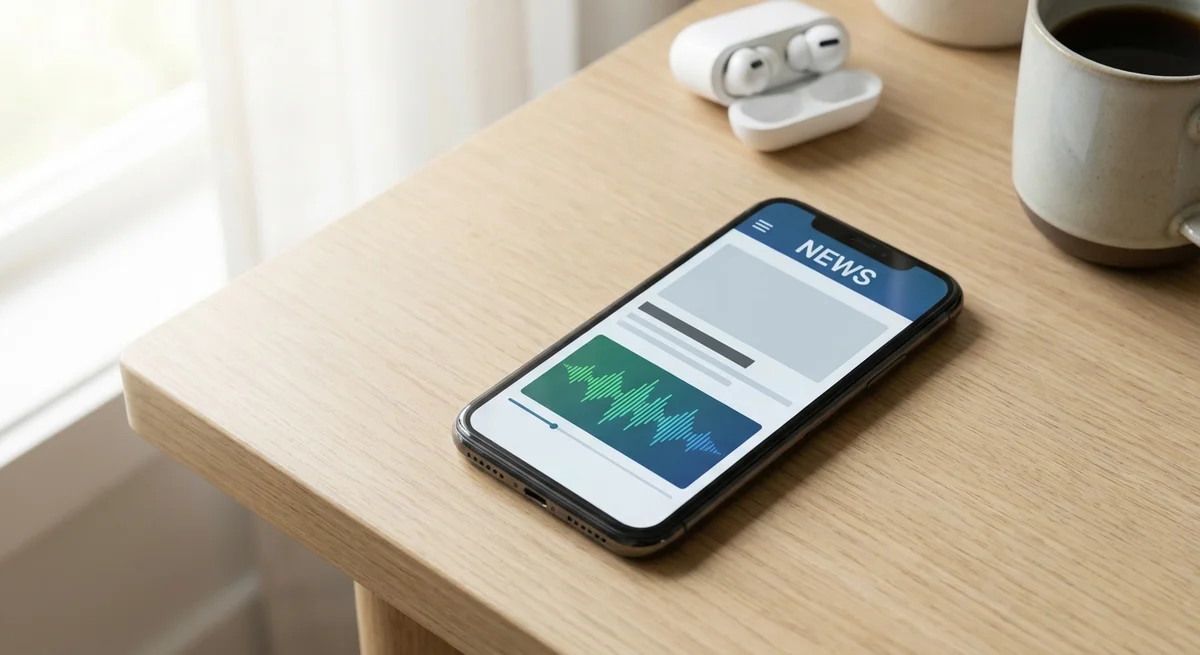
Podcasts have long been a major source of expert analysis, insider stories and in-depth conversations that don't fit into a news brief. The problem is that the average podcast runs from forty minutes to an hour and a half, and few people have that much free time. Particle, an app built on artificial intelligence, has taken a radical approach to the problem: it now listens to podcasts itself, finds the most significant moments and serves them to the user as short clips embedded directly in the news feed.
Particle is no newcomer to AI news aggregation. From the start, the app has bet on intelligent content curation: its algorithms analyze thousands of sources, group materials by topic, highlight key facts and build a personalized feed. Until now, though, it worked mostly with text sources: articles, news briefs, press releases. Adding podcasts is a qualitative leap, because working with audio requires an entirely different technology stack: speech recognition, an understanding of conversational context, and the ability to detect emotional and semantic peaks in a long dialogue.
Technically, the new feature works like this. Particle processes a podcast's audio stream, transcribes it and analyzes the content with language models. The algorithm determines which parts of the conversation carry the most significant information: a new fact, an unexpected expert opinion, an important statement. These segments are then tied to the relevant news stories in the user's feed. Say you are reading an article about a startup's new funding round: you can immediately listen to a thirty-second clip from a podcast in which the startup's founder explains his strategy. Text and audio stop existing in parallel universes and begin to complement each other.
This matters beyond being a product feature of one particular app. We are watching a new standard of information consumption take shape, one where the boundaries between formats blur. Until recently, text news, podcasts, videos and social media posts lived in isolated ecosystems. You read the news in one app, listened to podcasts in another and watched videos in a third. Particle is moving toward a model where all these formats merge into a single information stream, and AI acts as an editor that knows which format and which fragment will be useful at a given moment.
For the podcasting industry, this cuts both ways. On one hand, podcast creators get a new distribution channel: their content reaches an audience that would never have subscribed to the full episode. A short, vivid clip can attract a new listener. On the other hand, there is a risk of fragmentation. A podcast is a format built on long conversation, on the development of an idea, on context. A thirty-second excerpt torn out of that context can distort the meaning or, at the very least, thin it out. It is the same dilemma newspapers faced when aggregators began showing headlines without the full articles.
There is also a broader question about the role of AI in media. Every such product, whether Particle, Artifact (which, incidentally, has already shut down), Google Discover or Apple News, essentially decides for the user what matters and what does not. When an algorithm picks thirty seconds from an hour-long podcast, it makes an editorial call. And the quality of that call depends entirely on the quality of the model. Mistakes here are not merely annoying: they shape a distorted picture of the world. Particle, by all appearances, understands this and is betting on transparency: the user can always jump to the full podcast episode.
Ultimately, the Particle update is one more signal of where the news app market is heading. The future belongs not to text, audio or video on their own. It belongs to intelligent stitching of all formats into a single personalized stream, where AI does work that a person physically lacks the time for. The only question is how far we are ready to trust a machine as our personal editor, and how well it will handle the job.
- Nov 2, 2026Bun creator uses Claude Code to port 750K lines from Zig to Rust in 11 days
- Nov 2, 2026The Verge reviewer builds a $50 Meta Muse Charm alternative with Claude Code
- Nov 1, 202616 models tested on 7 search tools: Exa averaged 10.5 out of 14, SearXNG about 3
- Nov 1, 2026Google's StreamVibe video agent beats other models by 10.7% on response timing and quality
Test Frontier LLMs & Autonomous Agents in One Workspace
Run Claude Opus 5.5, GPT-6, Gemini 3.1, and DeepSeek side-by-side in Nomad AI (nomadnet.ai) — unified model routing, deep research, and multimodal workflows under one subscription.
The AI world, distilled — once a week
Seven stories that actually mattered, hand-picked. No noise, no reposts, no press releases.
Done! Check your inbox for a confirmation.