SK Hynix to ramp up AI memory chip output as data-center boom continues
SK Group Chairman Chey Tae-won has announced plans to significantly expand production of memory chips for AI. The move responds to explosive demand from global data-center infrastructure. SK Hynix, a key supplier of HBM memory for NVIDIA and AMD accelerators, wants to cement its lead in a market where every quarter brings new consumption records. The statement signals that the semiconductor industry is making a long-term bet on AI infrastructure as its main growth driver.
AI-processed from Bloomberg Tech; edited by Hamidun News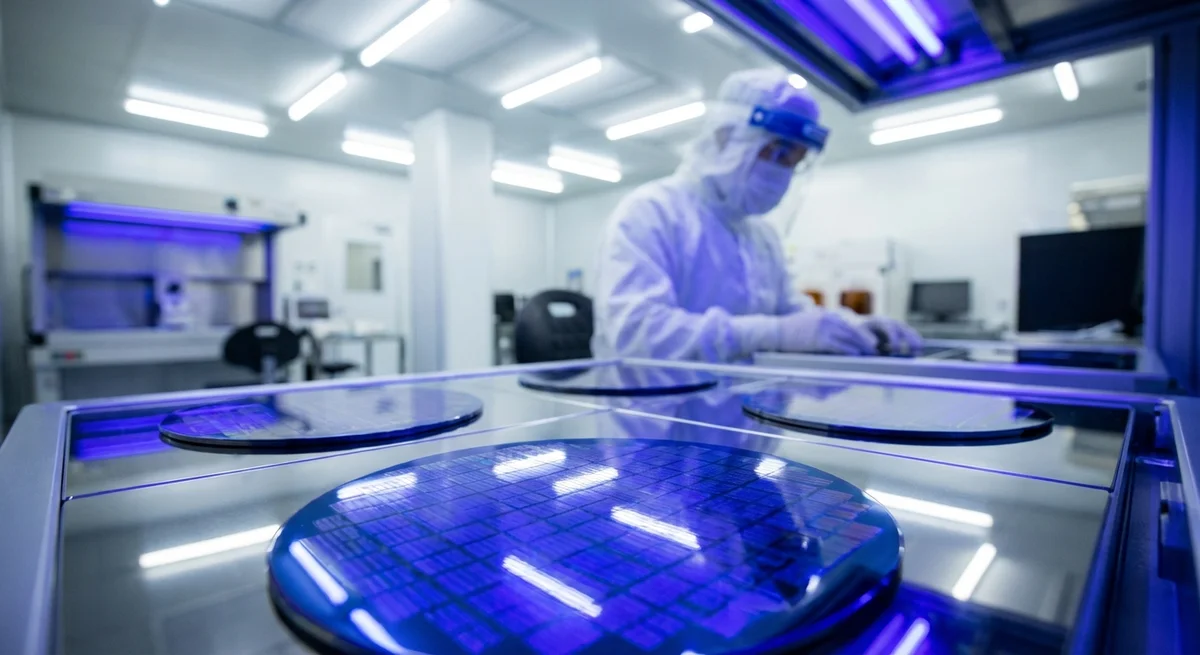
When the head of one of the world's largest semiconductor makers publicly commits to raising output, it is not just corporate rhetoric. It tells the market that demand has reached a level where running existing capacity at full tilt is no longer enough. That is what happened when SK Group Chairman Chey Tae-won announced plans for a major increase in production of memory chips for artificial intelligence.
SK Hynix, a subsidiary of SK Group, holds a unique position in the global AI hardware supply chain. It is the world's leading maker of HBM (High Bandwidth Memory), the component without which no modern AI accelerator works. HBM chips sit inside NVIDIA's H100, H200 and the latest Blackwell accelerators, and inside AMD Instinct products, and they largely determine the performance of the systems on which large language models are trained and run. Without HBM from SK Hynix, the global AI infrastructure as it stands today would simply be impossible.
The context of Chey Tae-won's statement cannot be understood without grasping the scale of the ongoing data-center construction boom. By various estimates, global investment in data-center infrastructure in 2025-2026 will exceed 300 billion dollars. Microsoft, Google, Amazon, Meta* and dozens of other companies are engaged in an unprecedented race for computing capacity. Each new data center means thousands of server racks, each filled with accelerators that need high-speed memory. Demand for HBM is growing exponentially, and until recently manufacturers barely kept up with orders.
This shortage has become one of the main brakes on how fast AI infrastructure can be deployed worldwide. NVIDIA has repeatedly pointed to shortages of components, including memory, as a factor limiting shipments of its accelerators. Samsung, the second major player in the HBM market, has run into technical difficulties producing the latest generations of memory, which has deepened the industry's dependence on SK Hynix. Under these conditions, the pledge to expand output is not charity but a strategic move that lets the company strengthen its position in a market with multibillion-dollar potential.
Technically, scaling up HBM production is no trivial task. Unlike ordinary RAM, HBM is a stack of several DRAM dies connected using TSV (Through-Silicon Via) technology, vertical interconnects through the silicon. Production requires not only advanced lithography but also extremely complex assembly and testing steps. Each new generation, HBM3, HBM3E and eventually HBM4, adds layers and packing density, which makes scaling harder still. Output cannot be raised at the push of a button: it takes new production lines, trained staff and well-tuned quality-control processes.
For the global AI market, the consequences of this decision could be quite significant. If SK Hynix does manage to raise volumes substantially, it could ease the accelerator shortage and lower the cost of computing for companies building AI services. More affordable infrastructure means a lower barrier to entry for startups, research labs and companies outside the "big five" tech giants. There is a flip side, though: expanding capacity requires enormous capital investment, and if demand slows, a scenario that seems unlikely for now but not impossible, the company risks facing overcapacity.
The geopolitical dimension also deserves attention. South Korea, along with Taiwan, remains one of the two key centers of advanced semiconductor manufacturing worldwide. A stronger SK Hynix reinforces Seoul's role in the global technology chain and makes the country an even more important player at a time when control over chip production is becoming a national security issue for the world's largest economies.
Chey Tae-won's statement is more than a corporate promise. It indicates that the semiconductor industry sees the current AI boom not as a short-term surge but as a fundamental shift worth rebuilding production strategies around for years ahead. The question now is not whether demand for AI memory will keep growing, but whether the industry can keep pace with that growth.
*Meta is designated an extremist organization and banned in the Russian Federation.
- Nov 2, 2026Bun creator uses Claude Code to port 750K lines from Zig to Rust in 11 days
- Nov 2, 2026The Verge reviewer builds a $50 Meta Muse Charm alternative with Claude Code
- Nov 1, 202616 models tested on 7 search tools: Exa averaged 10.5 out of 14, SearXNG about 3
- Nov 1, 2026Google's StreamVibe video agent beats other models by 10.7% on response timing and quality
Ship AI Faster with Founders, Engineers & Weekly Architecture Reviews
Inside Vibe Club (hamidun.com/club) — weekly live masterminds with Zhemal Khamidun, Tech Radar, full LMS access, and 370+ production Claude Code skills.
The AI world, distilled — once a week
Seven stories that actually mattered, hand-picked. No noise, no reposts, no press releases.
Done! Check your inbox for a confirmation.