Chinese startup ZhiPingFang becomes a unicorn after a record 12 funding rounds in a year
Chinese company ZhiPingFang, which builds general-purpose intelligent robots, has raised more than 1 billion yuan (about $140 million) in a Series B round. Investors include Baidu, CRRC Capital and key partners from the Tesla ecosystem. Over the past year the startup closed an unprecedented 12 funding rounds, making it the fastest-growing player in embodied AI. The company's valuation has officially crossed the 10 billion yuan threshold, cementing its status as a new tech heavyweight.
AI-processed from 36Kr (36氪); edited by Hamidun News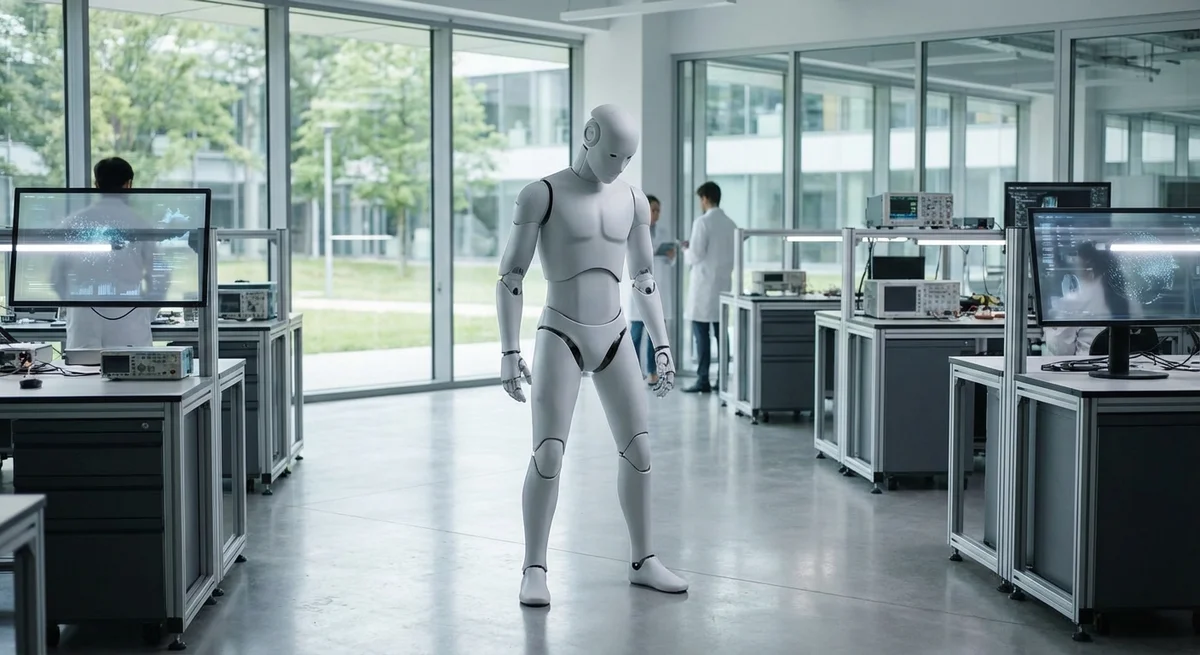
Chinese startup ZhiPingFang, which develops general-purpose intelligent robots, has officially joined the ranks of tech "unicorns": the company completed a Series B totaling more than 1 billion yuan, and its market valuation passed 10 billion yuan, roughly $1.4 billion. Behind that figure is a story with arguably no parallel in the global tech industry: in just one year the company closed 12 investment rounds in a row, making it, in effect, the fastest-funded player in embodied artificial intelligence anywhere in the world.
To grasp the scale, some context helps. Embodied AI is going through what generative AI went through in 2022–2023: a period of feverish interest in which money hunts for promising teams faster than they can spend their previous rounds. Embodied AI means building systems that do not merely process information but act in the physical world: robots that can perceive their surroundings, make decisions and carry out tasks with hands, not lines of code. China, for its part, treats this field as a strategic priority comparable in importance to semiconductors and electric vehicles.
Against this backdrop, ZhiPingFang's funding pace stands out. The company closed its first seven rounds in six months in 2025, and experts were already calling that rhythm unprecedented. Five more rounds followed, for twelve in twelve months. The investor list says a lot about where big capital is placing its strategic bets: Baidu, whose investment arm has long tracked promising AI companies; CRRC Capital, part of one of the world's largest rail equipment makers; and companies from the Tesla ecosystem, along with regional state funds. This mix of private venture capital, tech corporations and state money is the classic Chinese formula for backing strategically important industries.
Technologically, ZhiPingFang positions itself as a developer of general-purpose robots: not narrow machines built for a specific production line, but systems that can adapt to a wide range of tasks. The distinction matters. Industrial robots have existed for decades and handle repetitive operations in controlled environments very well. The new generation's job is to teach machines to work where conditions keep changing: in warehouses with unstructured cargo, in spaces shared with people, in scenarios that cannot be fully scripted in advance. This is where modern AI comes in, as the engine that turns a mechanical platform into an adaptive agent.
ZhiPingFang's new status means several things for the industry at once. First, it signals to global investors that China's humanoid and general-purpose robotics sector has moved from lab demos to serious commercial funding. Second, the presence of partners from the Tesla ecosystem among shareholders hints that the line between American and Chinese robotics schools, despite geopolitical tension, remains permeable at least at the level of capital. Third, twelve rounds in a year set a precedent: other startups in this segment will now be measured against that pace, and investors will expect similar momentum.
The question that inevitably arises at this fundraising speed is whether the technology is keeping up with the financial narrative. The history of tech bubbles teaches that valuations that outrun real sales sooner or later come back down to earth. ZhiPingFang has not yet disclosed detailed data on the commercial deployment of its systems, which leaves room for skepticism. Still, the investor mix, especially the presence of CRRC with its vast manufacturing base, suggests that more than expectations lies behind the money: there are concrete industrial interests too.
Twelve rounds, one billion yuan, a ten-billion valuation: these numbers sketch a company on which the market is placing a very large bet. If embodied AI really turns out to be the next big wave after generative models, ZhiPingFang has already taken a position among the main contenders to ride its crest. The next two to three years will show whether metal and code confirm a reputation that so far has been bought with investor optimism.
- Nov 2, 2026DeepSeek open-sources Super-agent prototype: p95 task completion time of 15.7 minutes vs. 29.5
- Nov 2, 2026Bun creator uses Claude Code to port 750K lines from Zig to Rust in 11 days
- Nov 2, 2026Microsoft releases 4B model Mage-VL-Cowork, which solves 66.0% of OSWorld-Verified tasks
- Nov 2, 2026Meta's Muse assistant keeps dossiers on loved ones and gets root on Ubuntu by default
Test Frontier LLMs & Autonomous Agents in One Workspace
Run Claude Opus 5.5, GPT-6, Gemini 3.1, and DeepSeek side-by-side in Nomad AI (nomadnet.ai) — unified model routing, deep research, and multimodal workflows under one subscription.
The AI world, distilled — once a week
Seven stories that actually mattered, hand-picked. No noise, no reposts, no press releases.
Done! Check your inbox for a confirmation.