London's Met Police Is Using Palantir AI to Monitor Its Own Officers
London's Metropolitan Police has admitted that it uses AI tools from Palantir to monitor the behavior of its own officers. The system analyzes data on sick leave, absences, and overtime to flag potential breaches of professional standards. The Police Federation sharply condemned the practice, calling it "automated suspicion." Palantir is a US company that also works with the Israeli military and with ICE, the immigration agency, under the Trump administration. Scotland Yard had previously refused to confirm or deny that it used Palantir technology.
AI-processed from Guardian; edited by Hamidun News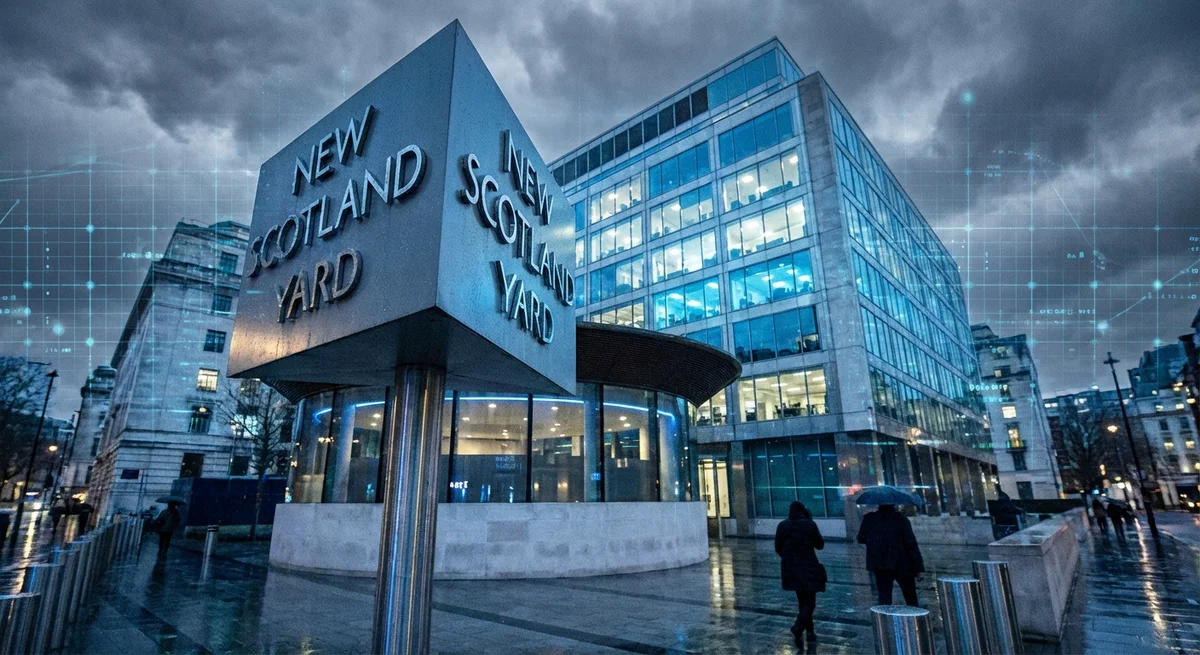
London's Metropolitan Police, the UK's largest law enforcement agency, has officially confirmed for the first time that it uses artificial intelligence tools from US company Palantir to monitor the behavior of its own staff. The system analyzes sick notes, absences, overtime, and other internal data to automatically flag officers who may have problems with professional ethics. The Police Federation, the union that represents rank-and-file officers, immediately condemned the practice as "automated suspicion."
Scotland Yard's admission followed an investigation by The Guardian. Until then, police leadership had consistently refused to confirm or deny any dealings with Palantir, a company whose reputation fuels heated debate on both sides of the Atlantic. Palantir, co-founded by Peter Thiel, one of Donald Trump's key allies in Silicon Valley, has long worked with US intelligence agencies and the military. Its current clients include ICE, the immigration agency carrying out mass deportations under the Trump administration, as well as the Israeli military. For British civil liberties advocates, the mere fact of working with such a company is already cause for alarm.
But the problem runs deeper than the choice of contractor. For the first time, a major police force in a Western democracy is openly applying algorithmic analysis not to suspects or the public, but to its own officers. On paper, the goal is a noble one.
The Met is in a deep crisis of trust after a string of scandals, from the murder of Sarah Everard by officer Wayne Couzens to systemic allegations of racism and sexism documented in Baroness Casey's damning 2023 report. Police leadership is desperately looking for tools that can identify problem officers before they commit a serious crime or offense. Palantir's algorithms, which analyze behavioral patterns such as frequent sick leave, irregular overtime, and unexplained absences, are meant to serve as that early-warning system.
This, however, is where technological efficiency runs into fundamental questions about workers' rights and the nature of suspicion. The Police Federation chose the phrase "automated suspicion" deliberately. When an algorithm flags an officer based on statistical anomalies, say, taking sick leave too often, that isn't an investigation into a specific offense. It's data-driven profiling. An officer with a chronic illness, or one going through a family crisis, risks falling under suspicion from a system that doesn't understand context. On top of that, blanket monitoring in itself breeds an atmosphere of distrust that could further erode already low morale in the ranks of the London police.
There is a legal dimension, too. UK data protection law, namely UK GDPR and the Data Protection Act 2018, sets strict requirements for automated decision-making that affects people. If Palantir's algorithms generate recommendations that influence officers' careers or disciplinary proceedings, that may require a data protection impact assessment and a guarantee that staff can challenge automated decisions. It remains unclear whether all of these procedures were followed, given that Scotland Yard concealed the very fact that it used the technology until the last moment.
The Met's situation fits into a broader trend that is rapidly gaining momentum worldwide. Law enforcement agencies from New York to Tokyo are increasingly deploying AI systems for facial recognition, predictive policing, and social media analysis. What makes London's case unique is that the algorithmic surveillance points inward, at the organization itself. That sets a precedent that could spread far beyond policing: if it's acceptable to algorithmically profile police officers, what's to stop the same logic from being applied to doctors, teachers, and civil servants?
For Palantir, this contract is another step in its expansion into the European public-sector market. The company already works with the UK's National Health Service, which has also drawn protests from civil liberties groups. Each new contract strengthens Palantir's position as an indispensable supplier of analytics infrastructure to the state, and at the same time makes it harder to answer the question of how far democratic institutions should depend on a private American company with a very particular client list.
London's experiment with AI surveillance of police officers confronts society with an uncomfortable question that has no good answer yet. Can institutional problems in policing be tackled with the same tools of blanket surveillance that the public criticizes when they're aimed at citizens? Or, to put it more simply: who will watch those who watch the watchers?
Test Frontier LLMs & Autonomous Agents in One Workspace
Run Claude Opus 5.5, GPT-6, Gemini 3.1, and DeepSeek side-by-side in Nomad AI (nomadnet.ai) — unified model routing, deep research, and multimodal workflows under one subscription.
The AI world, distilled — once a week
Seven stories that actually mattered, hand-picked. No noise, no reposts, no press releases.
Done! Check your inbox for a confirmation.