Socratic Lessons for Neural Networks: How AI Should Teach Us to Think
A senior Google engineer is urging users to change how they interact with generative AI, drawing on the principles of Aristotle and Socrates. Instead of treating neural networks as oracles that hand out finished solutions, he argues, people should use them as tools for sharpening logic and holding a dialogue. AI should help a person understand "how" to reach a conclusion, not dictate "what" to think. This philosophical approach matters in an era of automated content, the engineer says, because it keeps humans in the role of active thinkers and researchers and guards against the decline of cognitive skills.
AI-processed from ZDNet AI; edited by Hamidun News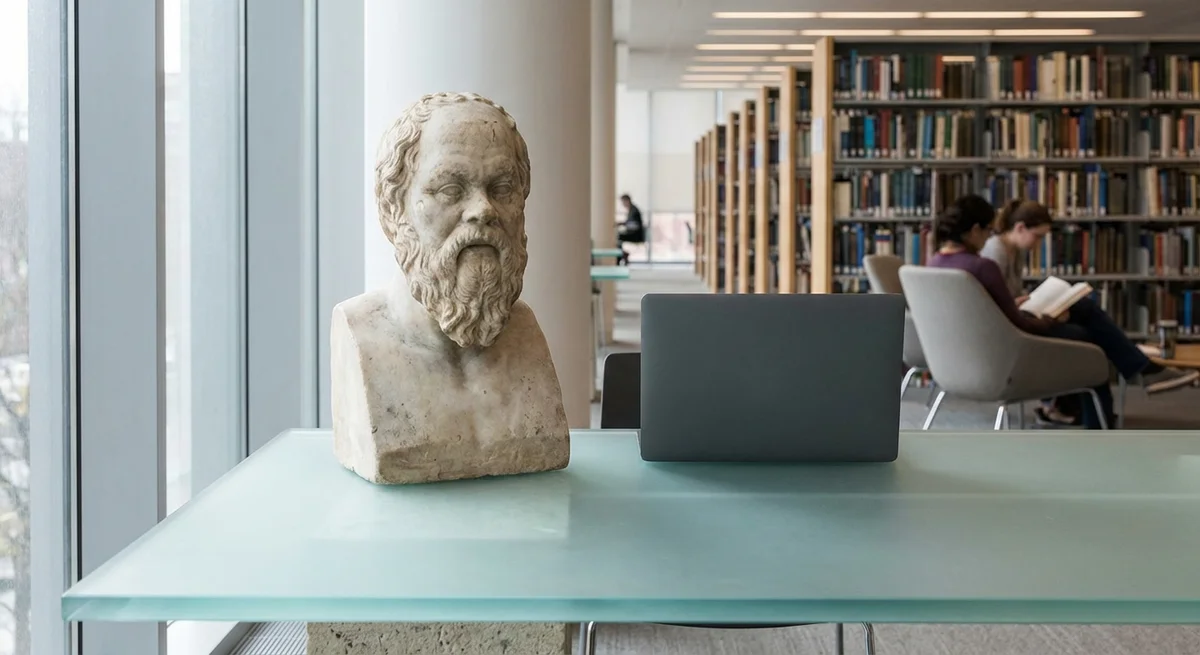
<h2>Socratic Lessons for Neural Networks: How AI Should Teach Us to Think</h2>
<p>As artificial intelligence develops at breakneck speed, particularly generative neural networks, there is a pressing need to rethink how we use these powerful tools. A senior Google engineer calls on users to stop passively consuming the information AI gives them and to use it instead as a catalyst for their own thinking. Drawing on the wisdom of ancient philosophers such as Aristotle and Socrates, he proposes treating neural networks not as all-knowing oracles that hand out ready answers, but as partners in dialogue that can help us sharpen our logic and learn to reach sound conclusions on our own.</p>
<p><strong>Context: AI as a tool of inquiry</strong></p>
<p>Modern generative neural networks such as ChatGPT, Gemini and others can generate text, images, code and much more with striking ability. That invites the temptation to treat them as a "black box" that solves our tasks for us. We can ask an AI to write an essay, draft a project plan or even answer a hard question, and receive a finished result. But as the Google engineer notes, this approach, though it looks efficient at first glance, carries a hidden threat. It encourages a passive stance in the user, where the main job becomes phrasing a request rather than thinking deeply about the problem and looking for a solution.</p>
<p><strong>Deep dive: The Socratic method in the digital age</strong></p>
<p>This is where the principles at the root of ancient philosophy come in. Socrates, known for his method of maieutics, or the art of midwifery, taught that true knowledge is born in dialogue, through a series of leading questions that help a person discover hidden truths on their own. In this method, the teacher does not hand over knowledge but helps the student "give birth" to it in their own mind.
Applied to AI, this means we should ask it questions that stimulate our own thinking, rather than simply collecting ready answers. Instead of asking "What were the causes of the First World War?", we can ask the AI: "What arguments could supporters and opponents of the war have made in 1914, and how would they have justified them?"
or "What alternative paths could have prevented the conflict, given the historical realities of the time?"
<p>Aristotle, for his part, paid great attention to logic and the systematization of knowledge. His works laid the foundations of rational thinking, analysis and proof. When interacting with AI, we can use it to test our own reasoning, to look for counterarguments, or to get information that helps us build a more coherent and logical argument. AI can become our "opponent" in an intellectual dispute, helping us find the weak points in our arguments and strengthen them.</p>
<p><strong>Consequences: Preserving cognitive independence</strong></p>
<p>In an era when content is generated at unprecedented scale, there is a real risk that our own cognitive skills will decline. If we rely entirely on AI for mental tasks, we risk unlearning how to think critically, analyze information and form judgments on our own. That scenario could lead to a society of passive consumers of information, easily manipulated and unable to grasp complex issues in depth. A philosophical approach to AI, by contrast, aims to keep humans in the role of active thinkers, researchers and creators. It lets us use AI as a powerful tool to extend our intellectual abilities, not to replace them.</p>
<p><strong>Conclusion: The future of thinking with AI</strong></p>
<p>The integration of AI into our lives is inevitable. The only question is how we do it. If we approach neural networks guided by the principles of Socratic dialogue and Aristotelian logic, we can not only avoid cognitive decline but also considerably enrich our thinking. AI should become our learning partner and a spur to reflection, a tool that helps us understand "how" to arrive at the truth rather than simply dictating "what" we should know. Only then can we preserve our intellectual independence and use the full potential of artificial intelligence for the benefit of humanity.</p>
- Nov 2, 2026Meta's Muse assistant keeps dossiers on loved ones and gets root on Ubuntu by default
- Nov 1, 2026Local models lose to Opus and Codex: 0.21 on a MacBook versus 1.00 for Codex
- Nov 1, 2026Kimi scores 96.2% on a 1C database analytics test and emerges as a fallback if Claude access is blocked
- Nov 1, 2026OpenAI Rewrites GPT Behavior Rules: Five Values and a Chain of Command
Build & Ship Production AI Agents Without Boilerplate Code
Start your free 72-hour trial at Hamidun Academy (academy.hamidun.com) — interactive lessons on Claude Code & Cursor, live Tech Radar, and production agent templates.
The AI world, distilled — once a week
Seven stories that actually mattered, hand-picked. No noise, no reposts, no press releases.
Done! Check your inbox for a confirmation.