Lenovo and Nvidia team up to build AI factories
Lenovo and Nvidia have announced the "Lenovo AI Cloud Super Factory", a project to turn data centers into AI factories. OpenAI and the Gates Foundation will commit $50 million to medical AI in Africa. In China, the film industry has reached a record value of 810 billion yuan. Chinese company Zhizhen Robot has received a patent for improving how robots interact in complex environments.
AI-processed from 36Kr (36氪); edited by Hamidun News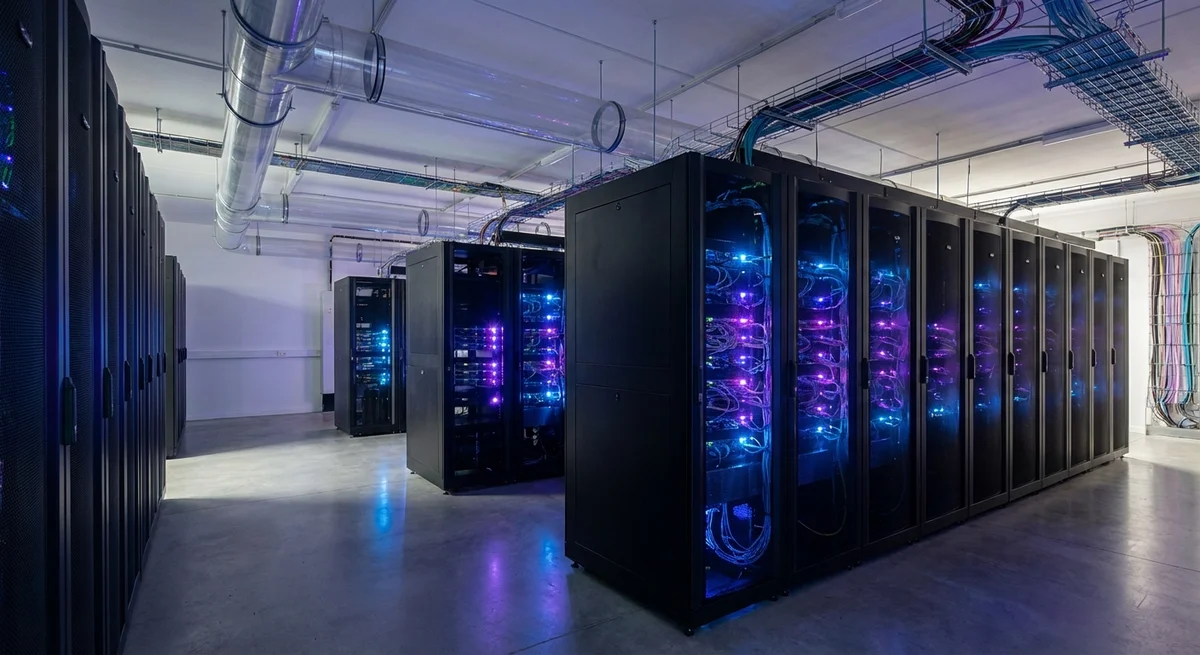
Lenovo and Nvidia team up to build AI factories
Introduction
The tech world keeps moving fast, and artificial intelligence (AI) is at the center of the shift. The latest news points to a new round of cooperation between leading industry players. Lenovo and Nvidia have announced an ambitious project, the "Lenovo AI Cloud Super Factory", meant to rethink data center architecture and turn data centers into highly efficient "AI factories". Meanwhile, OpenAI and the Bill & Melinda Gates Foundation are making significant investments in medical AI in Africa, and China's film industry is posting record growth figures, underscoring the global reach of technology and the creative industries.
Context: global transformation and local breakthroughs
In recent years, demand for computing power has grown exponentially, driven by the rapid development of AI. Companies worldwide are trying to optimize their data centers to cope with rising load and make effective use of AI's potential. Against this backdrop, the Lenovo–Nvidia partnership takes on particular weight. By combining their expertise in hardware and AI software, they are proposing a new paradigm, the "AI Factory", which goes beyond traditional "computing centers".
At the same time, technological innovation is aimed at pressing global problems. The initiative by OpenAI and the Gates Foundation to invest 50 million dollars in medical AI in Africa reflects a drive to use AI to improve quality of life and access to healthcare in developing regions. The project, which starts in Rwanda, aims to transform 1000 medical facilities by 2028, showing the potential of AI for humanitarian tasks.
On another front, China's film industry has posted impressive results, with a record value of 810 billion yuan across its entire production and distribution chain. The figure points not only to growth in the creative sector but also to its close integration with technologies that make it possible to create more complex and engaging films.
Deep dive: the "AI Factory" and the future of computing
The "Lenovo AI Cloud Super Factory" is a comprehensive solution aimed at modernizing enterprise data centers. Rather than treating them as places to store data and run standard workloads, Lenovo and Nvidia propose turning them into specialized "factories" optimized for training and deploying AI models. This involves integrating Nvidia's advanced hardware with Lenovo's server solutions, along with software platforms that simplify managing and scaling AI applications.
Microsoft CEO Satya Nadella stressed that in the AI era, what matters is not so much having a single "foundation" AI model as the ability to do "model orchestration" and to have a powerful "compute factory". This reflects a shift from monolithic solutions to more flexible, distributed architectures, in which cloud providers such as Azure act as "token factories", supplying the computing power and infrastructure for exponentially growing demand.
In robotics, Chinese company Zhizhen Robot has received a patent for a "motion redirection" technology that lets robots interact more effectively in complex environments. The technology, which can optimize movements, avoid collisions and ensure safety, is an important step toward more adaptive and versatile robotic systems, especially for industrial and service applications.
Implications: AI as a driver of innovation and social progress
Investment in medical AI in Africa opens new prospects for improving public health. Better access to medical services and more accurate diagnostics thanks to AI could significantly reduce illness and mortality, especially in resource-limited regions. It also stimulates the growth of local tech talent and the creation of new jobs.
The growth of China's film industry, backed by technological advances, shows how creative industries can use AI to produce next-generation content. This may lead to new forms of entertainment and cultural exchange.
The adoption of the "AI Factory" and the concept of "model orchestration" promises to speed up the development and deployment of AI solutions across all sectors. This should let companies bring new products and services to market faster, raise operational efficiency and make better-informed, data-driven decisions.
Conclusion
The Lenovo–Nvidia partnership, the investment in medical AI in Africa and the impressive results of China's film industry all point to a global shift toward broader use of artificial intelligence. Turning data centers into "AI Factories" and developing technologies for more effective robot interaction are key trends that will shape the future of technology and business. AI is ceasing to be merely a tool and is becoming a foundation for innovation, economic growth and solutions to the most difficult social problems.
- Nov 2, 2026TensorFold 1.2.0 boosts Qwen3.8-27B throughput on M3 Ultra by 44.2% at 16 streams
- Nov 1, 2026Local models lose to Opus and Codex: 0.21 on a MacBook versus 1.00 for Codex
- Nov 1, 2026Habr author fine-tunes YOLOv8l on dental X-rays and pushes mAP50 to 0.642
- Nov 1, 2026Voice bots built on LLMs turn to Jev, a fast classifier, for decisions in 200–500 ms
Test Frontier LLMs & Autonomous Agents in One Workspace
Run Claude Opus 5.5, GPT-6, Gemini 3.1, and DeepSeek side-by-side in Nomad AI (nomadnet.ai) — unified model routing, deep research, and multimodal workflows under one subscription.
The AI world, distilled — once a week
Seven stories that actually mattered, hand-picked. No noise, no reposts, no press releases.
Done! Check your inbox for a confirmation.