Nine Robotics Trends: How the Industry Is Moving from Hype to Real Deployments
A systematic review of reports and interviews with industry leaders points to nine fundamental shifts in modern robotics. The main one is the move from showy demonstrations to scalable deployment in production. AI and physical hardware are integrating more deeply, while companies increasingly focus on specific industrial tasks and on delivering a return on investment. The industry is maturing, filtering out marketing noise in favor of reliable, efficient systems in real-world operation.
AI-processed from Habr AI; edited by Hamidun News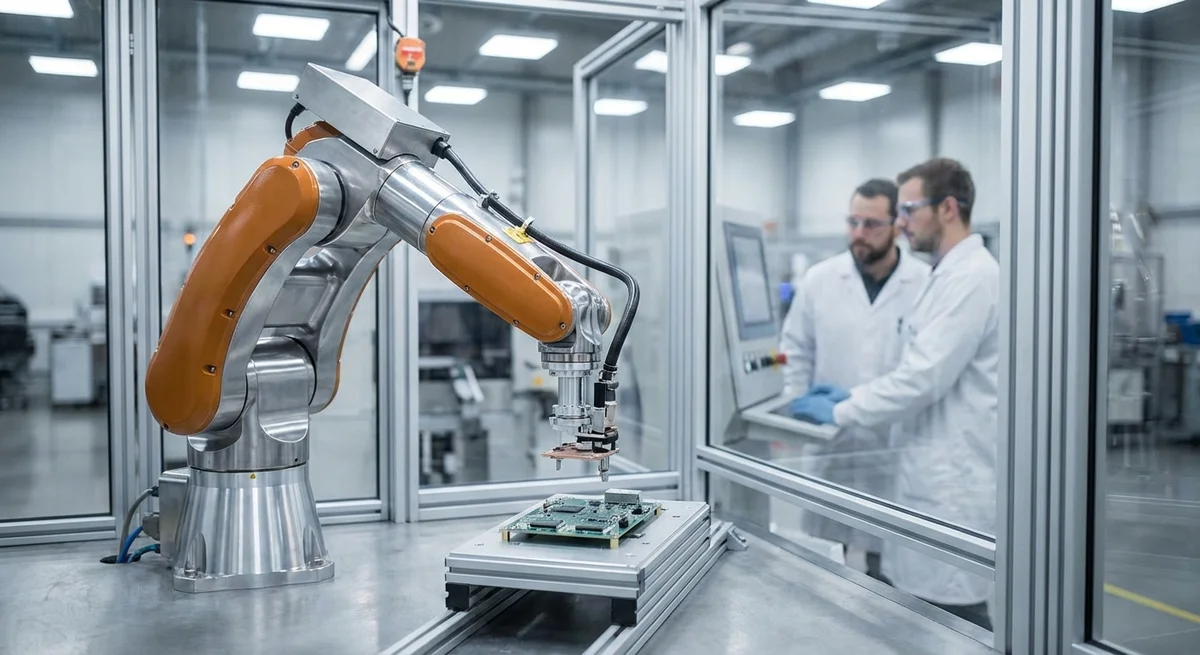
<h1>Nine Robotics Trends: How the Industry Is Moving from Hype to Real Deployments</h1>
<p>Over the past month, we ran an in-depth, systematic analysis of reports, research papers, technical blogs and interviews with leaders in the robotics industry. The goal was to identify the fundamental changes under way in the sector, setting aside marketing noise and flashy demos in favor of real, scalable deployments. The result is nine key trends that show robotics moving from the hype phase to a mature stage focused on solving specific industrial problems and delivering payback.</p>
<h2>Context: From Demos to Production</h2>
<p>Robotics has traditionally drawn attention with impressive but often unscalable demonstrations. Robots performing elaborate stunts, dancing or starring in futuristic concepts created the image of an industry far removed from everyday production reality. Recent trends, however, show a clear shift in paradigm. Developers and integrators are concentrating more on the practical value of their solutions, trying to prove their economic viability and reliability in real-world operation. The shift is driven both by maturing technology and by industry's growing need for automation, particularly amid labor shortages and the need to raise efficiency.</p>
<h2>Deep Dive: Nine Fundamental Shifts</h2>
<p>The analysis shows the robotics industry is undergoing nine key transformations. First, there is a <strong>deep integration of artificial intelligence and physical hardware</strong>. This goes beyond simply attaching sensors: AI works together with the hardware to control movement, make decisions and adapt robots in real time. Robots are getting smarter, better at learning and better at working independently in unpredictable environments.</p>
<p>Second, <strong>the focus is shifting to specific industrial tasks</strong>. Instead of universal solutions, companies build robots tailored to particular processes, from assembling complex components to warehouse logistics and infrastructure inspection. This makes for greater efficiency and predictability.</p>
<p>The third trend is <strong>payback (ROI) as the main criterion</strong>. Investors and customers increasingly demand a clear picture of how quickly a robotics investment will pay for itself. That pushes developers toward cheaper, more energy-efficient and easier-to-maintain systems.</p>
<p>The fourth important aspect is <strong>simpler integration and operation</strong>. Complex deployment and setup have always been a barrier. Now there is a trend toward platforms that let companies quickly integrate robots into existing production lines and train staff without deep technical knowledge.</p>
<p>The fifth trend is <strong>growth in the market for collaborative robots (cobots)</strong>. These robots, which can work safely alongside people, open up new automation opportunities for tasks where removing humans entirely is impractical or impossible.</p>
<p>The sixth item is <strong>the development of autonomous mobile robots (AMRs)</strong>. AMRs are actively displacing traditional automated guided vehicles (AGVs) thanks to their flexibility, their ability to navigate dynamic environments and the fact that they do not require complex infrastructure.</p>
<p>The seventh trend is <strong>an emphasis on reliability and safety</strong>. In real industrial deployments, uninterrupted operation and risk minimization are critical. Companies are paying more attention to testing, certification and fault-tolerance systems.</p>
<p>The eighth trend is <strong>the development of cloud platforms for robotics</strong>. The cloud lets operators manage a fleet of robots, collect and analyze data, update software and even run complex computations that onboard systems cannot handle.</p>
<p>Finally, the ninth trend is <strong>a focus on sustainability and energy efficiency</strong>. Robots are becoming "greener," consuming less energy and using more environmentally friendly materials, in line with global trends in corporate social responsibility.</p>
<h2>Implications: An Industry Grows Up</h2>
<p>These nine trends point to a maturing robotics industry. Hype and promises of a futuristic world are giving way to pragmatic solutions that can deliver real value to businesses today. Companies that successfully adopt these changes will gain a significant competitive advantage. That means developers must focus not only on innovation but also on cost-effectiveness, ease of use and the reliability of their products. For industrial enterprises, it opens new opportunities for modernization and higher productivity.</p>
<h2>Conclusion: The Future Is Already Here</h2>
<p>The move from showy demonstrations to scalable deployments is not just a change in trends; it is an evolution of the whole industry. Robotics is ceasing to be an exotic curiosity and is becoming an integral part of modern manufacturing. Deep AI integration, a focus on ROI, simpler operation and greater attention to reliability all signal that robots are ready to take on real tasks and deliver tangible benefits to business. The industry is growing up, and a future in which robots work side by side with people is becoming ever more tangible.</p>
- Nov 21, 2026Ego lite Gives Each AI Agent Its Own Workspace Space in the Browser
- Nov 21, 2026Instinct, valued at $10 billion, leads the market for AI agents you text like a messaging app
- Nov 21, 2026Docker rebranded for AI agents, but Sandboxes shipped back in September
- Nov 21, 2026Google Releases Gemini 4 Neon: 65.2% on Terminal-Bench 4.1 at $3 per Million Tokens
Test Frontier LLMs & Autonomous Agents in One Workspace
Run Claude Opus 5.5, GPT-6, Gemini 3.1, and DeepSeek side-by-side in Nomad AI (nomadnet.ai) — unified model routing, deep research, and multimodal workflows under one subscription.
The AI world, distilled — once a week
Seven stories that actually mattered, hand-picked. No noise, no reposts, no press releases.
Done! Check your inbox for a confirmation.