GPT-5.2 makes a breakthrough in theoretical physics by deriving a new formula
GPT-5.2 has shown remarkable ability in fundamental science. A new preprint describes how the model proposed an original formula for gluon amplitudes. A joint team of researchers from OpenAI and leading academic institutions later formally proved and confirmed the result. The achievement highlights the potential of large language models beyond text generation: they can also tackle some of the hardest problems in theoretical physics, which demand deep analytical reasoning and work with abstract structures.
AI-processed from OpenAI Blog; edited by Hamidun News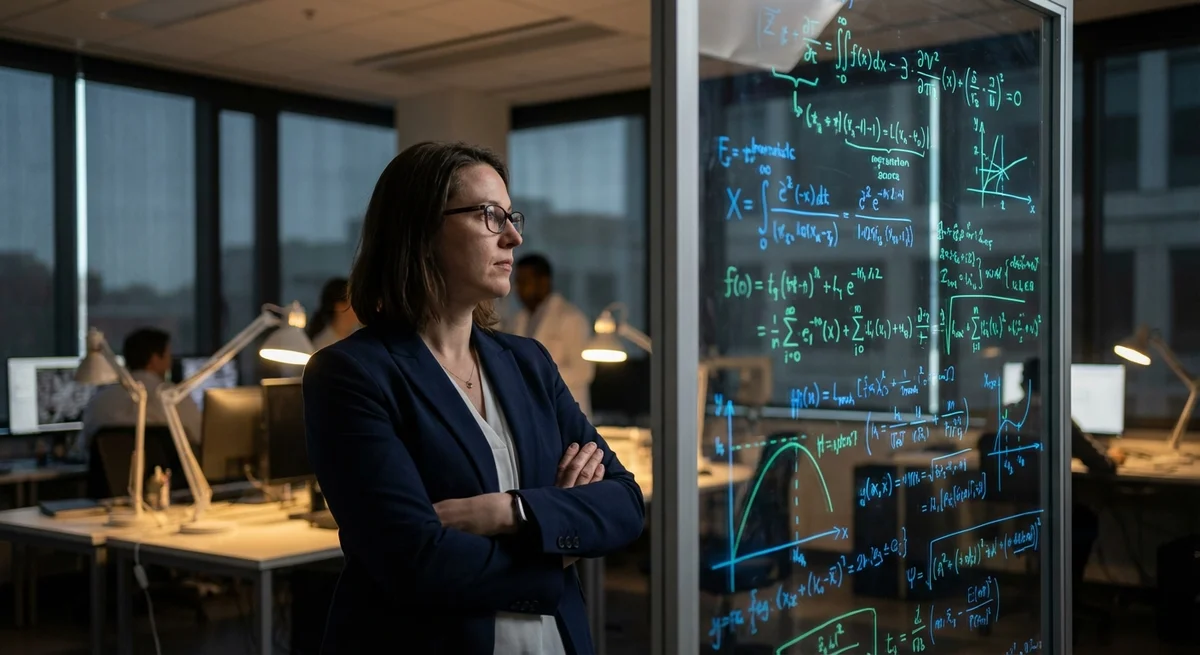
GPT-5.2 makes a breakthrough in theoretical physics by deriving a new formula
Artificial intelligence, and large language models in particular, keeps pushing the boundaries of human knowledge. OpenAI's GPT-5.2 has now gone well beyond the familiar uses of AI for writing text or answering questions. According to a new preprint, the model showed remarkable ability in fundamental science by proposing an original, previously unknown formula for gluon amplitudes. The machine produced the result first; a joint team of researchers from OpenAI and leading academic institutions then formally proved and confirmed it, which speaks to the significance of the breakthrough.
The discovery sits in quantum field theory, one of the most demanding areas of physics. There, calculating scattering amplitudes for elementary particles such as gluons (the particles that carry the strong nuclear force) is a cornerstone of understanding the structure of matter at the most fundamental level. These calculations have traditionally required deep mathematical knowledge, intuition, and years of experience from theorists. They often involve highly abstract mathematical structures and complex integrals. An AI that can do more than process huge volumes of data, and can instead generate new, nontrivial hypotheses in a field as specialized and theory-heavy as particle physics, marks a qualitative leap in AI development.
A closer look at the result suggests that GPT-5.2 did not simply "guess" the right answers. Instead, it apparently managed to identify hidden patterns in the complex mathematical expressions tied to gluon amplitudes. The formula the model proposed proved nontrivial, and the physicists needed considerable effort to fully verify it. The verification combined analytical methods with numerical calculations, which let the team confirm that GPT-5.2's solution was both correct and general. This matters because it shows that AI can do more than find support for existing theories: it can propose entirely new mathematical constructions that then survive rigorous scientific scrutiny.
The implications are hard to overstate. First, the result opens new possibilities for using large language models as tools for scientific research. Rather than treating AI purely as an assistant that speeds up routine tasks, scientists can now treat it as a full partner in discovery, one capable of generating new hypotheses and proposals. Second, it could accelerate progress in theoretical physics and other fields that depend on complex mathematical derivations and the search for new patterns. In the future, AI may play an even larger role in unraveling the mysteries of the universe.
In conclusion, GPT-5.2's breakthrough in theoretical physics is a landmark event that shows the exponential growth in AI capabilities. The model's ability to propose a new scientific formula and help prove it opens exciting prospects for human-machine collaboration in research. The achievement not only confirms AI's potential for solving the hardest analytical problems but also hints at a coming era in which artificial intelligence becomes an integral part of scientific discovery, helping humanity grasp nature's deepest secrets.
- Nov 2, 2026Meta's Muse assistant keeps dossiers on loved ones and gets root on Ubuntu by default
- Nov 1, 2026Local models lose to Opus and Codex: 0.21 on a MacBook versus 1.00 for Codex
- Nov 1, 2026Kimi scores 96.2% on a 1C database analytics test and emerges as a fallback if Claude access is blocked
- Nov 1, 2026OpenAI Rewrites GPT Behavior Rules: Five Values and a Chain of Command
Test Frontier LLMs & Autonomous Agents in One Workspace
Run Claude Opus 5.5, GPT-6, Gemini 3.1, and DeepSeek side-by-side in Nomad AI (nomadnet.ai) — unified model routing, deep research, and multimodal workflows under one subscription.
The AI world, distilled — once a week
Seven stories that actually mattered, hand-picked. No noise, no reposts, no press releases.
Done! Check your inbox for a confirmation.