WaveFormer: A New Approach to Computer Vision from Peking and Tsinghua University
A new architecture has emerged in the world of computer vision, promising to revolutionize approaches to image processing. This is WaveFormer, a development by scientists from the prestigious Beijing University and Tsinghua University. This innovative model, presented at the AAAI 2026 conference, proposes abandoning traditional attention mechanisms and heat conduction, replacing them with wave propagation modeling. In recent years, attention mechanisms have become an integral part of many computer vision architectures. However, they have their limitations, in particular, high computational complexity when working with high-resolution images. WaveFormer offers an alternative approach, inspired by the physics of wave processes. The idea is to consider an image as a wave and model its propagation using wave equations.
AI-processed from Jiqizhixin (机器之心); edited by Hamidun News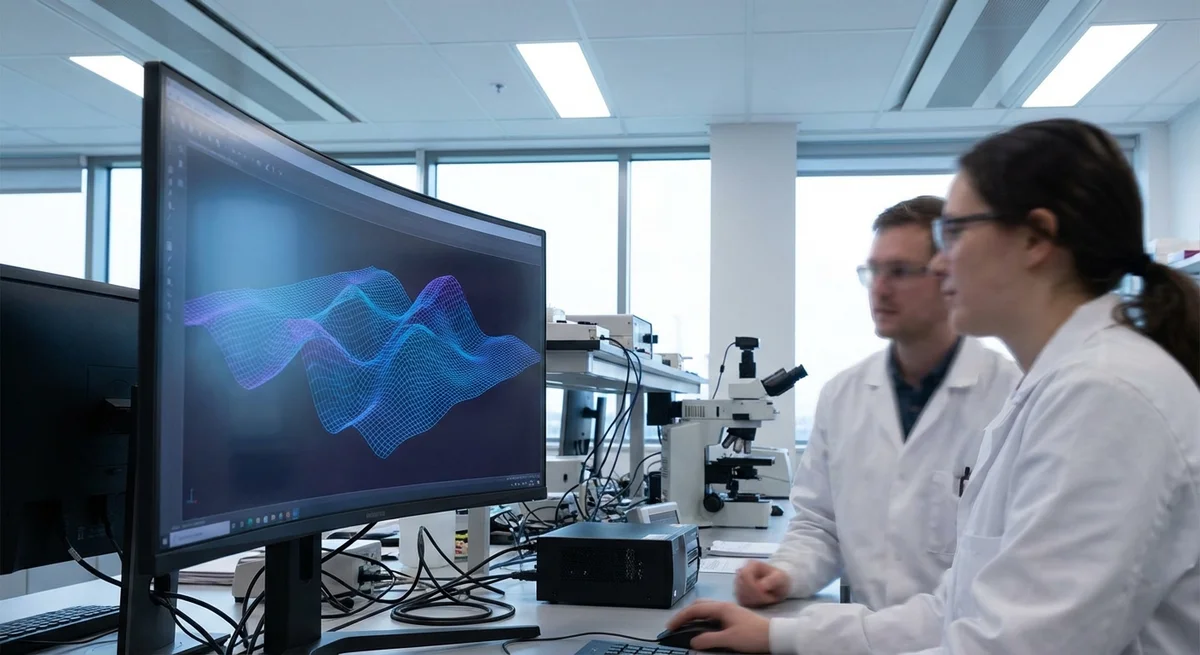
A new architecture has emerged in the world of computer vision, promising to revolutionize approaches to image processing. This is WaveFormer, a development by scientists from the prestigious Beijing University and Tsinghua University. This innovative model, presented at the AAAI 2026 conference, proposes abandoning traditional attention mechanisms and heat conduction, replacing them with wave propagation modeling.
In recent years, attention mechanisms have become an integral part of many computer vision architectures. However, they have their limitations, in particular, high computational complexity when working with high-resolution images. WaveFormer offers an alternative approach, inspired by the physics of wave processes.
The idea is to consider an image as a wave and model its propagation using wave equations. Such an approach allows efficient capture of global dependencies in an image, which is especially important for visual recognition tasks. A key feature of WaveFormer is the use of wave equations to model interactions between image pixels.
Unlike attention mechanisms, which explicitly compute the importance of each pixel relative to others, WaveFormer models the propagation of information as a wave. This allows capturing long-term dependencies and contextual information more efficiently. The WaveFormer architecture consists of several layers, each modeling wave propagation at a specific frequency.
The outputs of each layer are combined to obtain the final image representation. The proposed approach has several advantages. First, it is more computationally efficient than attention mechanisms, especially when working with large images.
Second, it allows capturing global dependencies in an image, which is important for semantic segmentation and object recognition tasks. Third, it is more robust to noise and lighting changes, since wave propagation is a more robust process than direct computation of dependencies between pixels. The impact of WaveFormer on the computer vision industry could be significant.
Abandoning attention mechanisms and transitioning to wave process modeling opens new opportunities for developing more efficient and robust algorithms. This could lead to improved performance across a wide range of tasks, from face recognition to automated medical image processing. For end users, this means more accurate and reliable computer vision systems that can operate in various conditions.
However, it should be noted that WaveFormer is still in the early stages of development. Further research is needed to optimize the architecture and evaluate its performance on various datasets. It is also important to explore the possibilities of applying WaveFormer to other areas, such as natural language processing and time series analysis.
WaveFormer represents a promising new approach to computer vision that could change the way images are processed. Abandoning attention mechanisms and transitioning to wave process modeling opens new horizons for research and development in this field, promising more efficient and robust systems for visual recognition in the future.
Need AI working inside your business — not just in your newsfeed?
I build production AI for companies — custom CRM, internal tools, autonomous agents, workflow automation. Owned by you, shaped to your process, no per-seat tax. Built by Zhemal Khamidun, CPO of AlpinaGPT (AI platform, 6,000+ users).
The AI world, distilled — once a week
Seven stories that actually mattered, hand-picked. No noise, no reposts, no press releases.
Done! Check your inbox for a confirmation.