Goodbye, Lag: Nanyang Technological University Speeds Up Robot Reactions in Dynamic Environments
Researchers at Nanyang Technological University (NTU) have unveiled a fix for a fundamental problem: the "slow reaction" of robots built on Vision-Language-Action (VLA) models. Until now, such systems suffered from high computational latency, which made them unfit for fast-changing conditions. The new optimization method lets robots process visual and text commands almost instantly, delivering smooth movement and high accuracy in a dynamic environment. The result narrows the gap between software intelligence and physical execution, paving the way for truly autonomous assistants.
AI-processed from Jiqizhixin (机器之心); edited by Hamidun News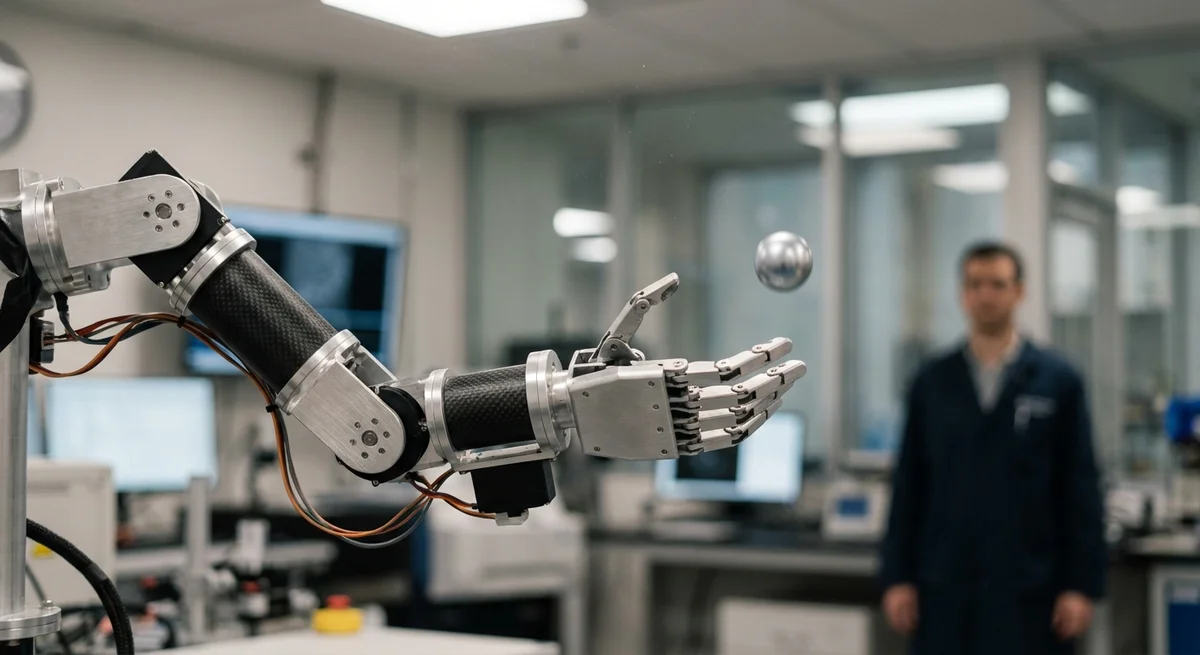
# Goodbye, Lag: How Nanyang Technological University Taught Robots to React Instantly
One of the most irritating flaws of modern robots is the pause. A robot sees an obstacle but seems to freeze for a moment before reacting. That delay, measured in seconds or even fractions of a second, makes machines clumsy in fast-changing conditions. Researchers at Nanyang Technological University have just announced a solution that could change the picture. Their new optimization method lets robots built on Vision-Language-Action (VLA) models process commands with almost no delay while keeping their movements accurate. The advance narrows the gap between how quickly a robot understands a situation and how quickly it acts.
The problem the NTU engineers solved looks simple at first glance but hides deep technical complexity. Vision-Language-Action models combine three powerful components: computer vision to analyze the surroundings, language models to understand instructions, and action-control systems to carry out commands. In practice, this means a robot must process a camera image, analyze it through a neural network, understand a text command, and coordinate many servomotors and joints, all at once. The computational cost of such a pipeline is enormous, and with traditional approaches the system can lag by several seconds. For a robot working in a dynamic environment, such as a factory next to moving objects or a home with people in it, that sluggishness is simply dangerous.
The researchers' solution rests on a precise understanding of where computational losses actually occur. Rather than simply speeding up each component separately, the NTU team developed a joint optimization method that makes the different parts of the system work in concert. They used knowledge distillation, which compresses large models without significant loss of accuracy, along with specialized algorithms for distributing computation across the robot's processors. The result is impressive: reaction time dropped enough that a robot can track the fast movement of a person or object and respond appropriately, as if it had real muscle memory.
The significance of this work goes well beyond theoretical interest. Robots that can react instantly gain the ability to work in real-world conditions rather than a controlled lab. In manufacturing, they can interact safely with people, adapting to unforeseen situations. At home, they can help elderly people without creating risks through slow reactions. In logistics, such robots can keep up with the pace set by a human worker. NTU's solution also shows that the path to true autonomy lies not in building ever more powerful models, but in smart engineering that makes existing technologies work more efficiently.
This is only a first step, however. The Nanyang engineers have shown the problem can be solved, but scaling their approach to more complex scenarios is still ahead. As robots grow more capable and take on harder tasks, the need for instant reaction will only increase. The NTU research opens the door to an era in which a robot is no longer "half a second behind" reality but lives at its pace, which is what machines need to become truly useful partners for people.
Test Frontier LLMs & Autonomous Agents in One Workspace
Run Claude Opus 5.5, GPT-6, Gemini 3.1, and DeepSeek side-by-side in Nomad AI (nomadnet.ai) — unified model routing, deep research, and multimodal workflows under one subscription.
The AI world, distilled — once a week
Seven stories that actually mattered, hand-picked. No noise, no reposts, no press releases.
Done! Check your inbox for a confirmation.