Lingxi Photonics raises tens of millions of yuan to build optical engines for AI clusters
Lingxi Photonics, a startup founded by alumni of the Chinese Academy of Sciences, has raised several tens of millions of yuan in an angel round. The company is building Co-Packaged Optics (CPO) and Optical I/O (OIO) engines to tackle the bottleneck in AI clusters. Its micro-ring modulator technology significantly cuts power consumption and raises system bandwidth to as much as 6.4T. Founder Wang Binhao plans to unveil the first prototypes by 2026. A key advantage is that the design does not depend on process nodes below 7 nm, which ensures stable production under current geopolitical conditions.
AI-processed from 36Kr (36氪); edited by Hamidun News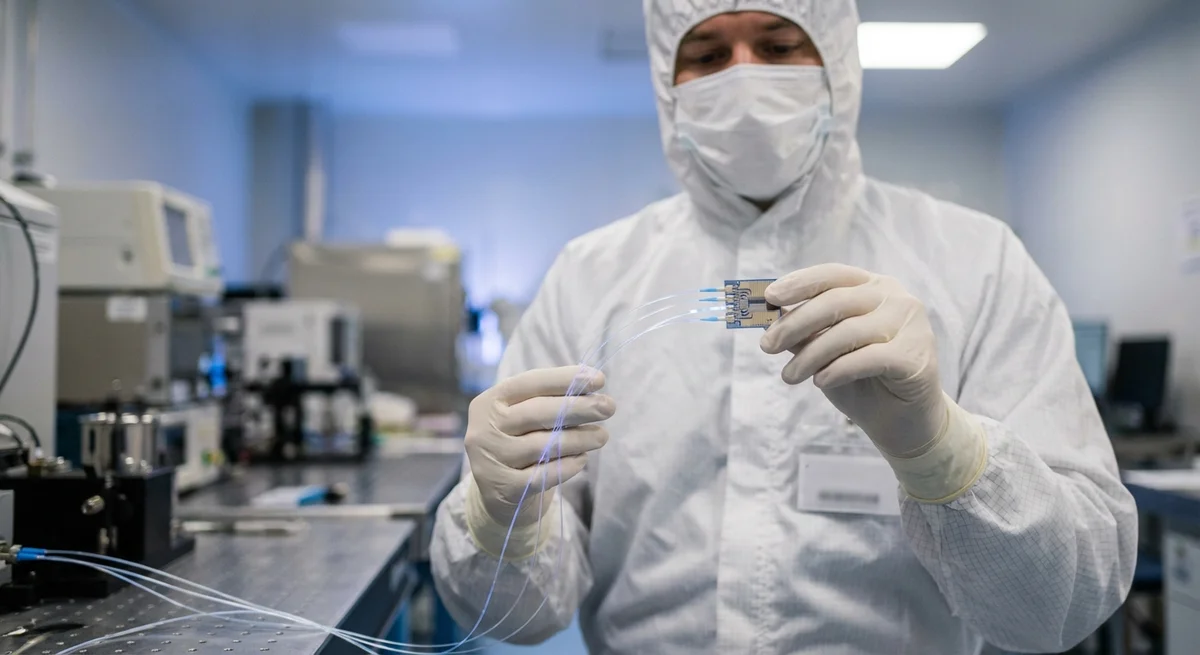
# Optical engines instead of copper cables: how a Chinese startup is tackling a critical problem in AI data centers
When you start a movie on Netflix, the video travels across the network at the speed of light. But with the cloud data centers that train huge language models, the picture gets more complicated. Data centers built for AI face a paradox: processors keep getting more powerful, while the copper cables that connect them are already falling behind. Beijing Lingxi Photonics, a young Chinese startup that has raised tens of millions of yuan to develop next-generation optical engines, is now going after this bottleneck.
Lingxi Photonics was founded in September 2025 by alumni of the Chinese Academy of Sciences. The company has announced the close of an angel round worth several tens of millions of yuan. Six investors took part, including state-backed and private funds such as Shunxi Fund, Puhua Capital, and Tsinghua Innovation Fund. Founder Wang Binhao holds a PhD from Texas A&M University in the US. He spent years working at HP's labs and later led the optical systems group at the Chinese Academy of Sciences.
At first glance, the problem Lingxi Photonics is solving looks highly specialized, but its consequences are huge. As AI clusters grow, the need for high-speed chip-to-chip communication becomes acute. Today's solutions — optical modules plugged into servers from the outside — draw too much power and have bandwidth limits. CPO (Co-Packaged Optics) and OIO (Optical I/O) build the optical components directly into switch chips and accelerators, eliminating the intermediate connections. Think of it as moving mail delivery from ground transport to air: speed and reliability improve many times over.
The heart of Lingxi Photonics' technology is the micro-ring modulator — a tiny silicon device one-thousandth the size of existing equivalents. These modulators convert electrical signals into optical ones with unprecedented efficiency. The company has already demonstrated prototypes that reach 256 Gbps per channel and 500 Gbps with advanced PAM4 modulation. With dense wavelength division multiplexing (DWDM), the system supports data rates of up to 6.4 terabits per second. For context, that is the equivalent of sending an entire library in a fraction of a second.
Lingxi Photonics' critical advantage is that its solution does not require the most advanced process technology in the semiconductor industry. The optical chips are built on standard silicon photonics, and the electronic components on analog ICs that existing fabs can produce at 28 nanometers and older. Under current geopolitical conditions, with US export controls squeezing the Chinese industry, this means the company can rely on domestic capacity without depending on foreign suppliers. Wang Binhao stresses that the team has already started production at multiple Chinese fabs.
The market the company is targeting is enormous. Analysts forecast that by the end of the decade the market for optical engines alone could reach $330 billion — more than ten times the size of today's optical module market. Lingxi Photonics plans to unveil its first prototypes in 2026–2027 and is pursuing two strategies in parallel: parallel multichannel solutions for switches and wavelength-division systems for accelerators such as GPUs and NPUs. The company is already in technical discussions with leading Chinese chipmakers, AI accelerator makers, and major internet companies.
American giants such as Nvidia and Broadcom have already invested billions in CPO, but the field remains open to competitors with strengths in design and manufacturing. Lingxi Photonics is entering at a moment when optical solutions are moving out of the lab and into real data centers. If the company manages to deliver its promised prototypes on time, it could rewrite the equation of the global race in intelligent infrastructure.
- Nov 1, 2026Local models lose to Opus and Codex: 0.21 on a MacBook versus 1.00 for Codex
- Nov 1, 2026Habr author fine-tunes YOLOv8l on dental X-rays and pushes mAP50 to 0.642
- Nov 1, 2026Voice bots built on LLMs turn to Jev, a fast classifier, for decisions in 200–500 ms
- Nov 1, 2026MoneyGate safety layer blocked all 42 fraudulent requests to local AI models
Ship AI Faster with Founders, Engineers & Weekly Architecture Reviews
Inside Vibe Club (hamidun.com/club) — weekly live masterminds with Zhemal Khamidun, Tech Radar, full LMS access, and 370+ production Claude Code skills.
The AI world, distilled — once a week
Seven stories that actually mattered, hand-picked. No noise, no reposts, no press releases.
Done! Check your inbox for a confirmation.