Opus 4.6: 750 billion reasons to forget how we used to write code
The new Opus 4.6 iteration finally breaks our familiar idea of what software is. It is no longer a program in the classical sense but a 750-billion-parameter "statistical crystal." Inside are 96 layers of neural networks, and every query you send runs through all of them. Instead of algorithms, we now have a giant field of probabilities that compresses all available human culture, from Wikipedia to Stack Overflow. The key point: no answer comes from a database lookup. Each one is the product of extremely complex matrix multiplication that outputs exactly one word at a time. We have moved from writing instructions to managing a digital mind that simply guesses the future.
AI-processed from Habr AI; edited by Hamidun News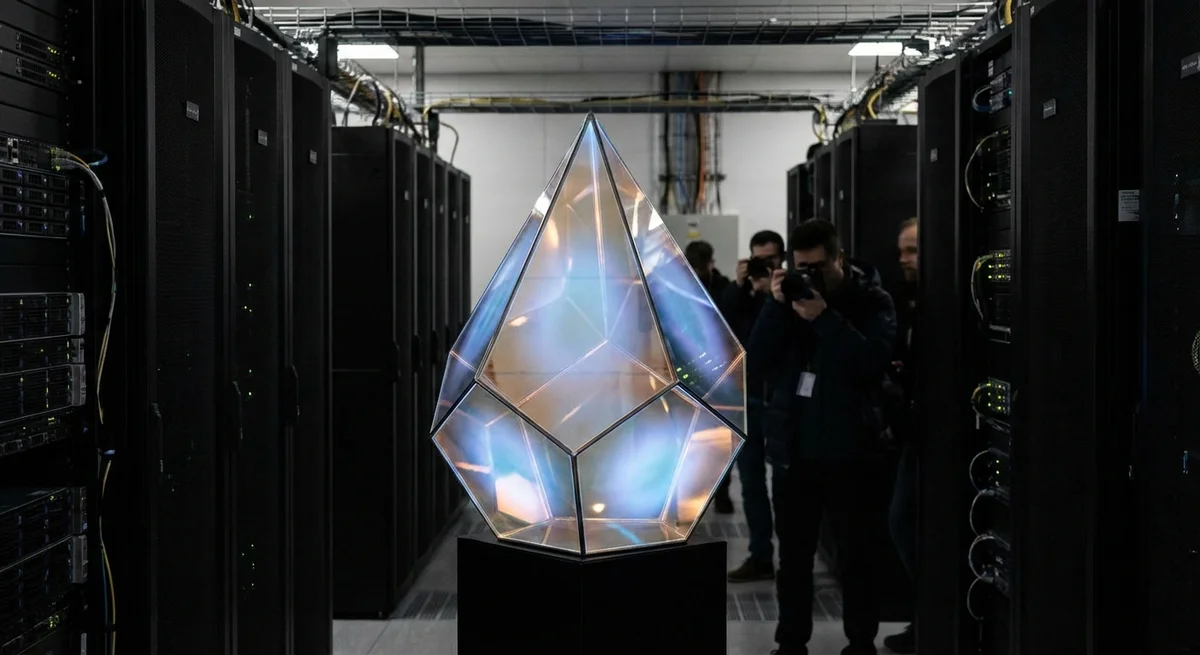
If you still think artificial intelligence is just a very complex algorithm stuffed with "if-then" conditions, Opus 4.6 is here to shatter that illusion for good. This is not software, not a decision tree, and not even a database with advanced search. The developers themselves are starting to call it a "statistical crystal." In essence, we are dealing with 750 billion parameters that are not code in the usual sense. They form a frozen field of probabilities, where every number is a tiny fragment of collective human experience, compressed into a kind of mathematical singularity.
Let's recall how we got here. Just a couple of years ago, we were amazed by models that could coherently finish a sentence. Today, Opus 4.6 operates at a scale the human brain struggles to grasp. Its 96 neural network layers are 96 consecutive stages that transform your question. Before the model outputs even a single letter of its answer, the information passes through giant matrices 96 times, getting multiplied, filtered, and matched against that "crystal." This is not a program at work. It is the physics of pure statistics, taken to the absolute.
All of Wikipedia, millions of digitized books, endless Stack Overflow threads, and billions of hours of human conversation no longer sit on servers as text. They are compressed into these matrices. When you ask Opus something complex, it does not "think." It forces its probability field to collapse into a single point: the next word. And it does so with such precision that the line between imitating intelligence and intelligence itself becomes almost invisible. It is a frightening and fascinating transformation at the same time: humanity has built a mirror made of humanity itself, yet running on pure mathematics.
Why does this matter right now? Because we have hit the limits of classical programming's efficiency. We can no longer write rules for every real-world situation. Instead, we "grow" models that absorb context. Opus 4.6 shows that scale matters. At 750 billion parameters, emergent properties appear: abilities the developers never deliberately built in. The model starts to understand irony, sense the nuances of code, and build chains of logic, not because it was taught to, but because that is the structure of the statistical reality it has absorbed.
The "one word at a time" concept unsettles many people. It seems strange to spend so much power generating a single token. But that is exactly where the secret lies. Each token is the result of an enormous effort to weigh every possible way events could unfold in the space of text. Picture a chess grandmaster calculating millions of games ahead just to move a pawn one square. Only here, the "games" are the entire history of human thought, and the "square" is your next reply in the chat.
Ultimately, Opus 4.6 confronts us with an uncomfortable question. If a statistical model can reason, write code, and empathize better than most people, how "biologically unique" are our own thought processes? Perhaps we, too, are statistical crystals of a sort, just grown on a carbon base. While we search for an answer, Anthropic and other market players keep adding layers and parameters, turning AI from a tool into a new kind of digital habitat.
The bottom line: Opus 4.6 finally moves AI out of the "tools" category and into the "phenomena" category. The question is no longer how the code works, but how deeply we are willing to look into this statistical mirror. Will Claude 5 become even denser, or will we hit the physical limits of computation?
- Nov 1, 2026Local models lose to Opus and Codex: 0.21 on a MacBook versus 1.00 for Codex
- Nov 1, 2026Kimi scores 96.2% on a 1C database analytics test and emerges as a fallback if Claude access is blocked
- Nov 1, 2026OpenAI Rewrites GPT Behavior Rules: Five Values and a Chain of Command
- Nov 1, 2026Google admits AI Mode cuts search revenue, shares fall 15%
Test Frontier LLMs & Autonomous Agents in One Workspace
Run Claude Opus 5.5, GPT-6, Gemini 3.1, and DeepSeek side-by-side in Nomad AI (nomadnet.ai) — unified model routing, deep research, and multimodal workflows under one subscription.
The AI world, distilled — once a week
Seven stories that actually mattered, hand-picked. No noise, no reposts, no press releases.
Done! Check your inbox for a confirmation.