Nvidia Returns to China: Jensen Huang Gets What He Wanted (With a Catch)
Nvidia has the green light to sell its accelerators in China after months of lobbying. Washington has allowed shipments of cut-down chip versions, which keeps the sanctions intact while preserving the company's revenue. For Huang, this is critical: the Chinese market once brought in up to 20% of revenue. But it is too early to celebrate. Local players such as Huawei have already taken over part of the niche, and the quality of Chinese alternatives keeps improving. Now Nvidia will have to prove that even a throttled H20 is better than the top-end hardware coming out of the Middle Kingdom.
AI-processed from Bloomberg Tech; edited by Hamidun News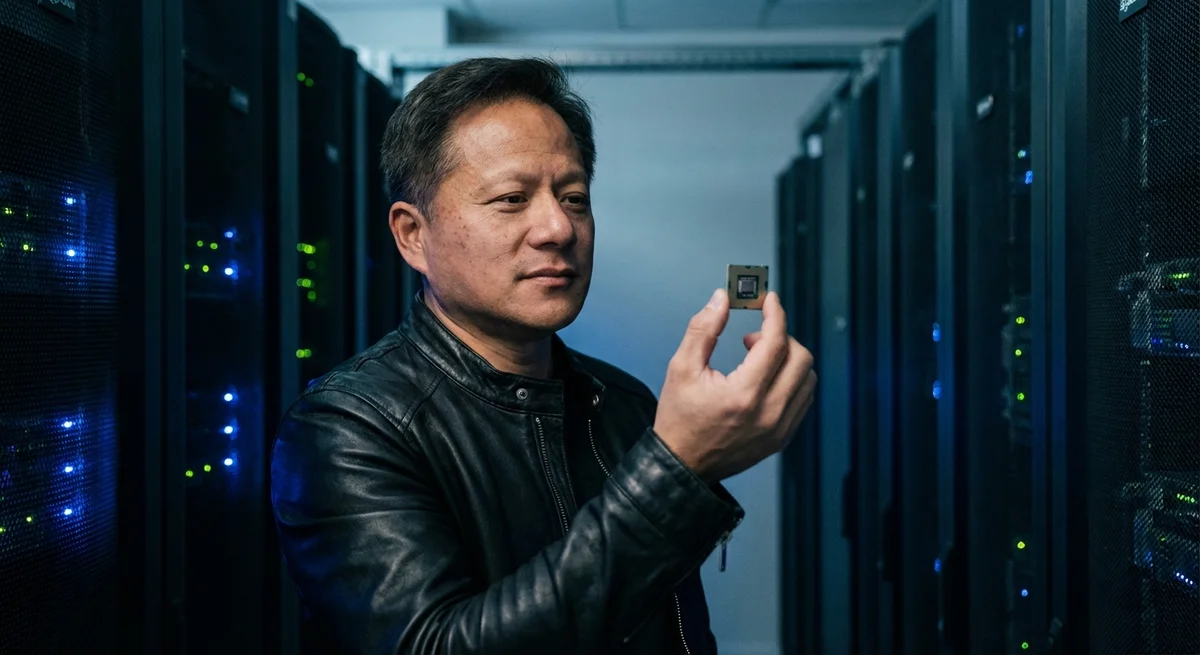
Jensen Huang knows how to wait and, more importantly, how to persuade. After months of endless flights between Santa Clara and Washington, the Nvidia chief has finally got what he fought for: official permission from the White House to ship AI chips to China. It looks like a win, but there are too many "buts" in this story to pop the champagne right now. Nvidia is returning to a market it once considered its backyard, and it is finding there not only the barbed wire of sanctions but also toothy competitors.
Let's recall how we got here. just a couple of years ago, China accounted for almost a quarter of all Nvidia's data center revenue. Then big politics intervened. The US government decided that feeding Chinese AI with powerful accelerators was a bad idea and introduced tough restrictions. First the top-end A100 and H100 went under the knife, then their China-specific versions, the A800 and H800. Jensen Huang said bluntly at the time that cutting American companies off from the Chinese market was like shooting oneself in the foot. Judging by the outcome, he was heard, though with serious caveats.
What is allowed to be sold now? The H20 series. It is a kind of "homeopathic" version of the flagship H100. Nvidia's engineers pulled off an architectural feat in reverse: they deliberately limited compute power so that the chip passes all US export control rules while still remaining useful for training neural networks. The problem is that Chinese giants such as Baidu, Tencent and Alibaba are no longer the naive buyers they used to be. They have learned to live with scarcity and have started looking around actively.
And what they see around them is Huawei. While Nvidia was blocked, Huawei did not waste time and aggressively pushed its Ascend 910B accelerators. In many tests they are already approaching the capabilities of those same "cut-down" Nvidia chips. For Chinese companies, buying domestic hardware is not only patriotism but also insurance against Washington changing its mind again tomorrow and turning their servers into expensive bricks. Huang will have to work very hard to convince old partners to return to American technology that can be taken away at any moment.
The situation is complicated by the fact that Nvidia has to play on two boards at once. On one side is pressure from American regulators, who watch every transistor. On the other is a capricious Chinese market that demands maximum performance. If the H20 proves too weak, the Chinese will simply wave it off and go to Huawei or Biren Technology. If it is too powerful, people in suits from the Commerce Department will once again show up at Huang's office. It is a tightrope walk over an abyss, where every step costs billions of dollars in market capitalization.
Nor should we forget the software ecosystem. The CUDA platform has long been the main "moat" around Nvidia's castle. Chinese developers are used to writing code for Huang's architecture, and switching to new rails is painful. However, Huawei is actively building its own software equivalents. If sanctions pressure lasts a couple more years, Chinese engineers will simply get used to a different toolset. At that point Nvidia will no longer be needed in China, even with its most powerful chips, because retraining thousands of specialists costs more than buying a server from a local supplier.
The Nvidia case shows that technological sovereignty is no longer a slogan but a reality. The world of AI hardware is splitting into two camps. We are watching the birth of an alternative ecosystem in China, one forced to develop in spite of sanctions. Nvidia is trying to sit on two chairs, keeping its status as a global monopolist, but with every new package of restrictions this gets harder. Jensen Huang has received permission to trade, but not a guarantee that his product is still needed in China as much as before.
The bottom line: Nvidia has kept access to China's wallet but has lost its aura of technological invincibility. Can a "slowed-down" chip beat a "fast" local competitor?
- Nov 2, 2026TensorFold 1.2.0 boosts Qwen3.8-27B throughput on M3 Ultra by 44.2% at 16 streams
- Nov 1, 2026Local models lose to Opus and Codex: 0.21 on a MacBook versus 1.00 for Codex
- Nov 1, 2026Habr author fine-tunes YOLOv8l on dental X-rays and pushes mAP50 to 0.642
- Nov 1, 2026Voice bots built on LLMs turn to Jev, a fast classifier, for decisions in 200–500 ms
Test Frontier LLMs & Autonomous Agents in One Workspace
Run Claude Opus 5.5, GPT-6, Gemini 3.1, and DeepSeek side-by-side in Nomad AI (nomadnet.ai) — unified model routing, deep research, and multimodal workflows under one subscription.
The AI world, distilled — once a week
Seven stories that actually mattered, hand-picked. No noise, no reposts, no press releases.
Done! Check your inbox for a confirmation.