Data Centers on Lockdown: New York Weighs an AI Pause Over Electricity Prices
New York is considering a bill that would impose a moratorium on building new data centers. This isn't a local whim: similar initiatives are gaining ground across the US, from Georgia to Virginia. The problem is simple: the appetite of AI models is overloading aging power grids and driving up electricity bills for ordinary residents. While tech giants promise a "green" future, politicians are choosing reliable power for their constituents' outlets. If the trend takes hold, cloud capacity will become scarce, and training new LLMs will turn into an even more expensive and politically toxic undertaking.
AI-processed from Wired; edited by Hamidun News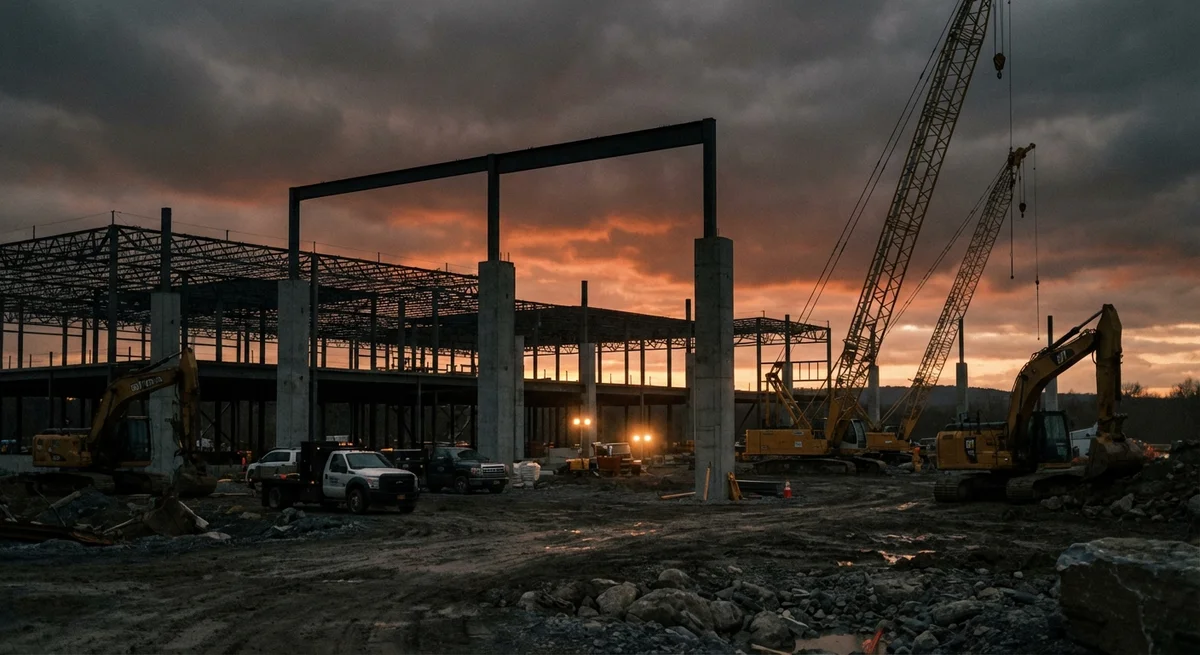
The honeymoon between Big Tech and American states appears to be officially over. Silicon Valley keeps painting a future where AI solves all of humanity's problems, but reality is knocking hard in the form of overheated transformers and sky-high utility bills. New York is the latest in a string of states where politicians have started talking seriously about a moratorium on building new data centers. This isn't just a bureaucratic hiccup. It's a symptom of a deep systemic crisis that has been building for the past several years.
The problem is that modern artificial intelligence is incredibly power-hungry. Data centers used to be little more than big warehouses full of servers; the era of generative models has turned them into industrial facilities with enormous energy consumption. A single rack of Nvidia's latest chips draws as much electricity as several dozen homes. When there are thousands of those racks, the local grid starts to groan under the load. New York felt this especially acutely when plans to expand computing capacity ran up against the need to keep voltage stable in ordinary people's homes.
Lawmakers in Albany are now looking closely at the numbers, and they've concluded that the promised IT-sector jobs don't outweigh the risks to infrastructure. Let's be honest: a data center isn't a factory, and it doesn't need thousands of workers. Once construction wraps up, a couple dozen engineers and security guards run the facility. Meanwhile, the burden on the environment and the state budget remains enormous. Residents are starting to ask awkward questions about why they should pay more for electricity just because corporations decided to train the next version of a chatbot in their neighborhood.
New York is far from alone in its concerns. Look at Virginia, long considered the "internet capital" thanks to its huge concentration of servers. Local opposition there has grown so intense that new projects stall for months over lawsuits and protests. Georgia and South Carolina are seeing the same thing. Politicians on both sides of the aisle have realized that unchecked growth of the "cloud" could lead to rolling blackouts in residential areas. That sets a dangerous precedent for the entire AI industry, which has grown used to treating compute as a practically limitless and cheap resource.
Tech giants are trying to maneuver their way out of the energy dead end. They have suddenly become nuclear power's biggest champions. Microsoft is signing contracts to bring reactors back online, and Google is investing in small modular systems. But that's a decade-long horizon, and servers need to be installed and running today. If states start imposing construction pauses one after another, we'll see capacity migrate en masse to countries with a more relaxed, or simply desperate, approach to the environment and energy.
Water adds another layer to the problem. Data centers don't just consume electricity; they practically drink local reservoirs dry to cool their systems. With the climate changing and New York trying to meet strict environmental standards, approving a giant new water consumer looks like political suicide. This is a classic conflict between digital progress and the preservation of basic resources: on one side of the scale sits the power of new neural networks, on the other, the stability of millions of people's lives.
The irony is that AI itself is often marketed as the perfect tool for optimizing power grids and fighting the climate crisis. For now, though, it's acting as the main destabilizing force, demanding more and more resources. The industry has hit a physical limit to growth that no software update can get around. Either chip architectures change radically, becoming dozens of times more efficient, or we should prepare for the cost of "smart" computing to climb along with the price of megawatt-hours.
The bottom line: The era of cheap, accessible cloud capacity is coming to an end, running up against the limits of aging power grids and the patience of taxpayers. Can the AI industry keep growing if it has to build its own power plants?
- Nov 1, 202616 models tested on 7 search tools: Exa averaged 10.5 out of 14, SearXNG about 3
- Nov 1, 2026Google's StreamVibe video agent beats other models by 10.7% on response timing and quality
- Nov 1, 2026OpenAI Rewrites GPT Behavior Rules: Five Values and a Chain of Command
- Nov 1, 2026Voice bots built on LLMs turn to Jev, a fast classifier, for decisions in 200–500 ms
Test Frontier LLMs & Autonomous Agents in One Workspace
Run Claude Opus 5.5, GPT-6, Gemini 3.1, and DeepSeek side-by-side in Nomad AI (nomadnet.ai) — unified model routing, deep research, and multimodal workflows under one subscription.
The AI world, distilled — once a week
Seven stories that actually mattered, hand-picked. No noise, no reposts, no press releases.
Done! Check your inbox for a confirmation.