Prism pairs LaTeX with GPT-5.2 so scientists can finally stop suffering
While the industry debates what base models can do, Prism has launched a free workspace with native LaTeX and built-in GPT-5.2. It is not just a text editor but a full environment for collaboration and scientific reasoning. The key feature: the model understands complex mathematics in depth and helps structure research in real time. After decades of Overleaf dominance, a player has appeared that bets on deep AI integration. Writing a paper stops being a fight with syntax and becomes a meaningful dialogue with an assistant that spots logical gaps before a reviewer does.
AI-processed from OpenAI Blog; edited by Hamidun News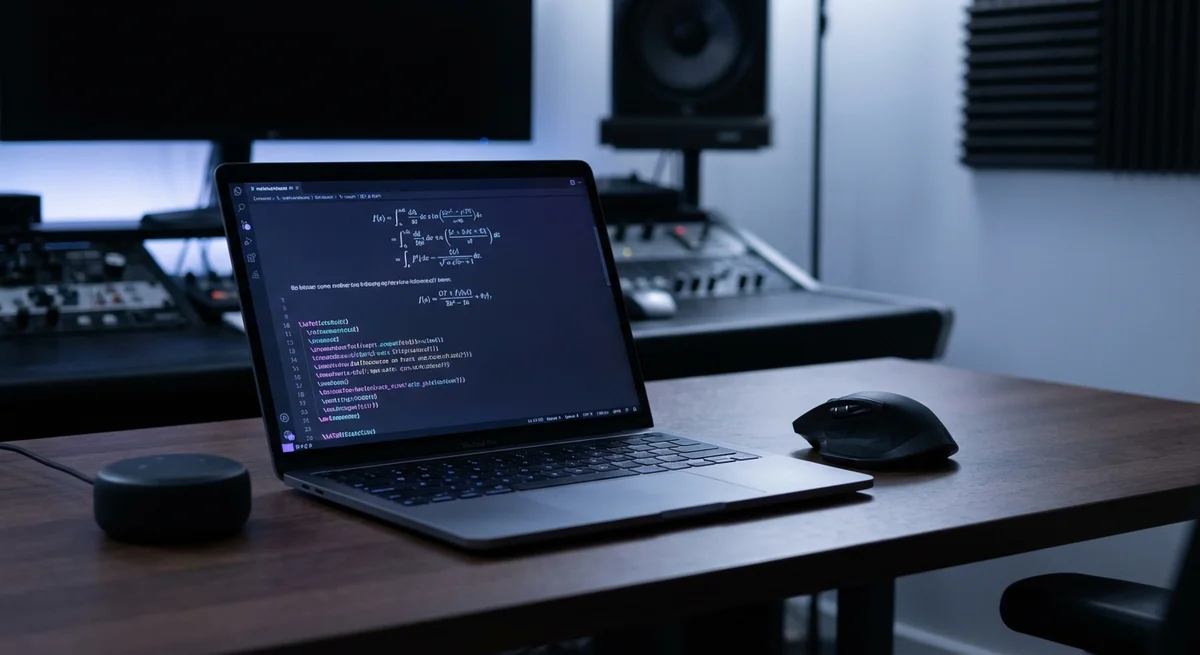
For years, the academic community has lived with a kind of Stockholm syndrome, with LaTeX as its captor. We have grown used to the idea that writing a serious scientific paper means a mandatory fight with finicky syntax, where one missing curly brace can bring down the compilation of an entire document. But times change, and today typesetting formulas by hand without the help of advanced AI looks as odd as calculating logarithms on a wooden abacus. Enter Prism, a tool that promises to make this archaic process feel human.
While the wider public waits for the official release of OpenAI's next generation of models, Prism's creators decided not to hold back and announced support for GPT-5.2. It looks like a bold challenge to the entire academic software industry. Prism is not just another VS Code plugin or browser add-on. It is a full workspace built for people who live in a world of formulas, graphs and strict logic. The developers realized early that researchers do not need a mere chatbot in the corner of the screen. They need an environment that understands the context of scientific work at the level of a co-author.
The main change comes down to one word: reasoning. Inside Prism, GPT-5.2 does not just fix typos or suggest synonyms. It can reason in terms of mathematics and physics. Imagine you sketch a draft of a proof, and the system points out in real time a logical failure in the third lemma or suggests a more elegant way to derive an equation. This changes the nature of the work: the scientist shifts focus from mechanical typing to generating ideas. The system takes over the dirty work of formatting references, tables and the bibliography, leaving the brain free to do what it is meant for.
Why does this matter right now? We are seeing a reproducibility crisis and an enormous overload on the scientific community. The number of publications is growing exponentially, while the time available to properly vet each paper is shrinking. Building powerful reasoning models directly into the writing process could become the filter that catches gross errors at the preprint stage. Prism also bets on collaboration. In a world where a physicist at CERN and a mathematician at Stanford have to work on one file, older tools often become a bottleneck.
The fact that Prism remains free is interesting in its own right. In an industry where the compute needed to run models of this class costs millions of dollars, such generosity hints at an aggressive market-capture strategy. The company is likely planning to build the highest-quality dataset of scientific interaction in order to fine-tune models on real processes of discovering new knowledge. For the user, it means access to the technology of the future without having to fight grant funders for a subscription budget.
If Prism really manages to deliver seamless work with GPT-5.2, we will see the sunset of the era of classic editors. Scientists are conservative people, but even they will not be able to ignore a tool that saves weeks of their lives on routine typesetting. The only question is how deeply we are ready to entrust the checking of our ideas to an algorithm, and whether an AI assistant will end up influencing the course of scientific thought too strongly, nudging researchers toward more predictable and safer conclusions.
Bottom line: Prism may become the Overleaf killer people have awaited for decades, but the real revolution is not in typesetting but in the ability to verify scientific logic on the fly. Claude and Gemini will have to find a way into the academic niche quickly, before GPT-5.2 becomes the de facto standard there.
- Nov 2, 2026Meta's Muse assistant keeps dossiers on loved ones and gets root on Ubuntu by default
- Nov 1, 2026Local models lose to Opus and Codex: 0.21 on a MacBook versus 1.00 for Codex
- Nov 1, 2026Kimi scores 96.2% on a 1C database analytics test and emerges as a fallback if Claude access is blocked
- Nov 1, 2026OpenAI Rewrites GPT Behavior Rules: Five Values and a Chain of Command
Test Frontier LLMs & Autonomous Agents in One Workspace
Run Claude Opus 5.5, GPT-6, Gemini 3.1, and DeepSeek side-by-side in Nomad AI (nomadnet.ai) — unified model routing, deep research, and multimodal workflows under one subscription.
The AI world, distilled — once a week
Seven stories that actually mattered, hand-picked. No noise, no reposts, no press releases.
Done! Check your inbox for a confirmation.