Claude in the Field: How AI Turned an Agri Website into an SEO Machine
A case study on SEO automation for agribusiness shows that pairing Claude AI with Python isn't just about code. It's about real money. The catalog grew from 134 to 358 pages in a matter of hours instead of weeks of an SEO specialist's work. The 85% time savings isn't a marketing figure; it comes from well-designed architecture. The key point: AI doesn't replace people here. It takes over the routine work of generating metadata and copy, which lets the business grow faster than its competitors. That changes the rules for small businesses by giving them enterprise-grade tools.
AI-processed from Habr AI; edited by Hamidun News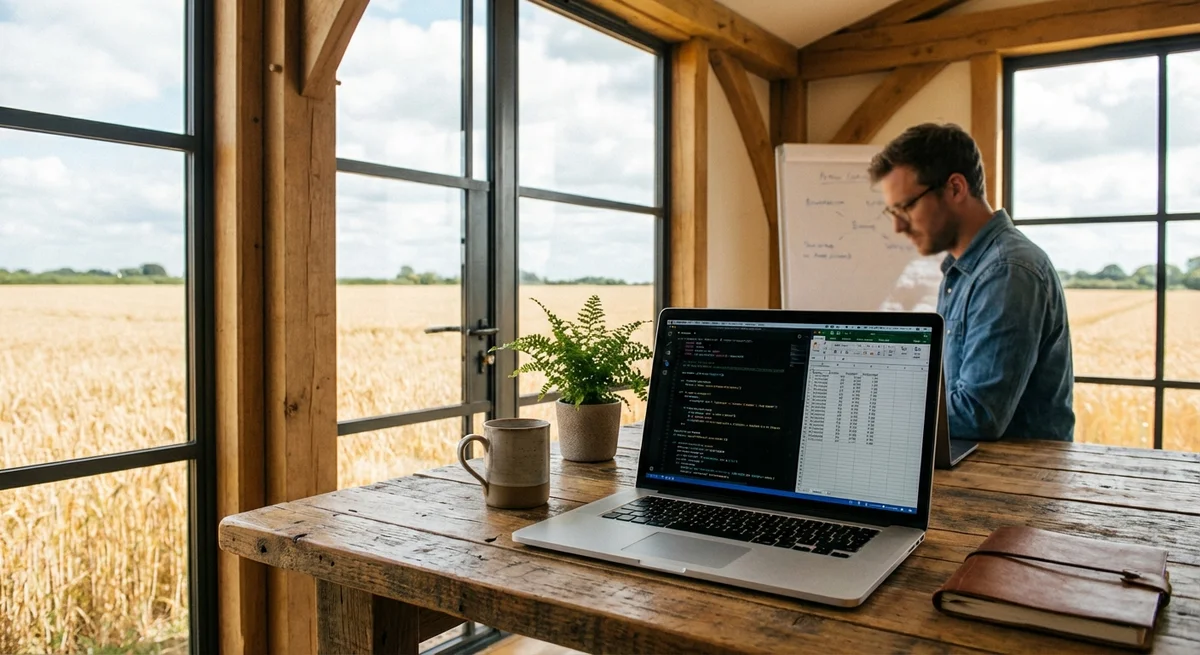
In 2024, SEO finally became a survival game. The winner isn't whoever has the bigger link-building budget, but whoever adapts neural networks to their needs fastest. While traditional agencies still hire students to churn out thousands of characters about tractor bearings, forward-thinking players are wiring together Claude AI, Python, and the trusty pandas library. One agri website quickly expanded its catalog from 134 to 358 pages through automation. That's not just a success story; it's a verdict on manual labor in search optimization. If you still think a human writer will do a better job describing sunflower seeds, I have bad news: Claude does it faster, cheaper, and, most annoyingly, often more accurately.
Why the agricultural sector specifically? It's one of the most conservative niches, where websites often look like they were left behind in 2010. Huge catalogs, specialized terminology, and endless spec tables. Scaling a project like this used to be like building the pyramids: hundreds of person-hours spent assembling the semantic core, clustering queries, and revising copy over and over. Here, the developers took a different route and made Claude their most diligent employee. Python fully automated the data pipeline: a script pulls information from spreadsheets, feeds it to the model, and gets back finished SEO-optimized pages that search engines treat as quality content.
The team chose Claude over the widely used GPT-4 out of pragmatism, not fashion. For tasks that require strict adherence to structure and no improvisation, Anthropic's models often perform more consistently. When you need to generate hundreds of meta tags and descriptions that precisely match user intent, any hallucination is a direct loss. In this case, Claude acted as an ideal editor: it understands the difference between mounted implements and combine harvester parts, and it doesn't try to philosophize about the meaning of life. The pandas library made it possible to manage huge volumes of data efficiently, turning a mess of Excel spreadsheets into structured input for the AI.
The 85% time savings isn't just a catchy headline. It's the plain reality of automated marketing. In the time one SEO specialist fills in a single product page by hand, the Python script processes an entire catalog section. That frees up resources for more important work: strategy, competitor analysis, and behavioral factors. The barrier to entry for quality SEO is dropping fast for anyone willing to learn to code. Small agribusinesses can now afford a depth of site development that used to be available only to national retailers with large teams and promotion budgets in the millions.
That said, don't think of this as a mythical money button. The main work shifts from writing copy to designing the system. You have to set up the pipeline correctly, prepare the data, and write prompts that keep the model from drifting off on its own. This is the new reality: the marketer becomes an engineer of meaning. Whoever manages to connect neural network APIs to their business processes will capture all the traffic over the next couple of years. Everyone else will keep paying experts for unique content that nobody but search crawlers reads anyway. Oddly enough, the future of agribusiness is being forged not in the fields but in code.
The bottom line: the era of human-driven SEO for mass catalogs is officially over. Claude and Python together let a business scale at the speed of thought, leaving the conservatives far behind. Are you ready to become the engineer of your own marketing, or will you keep paying for manual labor in the age of algorithms?
- Nov 2, 2026Bun creator uses Claude Code to port 750K lines from Zig to Rust in 11 days
- Nov 2, 2026mcp-linter finds 18 undescribed parameters in Anthropic's filesystem server
- Nov 2, 2026The Verge reviewer builds a $50 Meta Muse Charm alternative with Claude Code
- Nov 2, 20268 Skills for video in Claude Code: from 244 pixel effects to rough-cut editing
Test Frontier LLMs & Autonomous Agents in One Workspace
Run Claude Opus 5.5, GPT-6, Gemini 3.1, and DeepSeek side-by-side in Nomad AI (nomadnet.ai) — unified model routing, deep research, and multimodal workflows under one subscription.
The AI world, distilled — once a week
Seven stories that actually mattered, hand-picked. No noise, no reposts, no press releases.
Done! Check your inbox for a confirmation.