Super Bowl LX: AI Takes Over the Most Expensive Airtime
Super Bowl LX is shaping up to be AI's showcase. A couple of years ago, the airtime was stuffed with crypto exchanges that have since gone bankrupt. Now it belongs to large language models. Anthropic has prepared a spot that openly pokes fun at ChatGPT, while Google is trying to redeem itself after last year's Gemini blunder over gouda cheese facts. Sam Altman has already called the rivals' jabs "funny," but behind the irony lies a fierce fight for the mass-market user. While Bad Bunny prepares for the halftime show, tech giants are spending millions of dollars per second to prove their AI is the most useful, safe and human. This is the official start of the "AI for everyone" era.
AI-processed from The Verge; edited by Hamidun News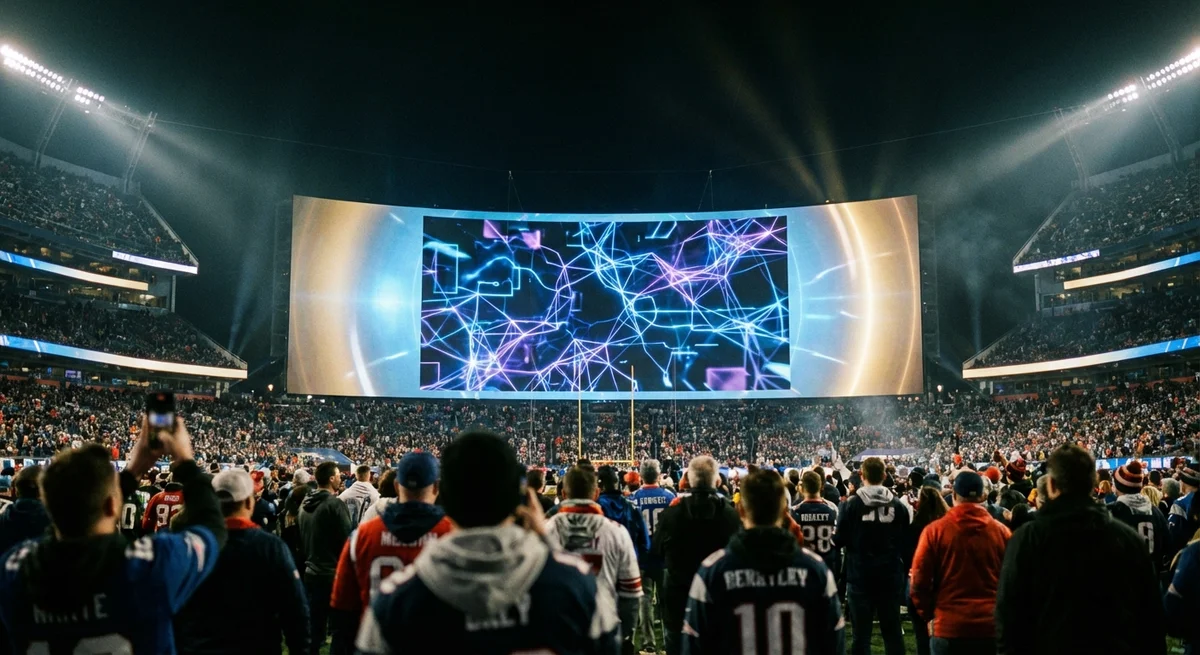
Remember 2022, when every other Super Bowl ad urged you to buy bitcoin or sign up for FTX? Those days feel like ancient history. Today, a very different drama is unfolding at Levi's Stadium in Santa Clara. Super Bowl LX is officially becoming the "AI Bowl," and it is the best indicator of where venture money and mass attention are heading. Artificial intelligence is no longer a toy for Silicon Valley geeks. It has moved fully into mass consumption, where it competes for viewers' attention alongside beer and chips.
Last year was a trial run for AI advertisers, and it did not go without failures. Everyone remembers how Google Gemini, in its own spot, managed to serve up wrong statistics about gouda cheese. It was a painful blow for a company that for decades was considered the gold standard of finding information.
This year the stakes are higher. Google wants revenge, but a new, aggressive player has taken the field: Anthropic. Its campaign aims at a head-on confrontation with OpenAI.
When a startup spends seven million dollars on thirty seconds of airtime just to needle ChatGPT, it says something about the maturity of the market. We are watching a classic brand war in the spirit of Pepsi versus Coca-Cola, except that instead of sugar and fizz, the contest is over model parameters and context windows.
Sam Altman has already responded to Anthropic's upcoming spots, calling them "funny." The reply carries the condescension familiar from the OpenAI chief, a leader who can still afford to ignore competitors. The reality, however, is that Anthropic is hitting the sorest spot: reliability and ethics. While OpenAI tries to build superintelligence, its rivals sell the idea of a "helpful and safe" assistant for ordinary people. The Super Bowl is the ideal stage for that message, aimed at those who still don't see why they need a chatbot on their phone at all.
It is also interesting who we will not see in the ad breaks. Despite the rise of prediction markets such as Polymarket and Kalshi, their advertising during the game is banned. That makes for a curious contrast: while regulators and broadcasters are cautious about financial instruments and betting, artificial intelligence has been given carte blanche. AI today is "safe" hype. It is a technology that can be sold to families watching football on a Sunday evening without fear of accusations of promoting gambling or dubious schemes.
The commercials themselves this year will most likely be products of the very thing they advertise. Generative video and AI voiceover have reached the point where they are hard to tell apart from traditional production. We are entering a recursion: neural networks make ads for neural networks, aimed at people who will soon use those same networks to create their own content. Set against Bad Bunny's halftime performance, it looks like the start of a new cultural paradigm. Technology is no longer the backdrop of life. It is its main sponsor and director.
Behind all this media noise lies a simple calculation. Investors have put tens of billions of dollars into LLM startups, and now it is time to show a return through user-base growth. The average Super Bowl viewer is the very "mass market" that must start paying for subscriptions. If Anthropic manages to convince even a small share of the audience that its model is "smarter" or "more honest" than Altman's product, the balance of power in the industry could shift faster than the fourth quarter ends.
The bottom line: The battle for the ordinary user has officially begun. Whoever first explains to a housewife from Ohio why she needs Claude or Gemini will take the personal assistant market for the next decade.
- Nov 2, 2026Meta's Muse assistant keeps dossiers on loved ones and gets root on Ubuntu by default
- Nov 1, 2026Local models lose to Opus and Codex: 0.21 on a MacBook versus 1.00 for Codex
- Nov 1, 2026Kimi scores 96.2% on a 1C database analytics test and emerges as a fallback if Claude access is blocked
- Nov 1, 2026OpenAI Rewrites GPT Behavior Rules: Five Values and a Chain of Command
Test Frontier LLMs & Autonomous Agents in One Workspace
Run Claude Opus 5.5, GPT-6, Gemini 3.1, and DeepSeek side-by-side in Nomad AI (nomadnet.ai) — unified model routing, deep research, and multimodal workflows under one subscription.
The AI world, distilled — once a week
Seven stories that actually mattered, hand-picked. No noise, no reposts, no press releases.
Done! Check your inbox for a confirmation.