Google Cloud and Team USA: Reaching New Heights with Algorithms
Imagine you're flying ten meters above a snowy slope, spinning faster than helicopter blades. In that moment, the last thing you're thinking about is cloud computing. Yet Google Cloud decided that in that rarefied air of extreme sports, there's a need for a little machine learning. While the rest of the industry giants train chatbots to write mediocre poetry, Google teaches algorithms to understand why one jump leads to the podium and another—to the physical therapy office. The collaboration with Team USA (the U.S. ski and snowboard team) is not just a marketing contract with pretty patches on jackets. It's an ambitious attempt to digitize what has been considered "a sense of the moment" for decades.
AI-processed from Google AI Blog; edited by Hamidun News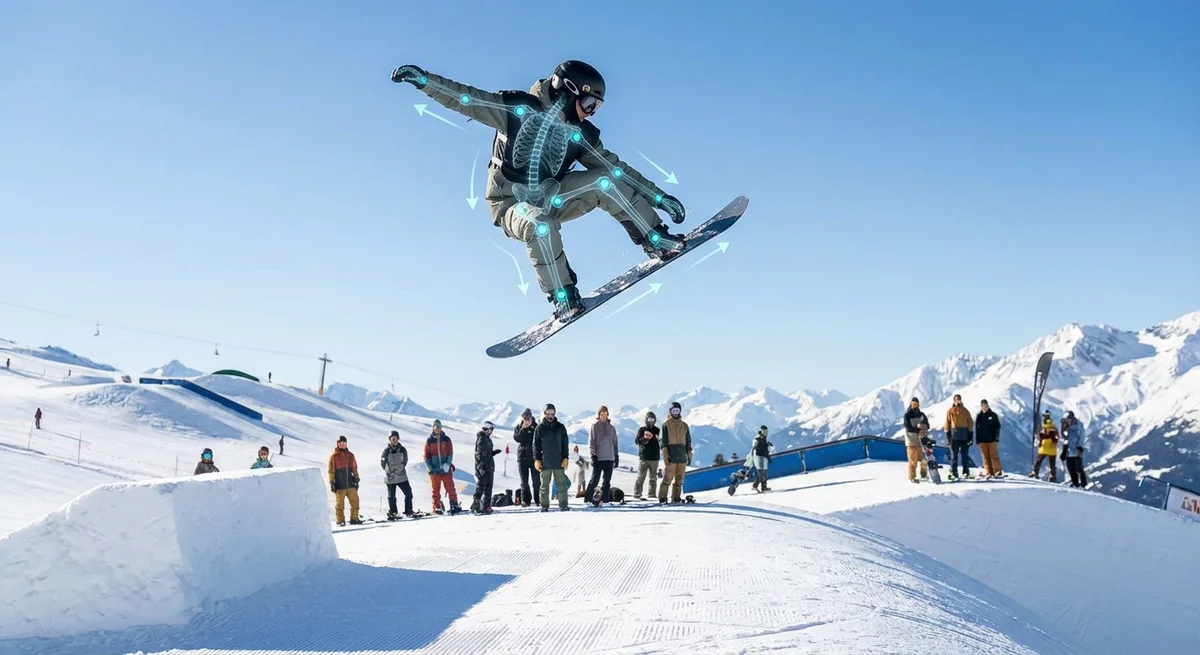
Imagine you're flying ten meters above a snowy slope, spinning faster than helicopter blades. In that moment, the last thing you're thinking about is cloud computing. Yet Google Cloud decided that in that rarefied air of extreme sports, there's a need for a little machine learning. While the rest of the industry giants train chatbots to write mediocre poetry, Google teaches algorithms to understand why one jump leads to the podium and another—to the physical therapy office.
The collaboration with Team USA (the U.S. ski and snowboard team) is not just a marketing contract with pretty patches on jackets. It's an ambitious attempt to digitize what has been considered "a sense of the moment" for decades. Until recently, the training process looked classical: an athlete jumps, the coach looks through the camera viewfinder, and then they try together to determine by eye at which exact millisecond the arm went too far to the side. Now AI wedges into this equation, one that doesn't blink, doesn't get tired, and doesn't make mistakes because of blinding sun.
The technical side looks like a data scientist's dream. The system analyzes video footage by overlaying a detailed skeletal mesh of the athlete's movements. It measures angles at the knees, the speed of torso rotation, and even the trajectory of flight down to the centimeter. This allows it to compare the current jump with a "reference" one or with that same athlete's previous attempts. Google claims their tool is the first of its kind, fully adapted to the chaotic conditions of freestyle, where standard motion recognition models usually fail when faced with baggy clothing and enormous speeds.
Why does a tech giant need this? The answer lies far beyond Olympic medals. Snowboarding is the most complex environment for computer vision. There are snow glints, constantly changing lighting, and equipment that hides body contours. If a neural network learns to flawlessly track human movements in a bulky suit during a triple somersault, then the task of analyzing movements of a warehouse worker or a patient in a rehabilitation center will become elementary to it. Sport here acts as an extreme testing ground for technologies that will later move into big business.
For the athletes themselves, this means the end of an era of subjectivity. When gold is on the line, the difference between first and fourth place is often hundredths of a point. Armed with objective data on jump height and landing precision, federations can not only better prepare athletes, but in the future potentially use these numbers to argue with judges. Although, knowing the conservatism of sports officials, we're still far from acknowledging AI as arbiters.
Of course, the question arises: will this kill the magic of sport? If every trick is calculated down to the degree, won't snowboarding turn into a competition of engineers, as happened with Formula 1? Team USA coaches are confident it won't. AI only highlights mistakes, but executing the most complex acrobatic elements still falls to a person of flesh and blood. A machine can suggest that the torso needs to rotate five degrees faster, but making the vestibular apparatus do it—that's not a task for cloud servers.
It's interesting to observe how Google Cloud aggressively searches for niches where their power can bring tangible, almost palpable results. After data analysis in football and basketball, venturing onto snowy slopes seems like a logical step. This demonstrates that "the cloud" is an active participant in the physical world. In reality, where every other startup calls itself AI-first, Google shows that their algorithms can not only generate images, but also help people overcome the limits of human capability.
The bottom line: Google turns coaches' intuition into hard data. If Team USA takes all the gold in 2026, we'll know exactly whose servers are to blame.
Need AI working inside your business — not just in your newsfeed?
I build production AI for companies — custom CRM, internal tools, autonomous agents, workflow automation. Owned by you, shaped to your process, no per-seat tax. Built by Zhemal Khamidun, CPO of AlpinaGPT (AI platform, 6,000+ users).
The AI world, distilled — once a week
Seven stories that actually mattered, hand-picked. No noise, no reposts, no press releases.
Done! Check your inbox for a confirmation.