Hon Hai and Nvidia: The Numbers Show the AI Fever Is Only Getting Started
Hon Hai Precision Industry, better known as Foxconn, reported a 35.5% jump in January revenue. These are not just dry figures but a direct indicator that demand for AI infrastructure remains sky-high. The main driver is servers for Nvidia. While skeptics talk about an overheated market, the world's largest contract electronics manufacturer is booked solid. For the industry, it is a signal: the capacity shortage has not gone away, and companies are ready to pay almost any price for the right to own coveted H100 and B200 chips. The AI bubble everyone talks about so much shows no sign of deflating yet.
AI-processed from Bloomberg Tech; edited by Hamidun News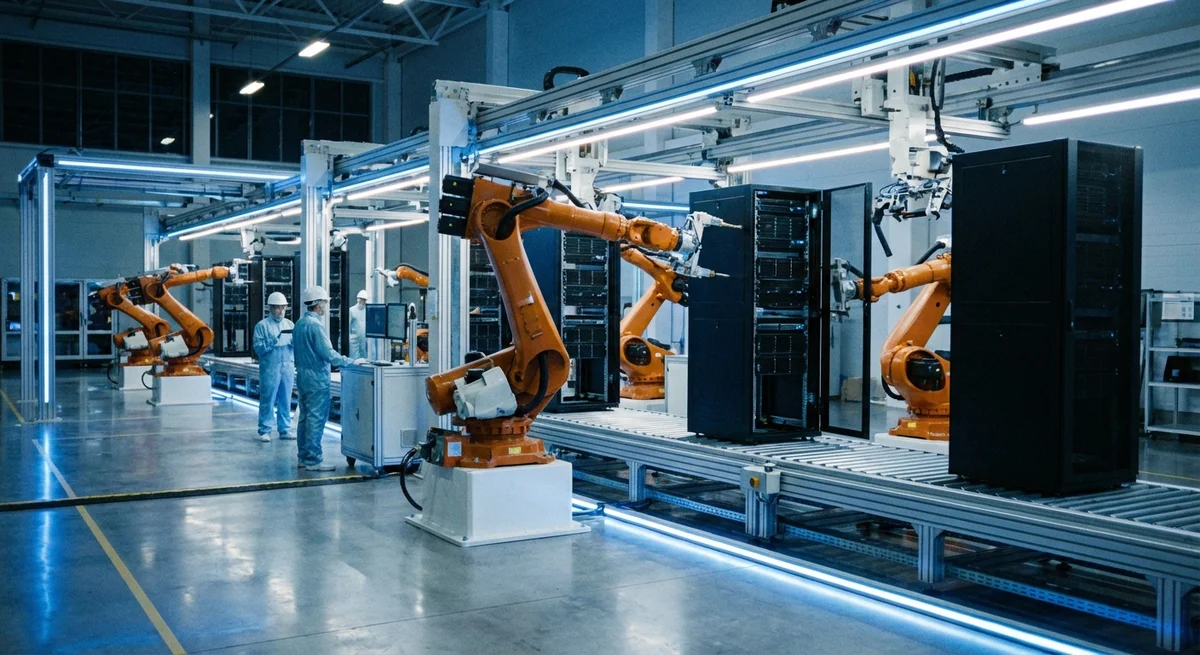
January is usually considered a quiet month after the holiday frenzy, but not for those building the foundation for neural networks. While financial experts in cozy studios debate when the artificial intelligence bubble will finally burst, the real economy keeps sending them invoices with very long strings of zeros. Taiwanese giant Hon Hai Precision Industry, which we all know as Foxconn, has just published its report for the first month of the year. The numbers are such that skeptics might want to go quiet for a while: the company's revenue jumped 35.5 percent. It is a clear sign that the industry's appetite for computing power is only growing.
To grasp the scale, remember who Hon Hai is in today's tech supply chain. It is not just an iPhone assembler; it is Nvidia's main server manufacturing partner. When Jensen Huang promises the world a new era of computing, it is at Hon Hai's factories that those promises turn into heavy, humming racks of hardware. Growth of a third year over year for a company of this size is not a random fluctuation but a direct consequence of cloud providers and tech giants continuing to buy up computing capacity as if it would be banned tomorrow. What we are seeing is not a temporary spike but a full-scale rebuild of global IT infrastructure.
What is interesting is how the company's revenue mix is changing. Traditionally, Hon Hai depended on consumer electronics release cycles — in plain terms, on how many people wanted to upgrade their smartphone this season. Now the situation is different. The cloud and networking products segment, which includes those very AI servers, is showing explosive growth. That means the center of gravity in global electronics manufacturing has shifted for good. The industry is now fed not by gadgets in users' pockets but by huge data centers training the next version of GPT or Claude. The consumer market may stagnate, but the server market is currently in a state of frenzy.
This report has become an important indicator for the whole market. After Nvidia unveiled its new architectures, concerns arose: would buyers pause to wait for the new products? Hon Hai's numbers say the opposite. Demand is so high that the market absorbs everything coming off the line, without waiting for the perfect moment. Companies fear missing the AI train more than overpaying for previous-generation hardware. It is a classic shortage situation, which has dictated the rules of the game for a second year running and does not intend to back down.
Looking deeper, Hon Hai's success is a verdict on those who expected a quick correction in the semiconductor sector. Infrastructure investment has moved from the stage of cautious experiments to a full-scale arms race. When capital of this volume pours into hardware, it creates momentum for years ahead. Even if interest in chatbots fades a little tomorrow, the equipment already purchased will need maintenance, upgrades and software. The flywheel is spinning at its limit, and Foxconn is now one of those shoveling coal into that furnace, keeping the global neural-network machine running without interruption.
What does this mean for the rest of us? Most likely, in the coming quarters we will see a continued parade of record profits for everyone tied in any way to chip and server production. The capacity shortage will remain the main theme, and physical access to hardware will be a key competitive advantage for any startup or corporation. While Hon Hai reports successes like these, talk of the end of the AI era looks premature, to say the least. The industry is only getting a taste for it, and the January report was merely a warm-up before a truly big season.
Bottom line: the AI fever has reached industrial scale, and while Hon Hai's factories run three shifts, waiting for a drop in big tech stocks or a slowdown in development is pointless.
- Nov 2, 2026TensorFold 1.2.0 boosts Qwen3.8-27B throughput on M3 Ultra by 44.2% at 16 streams
- Nov 1, 2026Local models lose to Opus and Codex: 0.21 on a MacBook versus 1.00 for Codex
- Nov 1, 2026Habr author fine-tunes YOLOv8l on dental X-rays and pushes mAP50 to 0.642
- Nov 1, 2026Voice bots built on LLMs turn to Jev, a fast classifier, for decisions in 200–500 ms
Test Frontier LLMs & Autonomous Agents in One Workspace
Run Claude Opus 5.5, GPT-6, Gemini 3.1, and DeepSeek side-by-side in Nomad AI (nomadnet.ai) — unified model routing, deep research, and multimodal workflows under one subscription.
The AI world, distilled — once a week
Seven stories that actually mattered, hand-picked. No noise, no reposts, no press releases.
Done! Check your inbox for a confirmation.