Jensen Huang vs Wall Street: panic over software is baseless
While Wall Street is once again trying to bury traditional software under the rubble of generative AI hype, a man in a leather jacket decided to remind everyone of the basics of economics. Jensen Huang, whose company Nvidia has become the main beneficiary of the current technological race, called the recent selloff of software company stocks "the most illogical thing in the world." This is not just an attempt to support ecosystem partners, but a cold calculation from an industry leader who sees the architecture of the future somewhat more clearly than analysts in the glass offices of New York. The market is now in a frenzy of fear over so-called "AI disruption." The logic of investors is simple and straightforward: if neural networks can write code, create interfaces, and automate routine tasks, why should we pay for subscriptions to Salesforce, Adobe, or ServiceNow?
AI-processed from Bloomberg Tech; edited by Hamidun News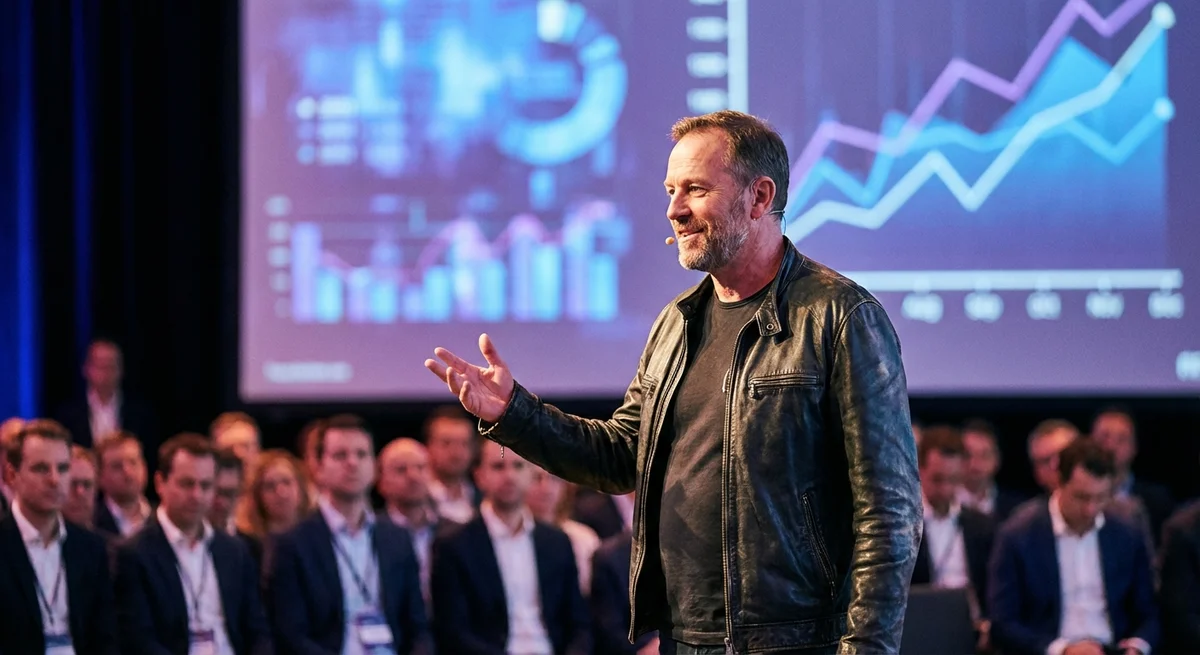
While Wall Street is once again trying to bury traditional software under the rubble of generative AI hype, a man in a leather jacket decided to remind everyone of the basics of economics. Jensen Huang, whose company Nvidia has become the main beneficiary of the current technological race, called the recent selloff of software company stocks "the most illogical thing in the world." This is not just an attempt to support ecosystem partners, but a cold calculation from an industry leader who sees the architecture of the future somewhat more clearly than analysts in the glass offices of New York.
The market is now in a frenzy of fear over so-called "AI disruption." The logic of investors is simple and straightforward: if neural networks can write code, create interfaces, and automate routine tasks, why should we pay for subscriptions to Salesforce, Adobe, or ServiceNow? It seems like good old SaaS is turning into a pumpkin, and its place will be taken by all-powerful agents that don't need complex dashboards. This fear has caused the stocks of many tech giants to slide down, creating a sense of the end of an era.
However, Huang sees in this a fundamental misunderstanding of how progress works. If Nvidia is a forge producing the best swords and armor, then software is the army itself. One cannot exist without the other. In the opinion of Nvidia's head, artificial intelligence does not replace software, but fundamentally changes its nature, making it more valuable and in demand. Every line of old code now needs an "intelligent" upgrade, and every existing corporate tool becomes a platform for training new models.
Remember the transition from local servers to the cloud. Back then, they also said that classical software vendors would die out. In the end, the software market grew by tens of times because access to tools became easier and their capabilities became broader. We are now at a similar point. Yes, old monetization models may shake, but the volume of tasks that can now be solved with AI-enhanced software is growing exponentially.
Jensen emphasizes that running the AI agents everyone is so enthusiastic about requires a colossal amount of infrastructure and application software. Someone has to manage data flows, someone has to ensure security, someone has to interpret results. The irony of the situation is that it is precisely those companies whose stocks are now being dumped in panic that possess the most valuable data for training specialized models. These are assets that cannot be replaced by a simple chatbot.
You must understand that Nvidia is in a unique position. Jensen sees orders from all the biggest players — from three-person startups to giants like Microsoft. And if he says that software isn't going anywhere, he's relying on real development pipelines that are scheduled years in advance. We are seeing not the decline of SaaS, but its rebirth into what is called Agentic Software. This is a world where applications don't just wait for a user click, but anticipate their needs and execute tasks in the background.
Investors often confuse a temporary paradigm shift with the complete disappearance of a market. This is a classic mistake. When smartphones appeared, many predicted the death of the web. In the end, the web simply adapted and became even more scaled. Now AI is doing the same thing to software: it forces developers to reconsider interfaces and interaction logic, but the need for logical layers between hardware and business tasks only grows. Huang's chips are not bought just to warm the air in data centers. They are bought to run the next generation of software on them.
The bottom line: Market panic is often an opportunity for those who understand the technological stack deeper than media headlines. If even the main supplier of hardware considers a software collapse absurd, perhaps investors should have some chamomile tea. We are not facing the death of software, but its greatest transformation in the last thirty years.
Need AI working inside your business — not just in your newsfeed?
I build production AI for companies — custom CRM, internal tools, autonomous agents, workflow automation. Owned by you, shaped to your process, no per-seat tax. Built by Zhemal Khamidun, CPO of AlpinaGPT (AI platform, 6,000+ users).
The AI world, distilled — once a week
Seven stories that actually mattered, hand-picked. No noise, no reposts, no press releases.
Done! Check your inbox for a confirmation.