Resolve AI: A Billion Dollars to Make Software Fix Itself
Resolve AI has officially joined the unicorn club with a $1 billion valuation. The startup is going after one of IT's most painful problems: sudden system outages. Instead of waking engineers up at 3 a.m., its AI agents track down the cause of a failure and fix it directly in production. This isn't code autocomplete. It's a full-fledged "autonomous admin." Investors believe software should become self-healing. If Resolve AI lives up to expectations, the SRE role could change beyond recognition, as monitoring and fixing errors shift from people to algorithms.
AI-processed from Bloomberg Tech; edited by Hamidun News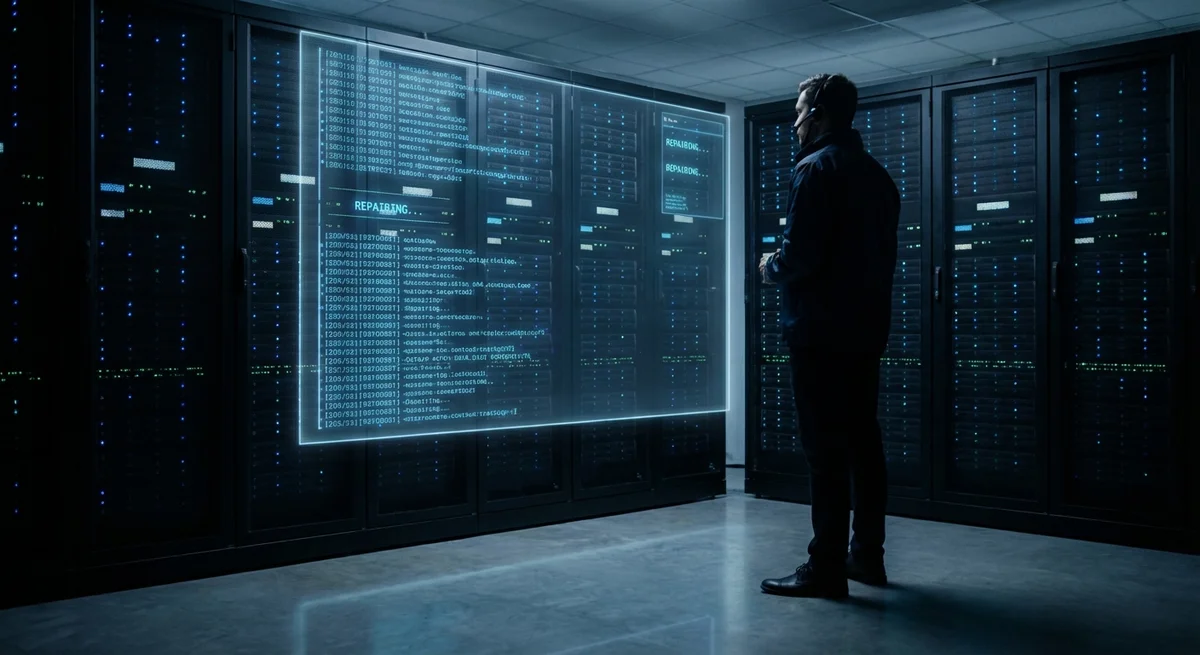
Picture every developer's classic nightmare: it's 3 a.m., you're fast asleep, and your main server decides it's had enough. In the old world, your phone explodes with alerts, you frantically open your laptop, and you scramble to figure out which commit or database update broke everything. In the world the startup Resolve AI is building, you keep sleeping. While you're deep in dreamland, an AI spots the anomaly, analyzes the logs, finds the culprit, and either rolls back the changes or applies the right patch. In the morning, you simply read a report explaining how a potential disaster was averted without you.
That's the dream investors just paid big money for, valuing Resolve AI at a billion dollars. In an industry where every hour of downtime can cost large corporations millions, the idea of "self-healing" software looks not merely attractive but essential. We're already used to AI assistants that write code in the editor, but Resolve AI goes much further. The company builds so-called autonomous agents that can act in the real, often chaotic and unpredictable production environment. It's a qualitative shift from suggestions to actual actions.
Until now, monitoring tools, even advanced ones like Datadog or New Relic, have worked like very expensive thermometers. They could tell you with great precision that your system had a "fever," but they couldn't write a prescription, let alone perform surgery. Engineers had to dig through terabytes of data and logs by hand to find that one needle in a haystack. Resolve AI promises to change the rules of the game. Its agents don't just look at dashboards; they understand the context of how the entire application works. They know how microservices connect to each other and can reason their way to the root cause of a failure, drawing on accumulated experience and documentation.
Why does this matter right now? The industry is at an important turning point. The euphoria around simple chatbots is fading, and businesses are starting to demand concrete results: money saved and less stress for their staff. The DevOps and SRE (Site Reliability Engineering) market today is overloaded with complexity. Modern cloud infrastructure has become so tangled and multilayered that the human brain struggles to hold the whole picture. That's where AI comes in: analyzing millions of events per second and finding correlations is its natural habitat.
Of course, a fair question arises: are we really ready to trust a "robot" with critical infrastructure that payments or the data of millions of users depend on? An AI mistake while writing code is unpleasant but fixable. An AI mistake in a live system can trigger a cascading collapse of the entire business. Still, Resolve AI and its backers are convinced that the risk of human error during an outage, under sleep deprivation and high stress, is far greater. The investors in this round are clearly betting that trust in autonomous systems will grow as fast as their technical capabilities.
It's fascinating to watch the software development landscape change at a fundamental level. First we automated builds, then testing, and now it's the turn of operations and support themselves. If Resolve AI manages to deliver on its ambitious promises, the job of the sysadmin or SRE engineer as we know it may become a thing of the past. Instead of endless firefighting, people will focus on architecture and on supervising an army of AI agents. It's a logical step in technology's evolution: we hand the most boring, routine, and stressful work to machines and keep room for creativity and design.
The bottom line: Resolve AI shows that the market is ready to pay for real autonomy, not for yet another wrapper around ChatGPT. Can AI become a reliable night-shift on-call engineer, or are we in for even bigger outages caused by automation "hallucinations"?
- Nov 1, 2026OpenAI Rewrites GPT Behavior Rules: Five Values and a Chain of Command
- Nov 1, 2026Google admits AI Mode cuts search revenue, shares fall 15%
- Oct 31, 2026Author puts his script before an AI jury: the verdict cost 850 thousand tokens
- Oct 31, 2026Anthropic: Fold Subagents Back Into a Single Loop — One Customer's Tasks Ran Twice as Fast
Test Frontier LLMs & Autonomous Agents in One Workspace
Run Claude Opus 5.5, GPT-6, Gemini 3.1, and DeepSeek side-by-side in Nomad AI (nomadnet.ai) — unified model routing, deep research, and multimodal workflows under one subscription.
The AI world, distilled — once a week
Seven stories that actually mattered, hand-picked. No noise, no reposts, no press releases.
Done! Check your inbox for a confirmation.