Roll Your Own ASR: Stop Feeding the Cloud and Take Back Your Privacy
Cloud speech recognition services are convenient right up until you need real privacy or specific customization. The author shares his experience moving to local solutions, from simple Python scripts to neural networks that can separate speakers in real time. The payoff goes beyond API savings: you get full control over your data in fields like healthcare and customer service. If you don't want conversations with your customers or patients piling up on big tech servers, it's time to learn how to deploy Whisper and similar models yourself. Over the long run, it's cheaper, faster, and far more secure.
AI-processed from Habr AI; edited by Hamidun News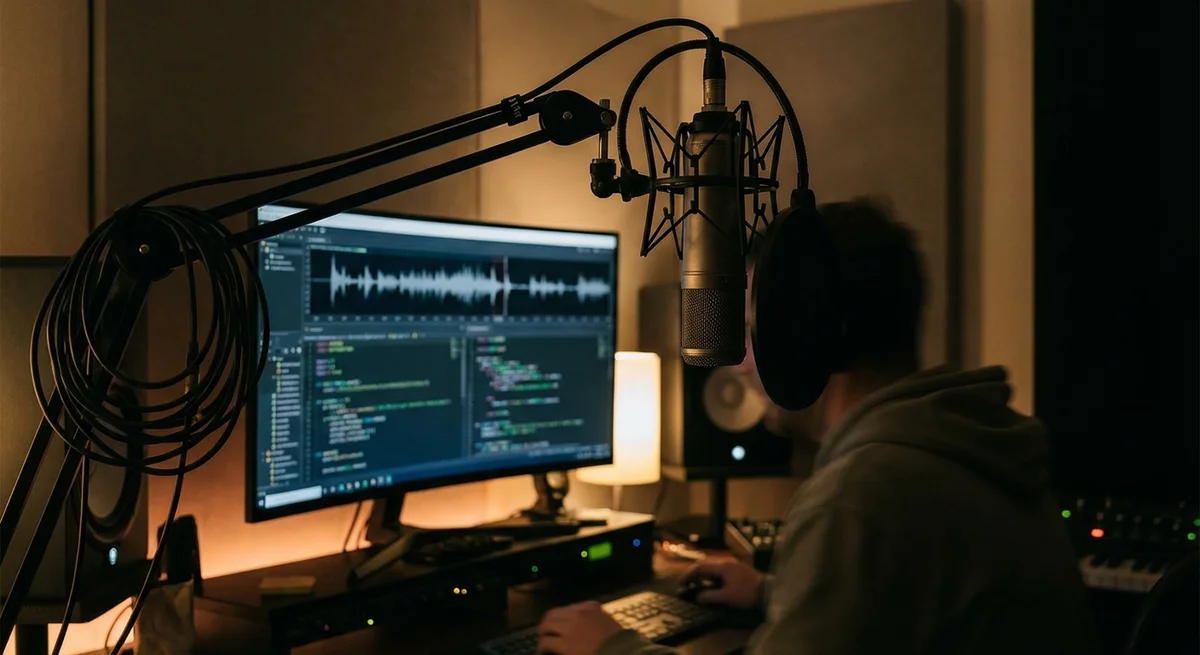
When people talk about speech recognition, their first thought is usually an API from Google or OpenAI. Paying a couple of cents per minute and never worrying about codecs, noise, or load again seems like the easy option. But let's be honest: in 2024, sending recordings of confidential conversations to someone else's cloud is naive at best and dangerous for your business at worst. And this isn't just paranoia. Every time your audio stream goes off to a third-party server, you lose control over your most valuable asset: your data.
Building your own ASR (Automatic Speech Recognition) system used to feel like trying to assemble a particle collider in your garage. You had to wrestle with monstrous libraries like Kaldi, which demanded a PhD in linguistics and endless patience. Today, the picture is unrecognizable. Powerful open models such as Whisper have turned building your own tool into a fun Python project you can realistically finish in a few evenings. We've gone from an era of pain to one where high-quality speech recognition is available to anyone with a mid-range graphics card.
Why bother at all if cloud services run reliably? First, there's deep customization. Every cloud service is a black box. You don't know why the model got a particular term wrong, and you can't fine-tune it for your narrow domain, whether that's medical diagnoses, niche legal slang, or ham radio jargon. Your own system can do more than convert audio to text: it lets you add advanced diarization. That's the process in which a neural network figures out who is speaking at any given moment, separating the voices of doctor and patient or of agent and customer. For serious analysis of a support team's work, this feature is critical, and providers often charge double or triple for it.
Real-time performance matters too. If your job is monitoring a live broadcast or helping a specialist fill out a chart during an appointment, cloud API latency can be fatal. Network lag, authentication problems, or a sudden change to the terms of service can bring work to a halt. A local Python solution processes the data stream instantly, without waiting for a response from a server on the other side of the ocean. And that brings us back to privacy. In medicine and law, patient and client data is sacred. Running ASR locally guarantees that not a single byte of information leaves your secured internal perimeter.
The industry is clearly moving toward decentralized AI. Companies are starting to recognize the value of owning their compute. Yes, deploying your own system requires an upfront investment in hardware and some expertise, but over the long term it pays for itself many times over. You no longer depend on big tech price list changes or sudden restrictions. On top of that, you get a tool that always works, even if the whole world decides to switch off the internet tomorrow. That is real technological independence, and it's worth pursuing.
Ultimately, choosing between the cloud and a local solution means choosing between short-term convenience and long-term strategy. If you're building a product where data matters, the answer is obvious. Modern frameworks let you do this elegantly and efficiently, without turning development into an endless cycle of maintaining outdated software. It's time to take your data back and teach your servers to listen and understand.
The bottom line: The era of total dependence on cloud ASR is coming to an end. Building your own speech recognition tool today isn't a geek's whim; it's a sensible move for any business that values security and wants flexibility. Can cloud providers offer anything beyond a simple interface to keep customers from leaving en masse for local solutions?
- Nov 1, 2026OpenAI Rewrites GPT Behavior Rules: Five Values and a Chain of Command
- Nov 1, 2026Google admits AI Mode cuts search revenue, shares fall 15%
- Oct 31, 2026Author puts his script before an AI jury: the verdict cost 850 thousand tokens
- Oct 31, 2026Anthropic: Fold Subagents Back Into a Single Loop — One Customer's Tasks Ran Twice as Fast
Test Frontier LLMs & Autonomous Agents in One Workspace
Run Claude Opus 5.5, GPT-6, Gemini 3.1, and DeepSeek side-by-side in Nomad AI (nomadnet.ai) — unified model routing, deep research, and multimodal workflows under one subscription.
The AI world, distilled — once a week
Seven stories that actually mattered, hand-picked. No noise, no reposts, no press releases.
Done! Check your inbox for a confirmation.