H Company's Holo2 Could Finally Make Localized Interfaces Stop Feeling Broken
French startup H Company has released Holo2, a specialized model for interface localization. Unlike general-purpose LLMs, Holo2 understands the context of buttons and menus, taking layout constraints and the meaning of each action into account. While OpenAI and Google compete over general knowledge, H is carving out a narrow but highly lucrative niche. Software localization may no longer be a headache and could become an automated process, with accuracy the company says exceeds that of native translators. It is an important step toward software that adapts to the user instantly and without errors of meaning.
AI-processed from Hugging Face Blog; edited by Hamidun News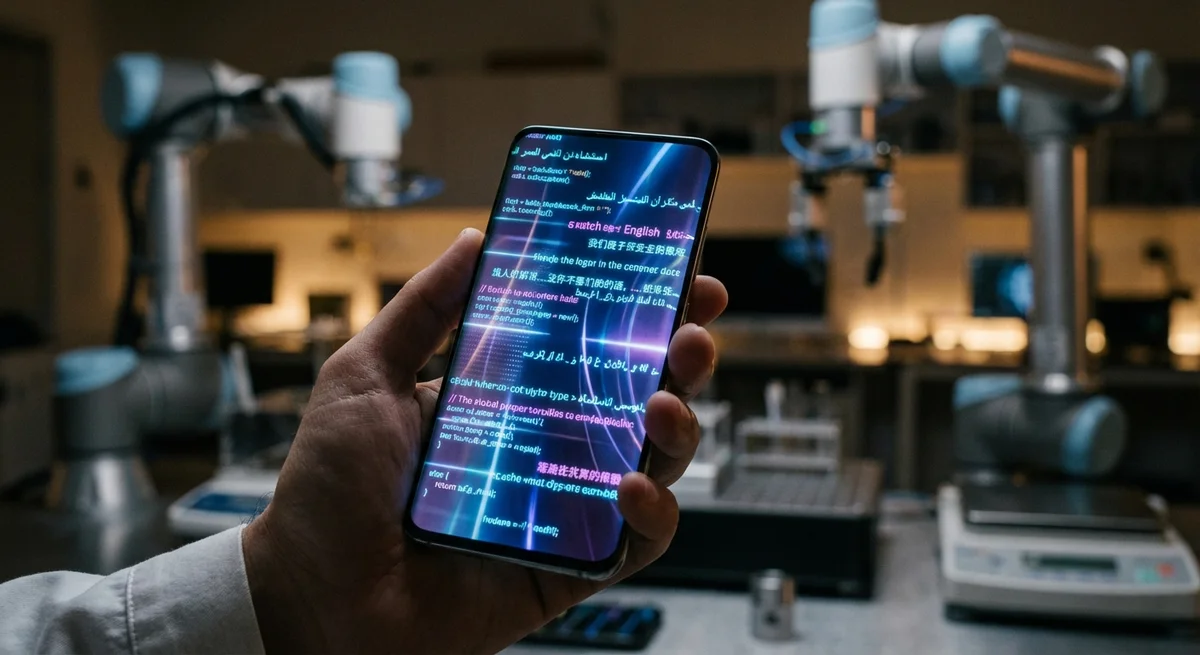
Interface localization has always been the "final boss" for developers, draining budgets and patience. You can hire the best translator, but they won't see that the word "Book" should be the verb "Забронировать" (to reserve) rather than the noun "Книга" (a book) until they look at the button itself. And when you try to cram a thirty-letter German word into a tidy English-language design, the layout simply "explodes". Until now, even advanced models like GPT-4 handled this poorly because they don't understand spatial context. French startup H Company, which was until recently called Holistic AI, decided it had had enough. Its new model, Holo2, is built specifically to settle the problem once and for all.
To see why this matters now, look at the company's background. H Company was founded by veterans of Google DeepMind who raised 220 million dollars in funding before they had a coherent landing page. The whole market expected a "GPT killer" from them, but they took a different path.
Instead of building yet another huge chatbot that knows everything about Ancient Rome, they focused on agentic models and specific business tasks. Holo2 is the result of that strategy. The model was trained not just on text but on interface structure, DOM trees and user flows.
It understands that the text on a button is not just a string but a call to action, strictly limited by a frame measured in pixels.
What exactly changed with Holo2? First, accuracy. Traditional LLMs often hallucinate or pick synonyms that are too long. Holo2 works like an experienced editor and designer in one. It analyzes the surrounding elements and picks a translation that preserves meaning without breaking the interface. Second, speed of rollout. Companies no longer need a staff of a hundred localizers to support an app in 40 languages. You run the interface through Holo2, and the output is a product that looks native to users anywhere in the world. This is especially critical for fast-moving SaaS platforms, where updates ship every week.
Why does this matter for the industry as a whole? We are seeing an important shift: the era of the "universal Swiss Army knife" is starting to give way to highly specialized tools. While Microsoft and Google try to embed AI everywhere, from email to spreadsheets, smaller players like H Company are taking specific, financially rich niches. Localization is a market worth tens of billions of dollars, and if Holo2 becomes the standard there, H Company will secure a comfortable existence without having to compete with OpenAI on model parameter counts. It is a smart move, and it suggests the future of AI lies in deep understanding of specific contexts, not abstract erudition.
Bottom line: Holo2 shows that narrow AI specialization currently works better than attempts to build a "god from the machine". Are you ready to trust a neural network with your product's interface entirely, or is manual review of "crooked" buttons a ritual you can't give up?
- Nov 2, 2026Meta's Muse assistant keeps dossiers on loved ones and gets root on Ubuntu by default
- Nov 1, 2026Local models lose to Opus and Codex: 0.21 on a MacBook versus 1.00 for Codex
- Nov 1, 2026Kimi scores 96.2% on a 1C database analytics test and emerges as a fallback if Claude access is blocked
- Nov 1, 2026OpenAI Rewrites GPT Behavior Rules: Five Values and a Chain of Command
Test Frontier LLMs & Autonomous Agents in One Workspace
Run Claude Opus 5.5, GPT-6, Gemini 3.1, and DeepSeek side-by-side in Nomad AI (nomadnet.ai) — unified model routing, deep research, and multimodal workflows under one subscription.
The AI world, distilled — once a week
Seven stories that actually mattered, hand-picked. No noise, no reposts, no press releases.
Done! Check your inbox for a confirmation.