Intel vs. Nvidia: Team Blue Finally Moves to Claim Its Share of the Market
Intel is officially entering the GPU race, aiming to break Nvidia's monopoly. After years of Team Green's dominance, the blue giant is forming a dedicated division to develop graphics processors. The company says its focus is not hardware for hardware's sake but the needs of customers tired of shortages and Nvidia's prices. It is an important step: if Intel can offer a competitive alternative, the AI computing market is in for a long-overdue shake-up. While Nvidia rests on its laurels, Intel is flexing its muscles to regain its status as a technology leader.
AI-processed from TechCrunch; edited by Hamidun News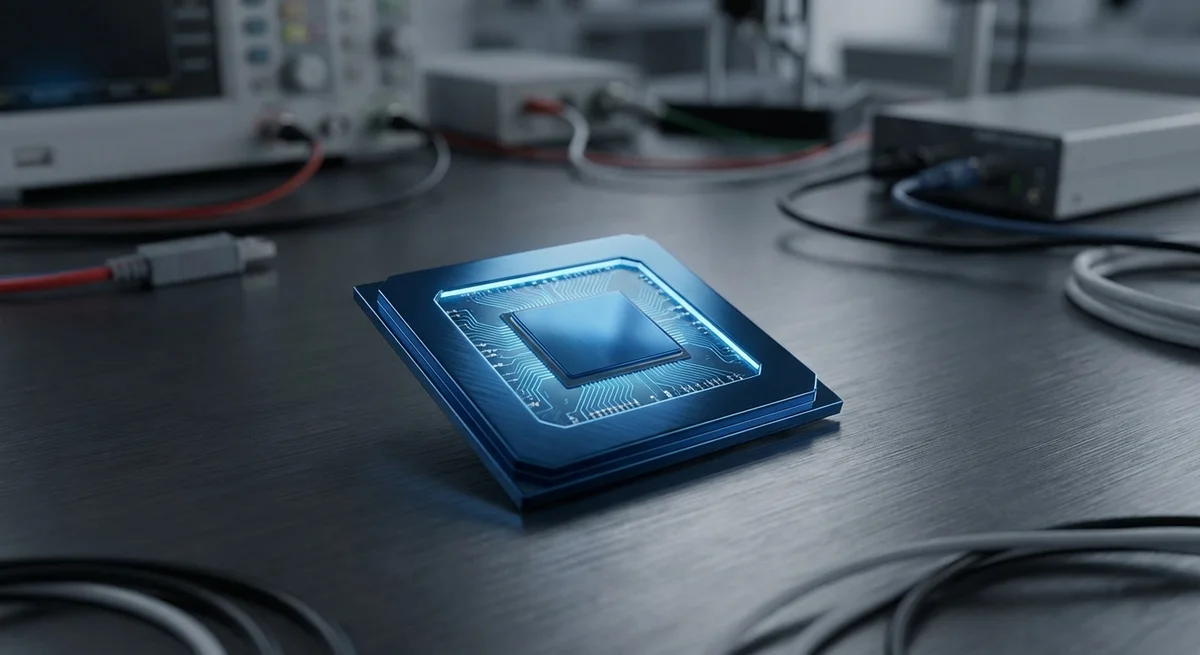
For a long time, Intel watched Nvidia evolve from a maker of graphics cards for gamers into the most valuable chipmaker in the world. While Team Blue struggled with the move to new process nodes and tried to hold on to the data center market with its Xeon processors, Jensen Huang simply took over the world. Now Intel officially confirms that it is assembling a team to build a full-fledged GPU strategy and challenge the monopoly of Team Green. This is not just an attempt to ship yet another piece of hardware, but an acknowledgment that the old world of general-purpose processors has definitively lost to the world of specialized accelerators.
To grasp the scale of the problem, it helps to recall where Intel has been for the past five years. While Nvidia built the CUDA ecosystem, Intel tried to prove that its CPUs could still handle neural network training. It was like entering a Formula 1 race in a very fast truck. In the end, the market voted with its dollars: almost all AI infrastructure budgets went to Nvidia, and Intel was left with falling revenue and tough questions from investors. Now the company is changing its approach by forming a division that will listen to customers rather than simply dictate its own terms.
Insiders say Intel is actively hunting for engineers and revisiting the architecture of its future products. The core bet is that the market is oversaturated and overheated. Companies on the scale of Microsoft, Google and Meta* are looking for an alternative not because Nvidia chips are bad, but because they want insurance against shortages and the dictate of a single supplier. Intel plays the role of the second player everyone has been waiting for. If it offers even eighty percent of its competitor's performance for sixty percent of the price, that would mark the beginning of the end of Team Green's total dominance.
However, hardware is only half the story. The real wall Intel has to break through is the software ecosystem. Nvidia won not only thanks to transistors, but because every AI developer knows how to work with CUDA. Intel is pushing its oneAPI initiative in an attempt to make development universal, but for now it looks like chasing a departing train. The new GPU division will have to solve exactly this problem: make the switch from Nvidia to Intel as painless as possible for engineers, so that code simply works without endless rewrites.
What does this mean for the industry? First, a potential end to shortages. If Intel brings its manufacturing capacity fully online, the era of waiting half a year for chips could end. Second, it will spur innovation. Nvidia felt safe for too long, rolling out updates in small portions. A real competitor will force it to move faster and, possibly, to revisit its pricing policy. Intel is now the one catching up, and that always demands more creativity and aggression in marketing.
The bottom line: Can Intel build a software environment that makes developers forget about CUDA, or will we see yet another attempt to catch the leader that ends with only middling results?
*Meta has been designated an extremist organization and is banned in Russia.
- Nov 2, 2026TensorFold 1.2.0 boosts Qwen3.8-27B throughput on M3 Ultra by 44.2% at 16 streams
- Nov 1, 2026Local models lose to Opus and Codex: 0.21 on a MacBook versus 1.00 for Codex
- Nov 1, 2026Habr author fine-tunes YOLOv8l on dental X-rays and pushes mAP50 to 0.642
- Nov 1, 2026Voice bots built on LLMs turn to Jev, a fast classifier, for decisions in 200–500 ms
Test Frontier LLMs & Autonomous Agents in One Workspace
Run Claude Opus 5.5, GPT-6, Gemini 3.1, and DeepSeek side-by-side in Nomad AI (nomadnet.ai) — unified model routing, deep research, and multimodal workflows under one subscription.
The AI world, distilled — once a week
Seven stories that actually mattered, hand-picked. No noise, no reposts, no press releases.
Done! Check your inbox for a confirmation.