GE Aerospace's Singapore Gambit: $300 Million to Let AI Inspect Your Engines
GE Aerospace is launching a five-year, $300 million investment plan in Singapore. By 2029, the company intends to rebuild its engine maintenance operation from the ground up, with deep automation and AI inspection. This is not just a purchase of new machine tools. It is an attempt to solve modern aviation's central problem: the speed and accuracy of diagnostics amid a labor shortage. While competitors stay cautious, GE is betting on algorithms that spot microcracks better than the most experienced engineers. For Singapore, it cements its status as the tech hub of the future. For the industry, it is a signal that AI has finally stopped being a chat toy and moved into heavy engineering.
AI-processed from 36Kr (36氪); edited by Hamidun News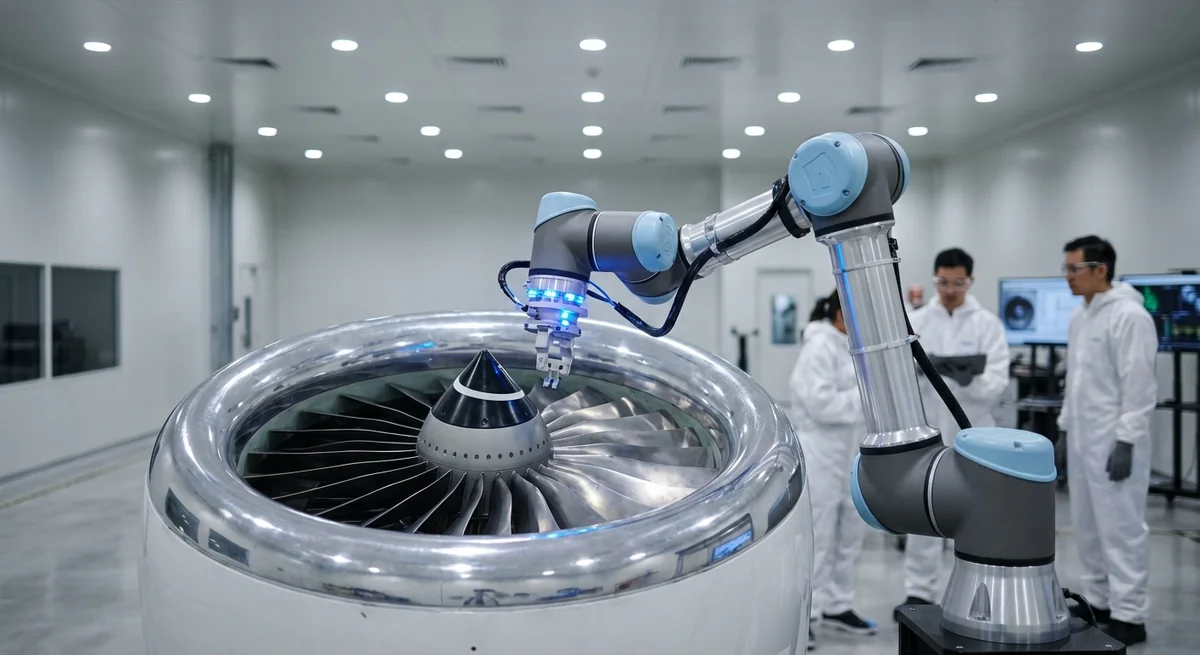
Imagine you are flying over the ocean at ten thousand meters, and the only thing between you and the water is a huge piece of metal spinning at thousands of revolutions per minute. It used to be that a person with a flashlight and a small mirror checked that metal, relying on experience and sharp eyesight. But times are changing.
GE Aerospace (GE) has decided that, when it comes to safety, it is time to trust the cold calculation of algorithms, and it has committed an impressive 300 million dollars to the effort. Singapore has long held the status of Asia's main "garage" for aircraft, but the new investment turns it from a plain service center into a futuristic proving ground. The five-year plan, running through 2029, aims at a radical modernization of engine maintenance, repair and overhaul.
At the center of this transformation is not more floor space but the adoption of advanced automation, digitalization and AI inspection technology. It is a logical step: the aviation industry is currently feverish over shortages of spare parts and qualified engineers, and every aircraft's downtime costs airlines a fortune. Why is GE doing this now?
The answer lies in the growing complexity of modern aircraft engines. New alloys and composite materials demand inspection methods that go beyond human capability. Instead of an engineer spending hours peering at turbine blades through a magnifying glass, a computer vision system will scan parts with micron-level precision.
Algorithms trained on millions of images of real defects can recognize the onset of metal fatigue long before it becomes critical. This is the shift from reactive to predictive maintenance, in which a failure is prevented before it ever appears in reality. It is interesting to watch GE Aerospace rework its very philosophy of operation.
It is adopting the concept of "digital twins," in which every engine has a virtual copy, updated in real time from sensor data. The 300 million investment will allow that data to be integrated with physical processes in Singapore's workshops. This creates a closed ecosystem in which AI does not merely "advise" but manages spare-parts logistics and work schedules, minimizing the human factor.
The irony is that we often fear a machine uprising, yet in aviation human error remains the main risk. AI does not tire at the end of a twelve-hour shift, and its eye does not go dull after the hundredth turbine of the day. For Singapore, this news is further confirmation of its technological dominance in the region.
The city-state skillfully creates an environment where giants like GE are willing to spend hundreds of millions on experiments. While other countries are mired in bureaucracy, Singapore is setting the standard for what heavy industry will look like in ten years. It is a clear signal to the whole market: the future of aviation depends not only on engine power or wing aerodynamics, but on how deeply neural networks have penetrated quality control.
Ultimately, we are watching artificial intelligence leave the cozy offices of software companies and head into noisy, oily workshops. This is an important stage in the technology's maturing. We are moving from generating amusing pictures and texts to ensuring the safety of hundreds of millions of passengers at the level of program code.
If GE Aerospace's Singapore experiment succeeds, the aircraft engineer's profession will change forever: engineers will have to work more with data and model training than with a wrench and a micrometer. The bottom line: GE Aerospace is turning engine maintenance into a high-tech IT process. Will competitors like Rolls-Royce and Pratt & Whitney be able to answer with something equally large-scale, or will Singapore become the exclusive domain of GE's AI?
Test Frontier LLMs & Autonomous Agents in One Workspace
Run Claude Opus 5.5, GPT-6, Gemini 3.1, and DeepSeek side-by-side in Nomad AI (nomadnet.ai) — unified model routing, deep research, and multimodal workflows under one subscription.
The AI world, distilled — once a week
Seven stories that actually mattered, hand-picked. No noise, no reposts, no press releases.
Done! Check your inbox for a confirmation.