Robot Bolt: China taught humanoids to run faster than Olympic athletes
While we watched with interest as Tesla and Figure robots carefully rearranged building blocks and brewed coffee, China decided it was time for humanoids to hit the track. And not just hit it—but set a record that will make professional athletes nervously glance over their shoulders. The new full-sized Bolt robot reached speeds of 10 meters per second, making it the fastest humanoid on the planet right now. The development was presented by the Hangzhou International Innovation Center of Zhejiang University. It's important to understand the context: this is not just a student project, but the result of collaboration between a powerful academic resource and industrial players—Jingshi Technology and Kaierda. China is systematically transitioning from copying Western technologies to creating its own benchmarks in robotics.
AI-processed from 36Kr (36氪); edited by Hamidun News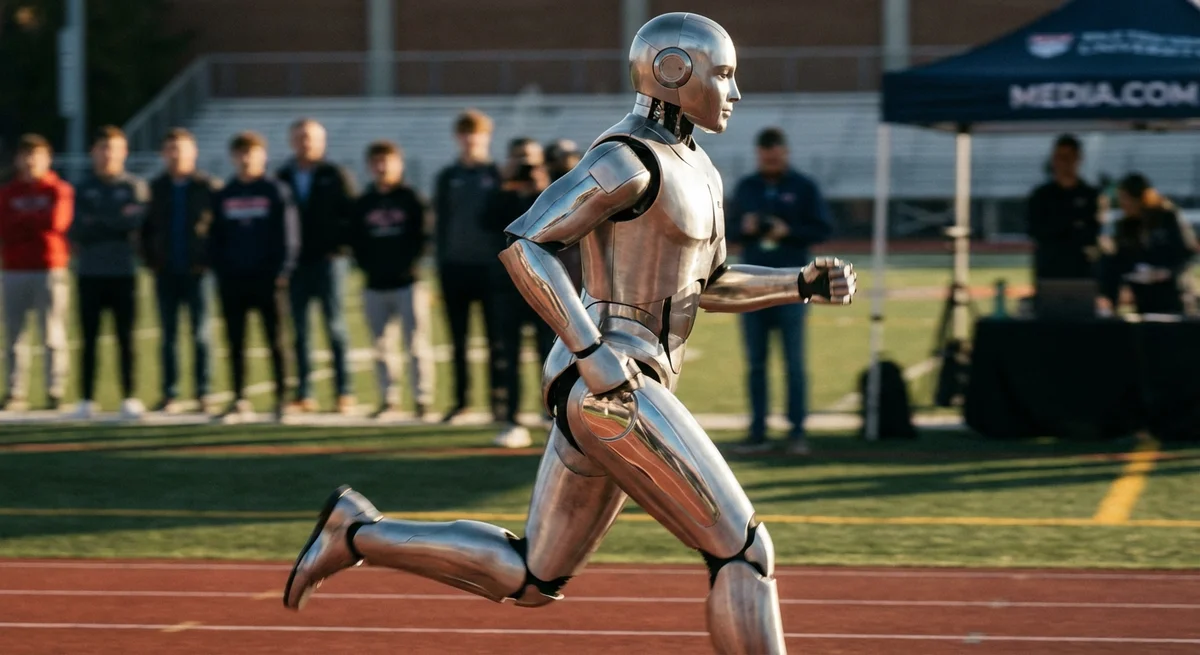
While we watched with interest as Tesla and Figure robots carefully rearranged building blocks and brewed coffee, China decided it was time for humanoids to hit the track. And not just hit it—but set a record that will make professional athletes nervously glance over their shoulders. The new full-sized Bolt robot reached speeds of 10 meters per second, making it the fastest humanoid on the planet right now.
The development was presented by the Hangzhou International Innovation Center of Zhejiang University. It's important to understand the context: this is not just a student project, but the result of collaboration between a powerful academic resource and industrial players—Jingshi Technology and Kaierda. China is systematically transitioning from copying Western technologies to creating its own benchmarks in robotics.
If previously we looked at Boston Dynamics' Atlas backflip as unreachable magic, today Bolt shows that the question of machine physical superiority is merely a matter of torque and sensor polling frequency. Why is the 10 m/s figure so important? For comparison: the average human running speed is about 6–8 m/s, and elite sprinters at their peak produce slightly more than 12 m/s.
Bolt has come very close to the human limit. To make a heavy metal structure move at such speed without turning into a pile of scrap metal on the first step, engineers had to solve the fundamental problem of stabilization. The humanoid's center of mass constantly shifts, and even a slight error in the control loop algorithm calculations will result in a fall.
Bolt proves that Chinese motion control systems are now capable of processing data in real time at speeds that were previously considered impossible for bipedal machines. The industry is currently experiencing a curious split. On one hand—American companies obsessed with the robot's "brain," trying to cram something like GPT-4 into it for command understanding.
On the other hand—Chinese centers that seem to have decided to first create the perfect "body." Bolt is a triumph of "hardware." The use of highly efficient actuators and lightweight materials made it possible to achieve dynamics that many specialized quadruped robots, like Boston Dynamics Spot, would envy.
What does this mean for us? In the short term—nothing but spectacular videos. But long-term—this is the foundation for rescue robots and efficient logistics.
A robot that can quickly move through an environment created for humans (stairs, narrow passages, uneven terrain) becomes a truly useful tool, not just an expensive toy in a tech corporation's lobby. The only question is whether we're ready for the fact that in case of machine uprising, we won't even be able to run away from them. Main takeaway: China is seizing leadership in dynamic robotics.
Will Elon Musk be able to respond with something faster than 2 meters per second at the next Optimus presentation?
Need AI working inside your business — not just in your newsfeed?
I build production AI for companies — custom CRM, internal tools, autonomous agents, workflow automation. Owned by you, shaped to your process, no per-seat tax. Built by Zhemal Khamidun, CPO of AlpinaGPT (AI platform, 6,000+ users).
The AI world, distilled — once a week
Seven stories that actually mattered, hand-picked. No noise, no reposts, no press releases.
Done! Check your inbox for a confirmation.