1.2 billion faces in a pocket: how DHS turned the US into a digital panopticon
The US Department of Homeland Security (DHS) has taken government surveillance to a new level. According to Bloomberg, the agency is actively using a mobile facial recognition app connected to a massive database of 1.2 billion images. This is not just an archive of criminals: the system also holds biometric data from ordinary travelers, visa applications, and immigration records. The technology works in real time, turning any agent's smartphone into a powerful identification terminal. While regulators debate AI ethics, law enforcement agencies have already built an infrastructure in which the right to privacy looks like an annoying technical bug. It sets an important precedent for how government data becomes fuel for algorithms of total control.
AI-processed from Bloomberg Tech; edited by Hamidun News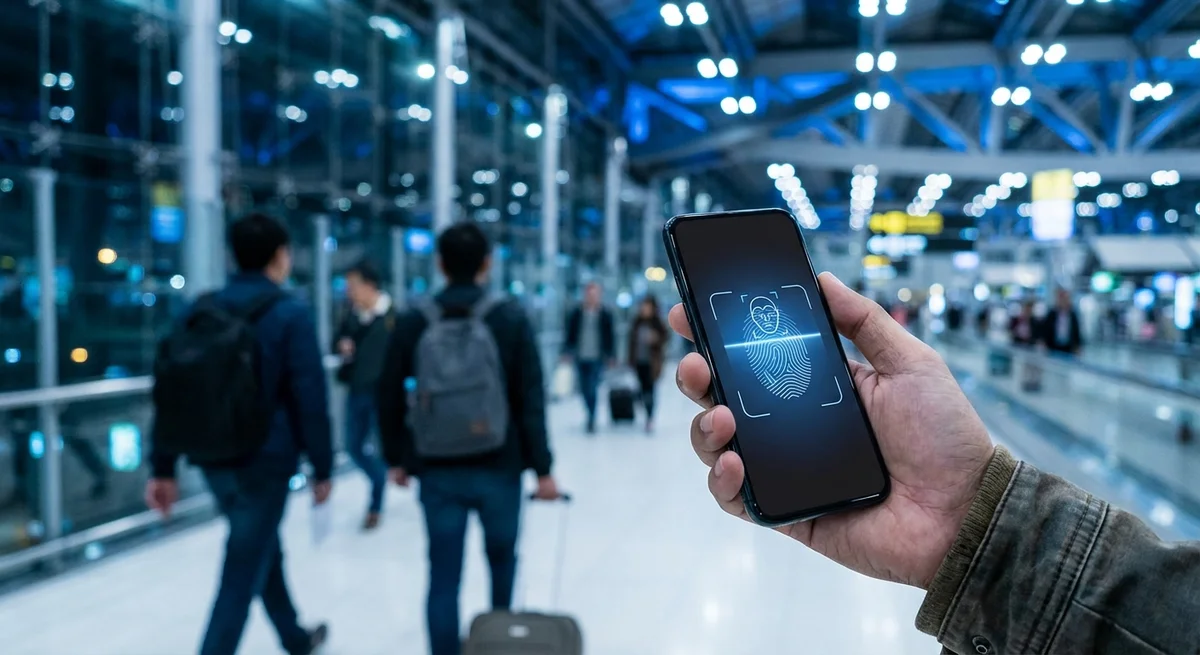
Imagine you're standing in line at passport control. You haven't committed any crimes, your record is clean, and your visa is fresh. Then an officer points an ordinary-looking smartphone at you, and within a second an algorithm matches your facial features against a database larger than the population of most countries on Earth. This isn't a plot from the new season of Black Mirror. It's everyday reality at the US Department of Homeland Security (DHS). According to documents reviewed by Bloomberg reporters, the agency actively uses a facial recognition system with access to 1.2 billion images. It may well be the largest deployment of AI surveillance we've learned about in recent memory.
The 1.2 billion figure is striking, but where the data came from matters far more. These aren't just police mugshots or Interpol records. The feds threw everything they could get their hands on into this digital cauldron: biometrics from visa applications, border crossing data, immigration service archives, and partner databases from other agencies. If you have ever crossed the US border or applied for a green card, your face is already part of this enormous training set. In effect, the government has built a giant photo album of humanity without asking permission from the people in it.
Why is this happening now? The answer is simple: the technology has finally caught up with the appetites of the security services. Reliable identification used to require fixed equipment, controlled lighting, and plenty of time to process each request. Today, DHS hands its agents a mobile app that does all of that in a fraction of a second. The camera in every border agent's pocket is no longer just a gadget; it's a full-fledged access terminal for a global surveillance system. That radically shifts the balance of power. Anonymity in public spaces stops being a right and becomes a technical bug the government is rushing to fix.
The problem isn't only the surveillance itself, but also how these algorithms work. We all know facial recognition systems often make mistakes, especially with darker-skinned people or unusual camera angles. When the image generator on your phone gets something wrong, it's a joke. When an on-duty agent gets something wrong based on an AI "hint," it can end in deportation or arrest. Meanwhile, DHS is in no hurry to disclose how accurate its systems are, citing national security. We're dealing with a "black box" that makes decisions affecting people's lives.
It's telling to watch government agencies deftly sidestep the ethical debates now tearing Silicon Valley apart. While Google and Microsoft publish lofty manifestos about "responsible AI" and publicly restrict sales of facial recognition technology to police, the state simply builds its own closed ecosystems. That sets a dangerous precedent: businesses can play at ethics all they like, but law enforcement will always have its own parallel AI world, governed by expediency rather than morality. And that world doesn't need public approval.
What does this mean for the rest of us? First, the surveillance technology market will only keep growing, regardless of any protests from human rights advocates. Second, we're seeing a new kind of digital sovereignty take shape, in which citizens' biometric data becomes the state's most valuable asset. Third, it puts an end to the illusion that AI can be fully regulated. If the regulator is itself the technology's main user and beneficiary, who will watch the watchmen? It looks like we're entering an era in which our face is a permanent, unchangeable ID, read without our consent every hundred meters.
The bottom line: Privacy has finally become a luxury available only to those willing to go offline for good. Are you ready for every public appearance you make to be automatically logged in a database that never forgets anything?
- Nov 1, 2026Google taught its StreamVibe video agent to decide when to step in on its own: +10.7%
- Nov 1, 2026OpenAI Rewrites GPT Behavior Rules: Five Values and a Chain of Command
- Nov 1, 2026Voice bots built on LLMs turn to Jev, a fast classifier, for decisions in 200–500 ms
- Nov 1, 2026Google admits AI Mode cuts search revenue, shares fall 15%
Delegate Deep Research, Coding & Multi-Step Workflows to Nomad Agent
Deploy autonomous task execution with Nomad Agent (agent.nomadnet.ai) — automated web research, data synthesis, code generation, and MCP tool orchestration.
The AI world, distilled — once a week
Seven stories that actually mattered, hand-picked. No noise, no reposts, no press releases.
Done! Check your inbox for a confirmation.